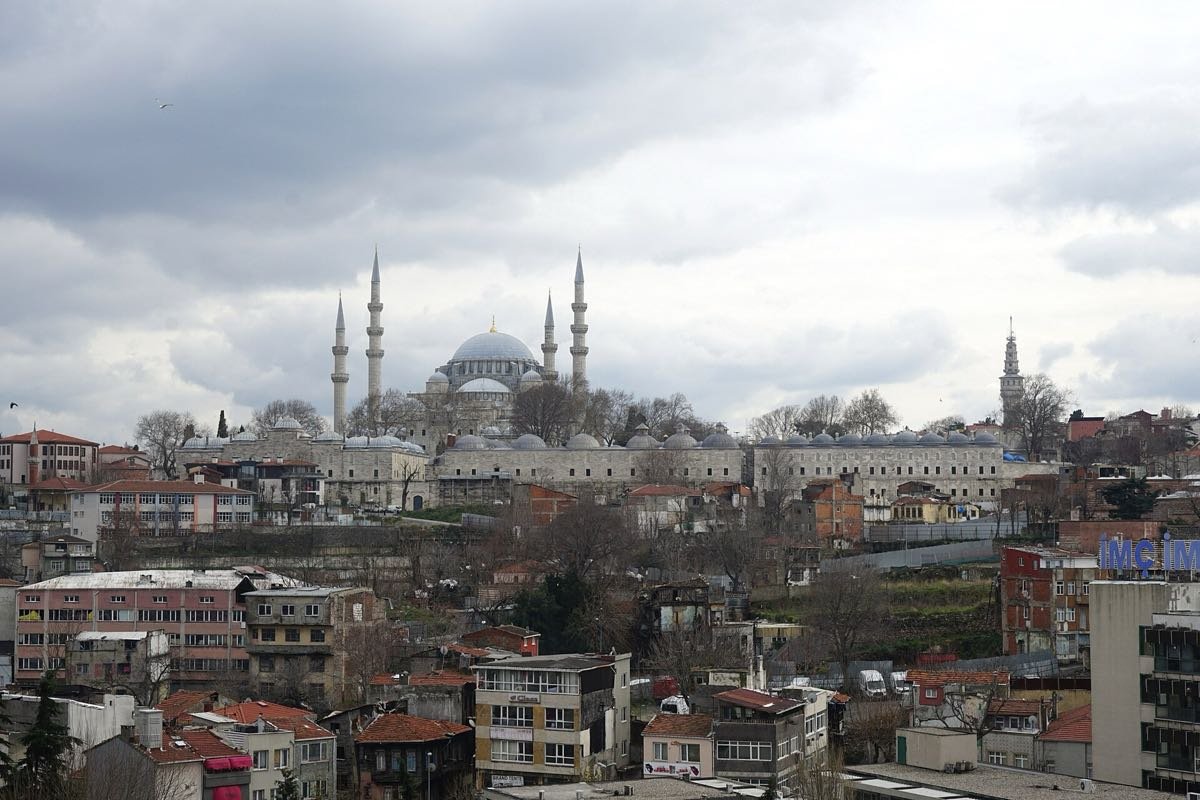
The Süleymaniye Mosque is the largest of the Ottoman imperial mosques in Istanbul, and for many architecture lovers it is the finest. Sultan Suleiman the Magnificent commissioned it from the court architect Mimar Sinan, and it was built between 1550 and 1557. It crowns the third hill of the old city above the Golden Horn, so its silhouette dominates the skyline from the water and from Galata. Unlike the Blue Mosque and Hagia Sophia, it rarely has a long queue, and that alone makes it worth a place in your Istanbul plan.
Entry is free. The mosque forms part of the Historic Areas of Istanbul UNESCO World Heritage property, and Go Türkiye is the official tourism portal if you want to cross-check anything before you travel.
Visiting Hours and Prayer Times (as of 2026)
The mosque is open to visitors during daylight hours, roughly from early morning until late afternoon or dusk depending on the season. It closes to tourists around each of the five daily prayers, and most guides put each closure at about 30 to 60 minutes. Friday is the exception to plan around: the midday congregational prayer draws large crowds, and tourists are generally let in again only in the early afternoon.
- Best time: the first hour after opening, or mid-afternoon between prayers on a weekday.
- Prayer times: they move through the year with sunrise and sunset, so look up the day’s schedule rather than relying on a fixed table.
- Religious holidays: Ramadan evenings and both Eid holidays bring heavy worshipper traffic. Visit another day if you can.
Hours are reported by secondary sources and can change, so treat them as a guide and confirm at the visitor door.
Dress Code and Etiquette
The rules match every other working mosque in the city.
- Knees and shoulders covered for everyone.
- Women cover their hair. Wraps are usually available at the door, but a light scarf of your own is easier.
- Shoes come off and go in a bag you carry or a rack near the entrance.
- Keep your voice low, never walk in front of anyone praying, and skip flash photography.
Why Sinan’s Design Matters
Sinan called the Süleymaniye his work as a journeyman, and later called the Selimiye in Edirne his masterpiece, but Istanbul’s mosque is where his mature style is easiest to read. The central dome rises about 53 metres above the floor, supported by half domes and four huge piers, and the prayer hall feels wide and calm rather than crowded with ornament. Light enters through a ring of windows at the dome’s base and through dozens of others, which is why the room seems to glow even on a grey day.
Four minarets mark the corners of the courtyard. Together they carry ten balconies (şerefe), a number usually read as a reference to Suleiman being the tenth Ottoman sultan. Inside, the decoration is restrained: calligraphy, a carved marble mihrab and minbar, and stained glass attributed to the master glassmaker Sarhoş İbrahim. If you have just come from the tiled interior of the Blue Mosque, the difference in mood is striking.
The Tombs in the Garden
Behind the qibla wall, a walled garden holds the tombs (türbe) of Suleiman the Magnificent and his wife Hürrem Sultan (Roxelana), among others. Suleiman’s octagonal tomb is the larger of the two and is covered in İznik tiles. The garden itself is quiet and shaded, and the tombs are often open for a short window of the day. Entry rules and any small fee for the tombs have changed over the years, so ask at the gate. Sinan’s own modest tomb sits outside the complex wall on the corner of the Mimar Sinan and Prof. Sıddık Sami Onar streets, a short walk away.
The Terrace View
Walk around to the northeastern side of the courtyard, where a long terrace looks straight down onto the Golden Horn, the Galata Bridge and the Galata Tower beyond. This is the reason many people come at sunset: the mosque’s own light, the ferries below and the call to prayer arriving from several mosques in turn. It is free and usually far less crowded than Çamlıca or the viewpoints on the Galata side.
The Rest of the Complex
The mosque is the centre of a külliye, a charitable complex that originally included four madrasas, a hospital, a soup kitchen, a hammam, a caravanserai and a primary school. Many of the old buildings survive and now house libraries, offices and cafés. The Süleymaniye Library holds a large collection of Islamic manuscripts and is a working research library rather than a visitor attraction. Along Prof. Sıddık Sami Onar Caddesi, the street running beside the complex, a row of small restaurants serve kuru fasulye (white beans) with rice and pickles, a simple Istanbul lunch at roughly TRY 250 to 450 a portion as of 2026.
How to Get There
The mosque is on a hill, so approach with that in mind.
- Metro: M2 to Vezneciler, then about 10 minutes on foot past Istanbul University.
- Tram: T1 to Beyazıt-Kapalıçarşı or Eminönü, then a 10 to 15 minute uphill walk. From Eminönü you can wander through the Spice Bazaar area on the way.
- On foot: it is roughly 15 to 20 minutes from the Grand Bazaar, which makes the two a natural pair.
An Istanbulkart covers the metro and tram at the lowest fares, and our Istanbul public transport guide explains the whole network.
Making a Plan
A sensible half-day is the Grand Bazaar late morning, lunch in the streets around the mosque, the Süleymaniye in the early afternoon and the terrace as the light turns. Pair it with Hagia Sophia and Topkapi Palace on another day. If you want the history of Sinan and the Ottoman court explained, several Istanbul guided tours cover the old city with a licensed guide, and our best tours in Istanbul guide compares the main options. Browse where to stay in Istanbul if you are choosing a base near the old city.
Tips
- Beware of touts near the gate claiming the mosque is closed and steering you to a carpet shop.
- Bring a small bag, because large backpacks can slow the security check.
- Visit twice if you can, once inside in the morning and once on the terrace at dusk.
- Photography is allowed without flash, but do not photograph worshippers.
Photo: Canercangul / Wikimedia Commons, CC BY-SA 4.0.
