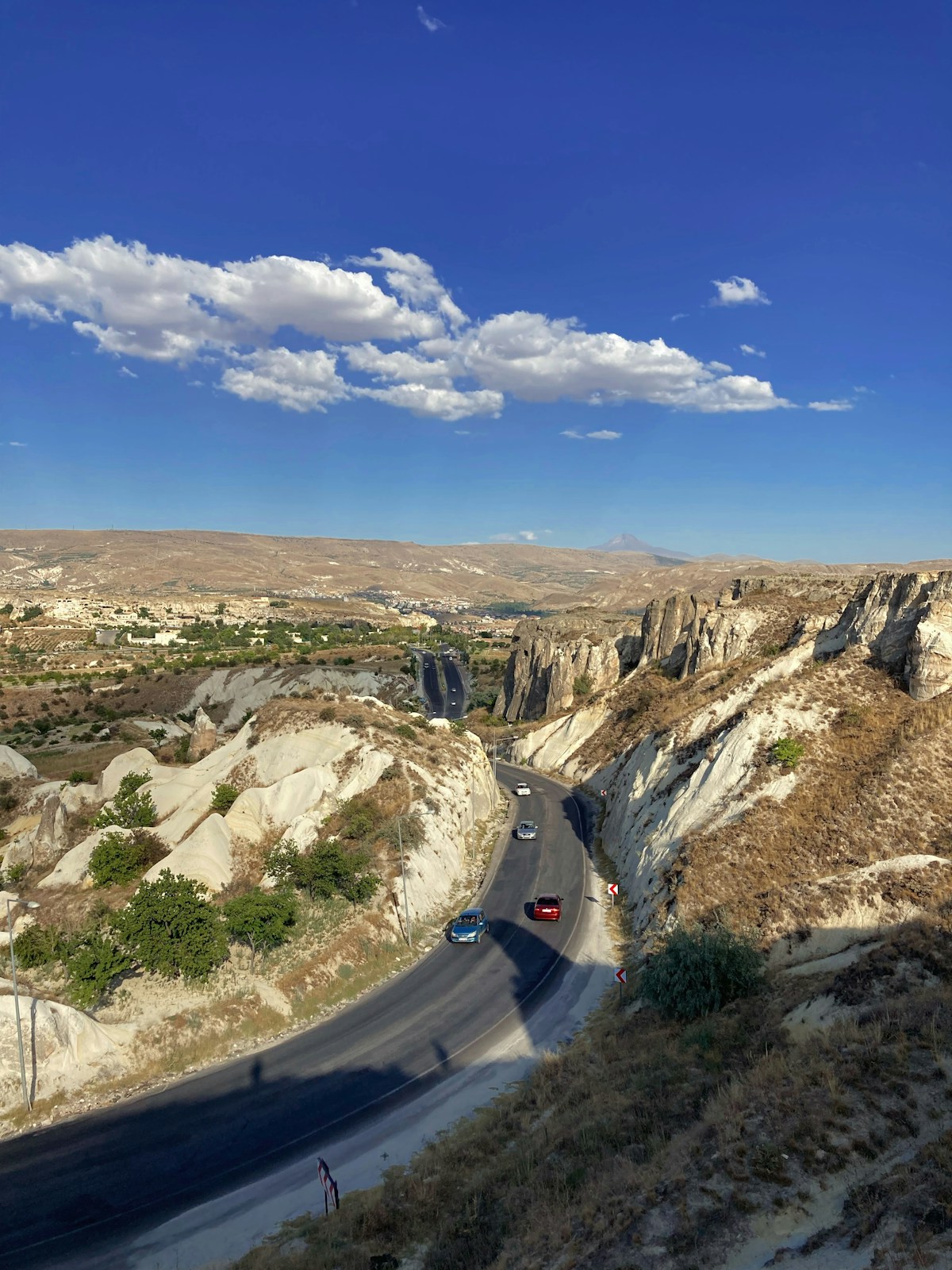
Turkey’s road network has improved dramatically since the 2000s, with new motorways connecting Istanbul to İzmir, Ankara, and Konya, and major upgrades to coastal roads in Antalya and the Aegean region. Driving here unlocks destinations that public transport simply cannot reach - plateau villages, Aegean coves, Black Sea tea gardens, Cappadocian valleys - and the distances between major cities are manageable. Understanding the toll system, road hierarchy, and local driving culture before you pick up the keys saves both time and money.
Renting a Car
At the Airport vs. In Town
Airport desks (Avis, Budget, Europcar, Hertz, Sixt) are the simplest option, with English-speaking staff and reliable vehicles. In-town local operators can be 20–30% cheaper but terms vary significantly - read the small print on damage waivers and fuel policies carefully. Compare rates across all suppliers at GetRentacar.
What to budget: Economy hatchbacks (Renault Clio, Fiat Egea equivalent) from major operators run approximately ₺800–1,400 per day including basic insurance. Adding a collision damage waiver (CDW) to zero the excess costs ₺200–400 per day extra. Diesel vehicles are cheaper to run but slightly more expensive to rent.
Driving licence requirements: EU and UK licences are accepted directly. US and Australian licences are generally accepted by major rental companies but require an IDP at some local operators. Minimum age is typically 21, with some companies requiring 25 for larger vehicles.
What to Check Before Driving Away
Walk around the vehicle and photograph every existing scratch and dent before departing the rental lot. Email or WhatsApp the photos to yourself with a timestamp. Note any damage on the rental agreement - disputes about pre-existing damage are the most common car rental complaint in Turkey.
Check:
- Spare tyre condition and location
- HGS transponder is present and active (ask staff to confirm)
- Fuel level (most rentals are full-to-full)
- Whether the car takes petrol or diesel
The HGS Toll System
Turkey’s electronic toll system operates on motorways (otoyol), the Bosphorus bridges, the Çanakkale 1915 Bridge, and several urban bypasses. All tolls are paid electronically - there are no cash booths on modern Turkish roads.
If your rental car has HGS: Drive through the HGS-marked lanes (blue signs). Tolls are deducted automatically and billed to your credit card at rental return, often with a ₺20–50 administration fee per toll transaction.
Major toll rates (approximate, 2026):
- Osmangazi Bridge (İzmit, Istanbul to İzmir route): ₺380 per crossing for cars
- Yavuz Sultan Selim Bridge (north Bosphorus): ₺260 per crossing
- Fatih Sultan Mehmet Bridge (middle Bosphorus): ₺260 per crossing
- Çanakkale 1915 Bridge: ₺490 per crossing for cars
- O-3 motorway (Istanbul–Ankara): approximately ₺250–350 for the full route
Alternative routes: Most toll roads have parallel free alternatives. The D100 (Istanbul–Ankara) avoids the O-4 motorway; coastal D400 avoids the Çanakkale bridge. The free routes are slower but often more scenic.
Road Hierarchy
Otoyol (O-roads): Full motorways, mostly dual carriageway, 120km/h limit, toll-paying, high standard.
Devlet Yolları (D-roads): State highways, mostly two-lane with occasional overtaking lanes. Speed limit 90km/h. Variable surface quality - very good on the Aegean and Mediterranean corridors, rougher in eastern and Black Sea regions.
İl Yolları and köy yolları: Provincial and village roads. Often single-track with passing places in mountainous areas. No speed limit posted but conditions dictate caution.
Driving Culture and Road Safety
Turkish driving culture is more assertive than northern European norms. Several things to expect:
Overtaking: Overtaking on straights is common and expected, even with limited visibility margin by European standards. Hold your lane and let the car behind pass - do not accelerate to prevent overtaking.
Flashing headlights: An oncoming flash typically means police ahead with a radar check. A flash from behind means the driver wants to overtake - move right.
Horn use: Routine in city traffic. Not aggressive, just communicative.
İstanbul traffic: Can be brutal. Avoid driving in İstanbul during rush hours (07:30–09:30 and 17:00–19:30). The GPS navigation apps Yandex Maps and Google Maps both show live traffic and are reliable for Istanbul routing.
Road safety statistics: Turkey has a higher road fatality rate than Western Europe, largely concentrated on rural two-lane highways. The risks are greatest on mountain roads at night, during Eid holidays (Bayram) when traffic increases sharply, and on the D100 east of Ankara. Drive defensively, particularly on the bends of the Black Sea coastal roads.
Fuel
Petrol stations (akaryakıt istasyonları) are widespread on all main routes. Major chains include BP, Shell, Total, Petrol Ofisi (PO), and Opet. Most are 24-hour on trunk roads.
Fuel types:
- 95 Benzin: standard unleaded
- 98 Benzin: premium unleaded (not necessary for most rental cars)
- Motorin: diesel
- LPG: autogas, approximately ₺15–18/litre, available at around 30% of stations
Self-service vs. attended: Many Turkish stations still have attendants who pump the fuel. Tipping ₺10–20 for an attended fill-up is customary.
Fuel in eastern Turkey: The network thins east of Erzurum and Diyarbakır. In Van province and remoter Black Sea roads, fill up when you see a station - do not rely on finding the next one quickly.
Parking
In cities: Pay-and-display on-street parking (ücretli park, typically ₺20–50 per hour) and municipal car parks (otopark, ₺30–80 per hour) are common. Many shopping centres provide free parking for 1–3 hours with validation.
Illegal parking: Traffic wardens (zabıta) are active in Istanbul, Ankara, and İzmir. Clamping and towing occur; retrieval requires visiting the municipal impound (which moves) and paying ₺400–600 plus the fine.
At hotels: Smaller boutique hotels and pansiyons often have no parking - ask when booking. Business hotels in city centres typically charge ₺100–200 per night.
Key Road Trip Routes
Istanbul to Cappadocia (O-4 motorway + D750): 730km, approximately 8–9 hours. Break the journey in Ankara or Kayseri. The motorway from Istanbul to Ankara is excellent; the road from Kayseri to Göreme is two-lane but straightforward.
The Turquoise Coast (Muğla to Antalya, D400): 450km, 6–7 hours without stops - but this road is so scenic that allow 2–3 days minimum. Hire a car in Dalaman or Bodrum and drop off in Antalya (one-way fees apply). The Datça peninsula, Marmaris bay, Dalyan delta turnoff, Ölüdeniz, Kaş, and Kalkan are all roadside stops worth building into the schedule.
Black Sea coastal road (Trabzon to Hopa): 155km, 3–4 hours, winding and spectacular. The road clings to the cliff edge above the sea in places. Drive in daylight; the mountain sections above Rize require careful driving in wet conditions.
Ankara to Konya (O-21): 260km, 2.5–3 hours. Straightforward motorway with one toll section.
Documents You Need
- Driving licence (plus IDP if from outside EU/UK)
- Rental agreement
- Vehicle registration (provided by rental company)
- Insurance document (güvence belgesi)
- Passport or identity card
Police checks are routine at city outskirts, border crossings, and during holidays. All four documents are expected at every stop.
For itineraries that work well as self-drive trips: the Turkish Riviera road trip covers Antalya to Fethiye via the coast. Key destinations: Antalya, Fethiye, Kaş, Cappadocia.
Plan Your Trip
- Flights - Find the best fares to Türkiye
- Travel Insurance - Get covered before you go
- eSIM - Stay connected from landing
- Car Hire - Compare prices across providers
See also: Getting around Türkiye · Istanbul to Antalya · Istanbul to Cappadocia · Black Sea coast road trip · Lycian Way hiking guide