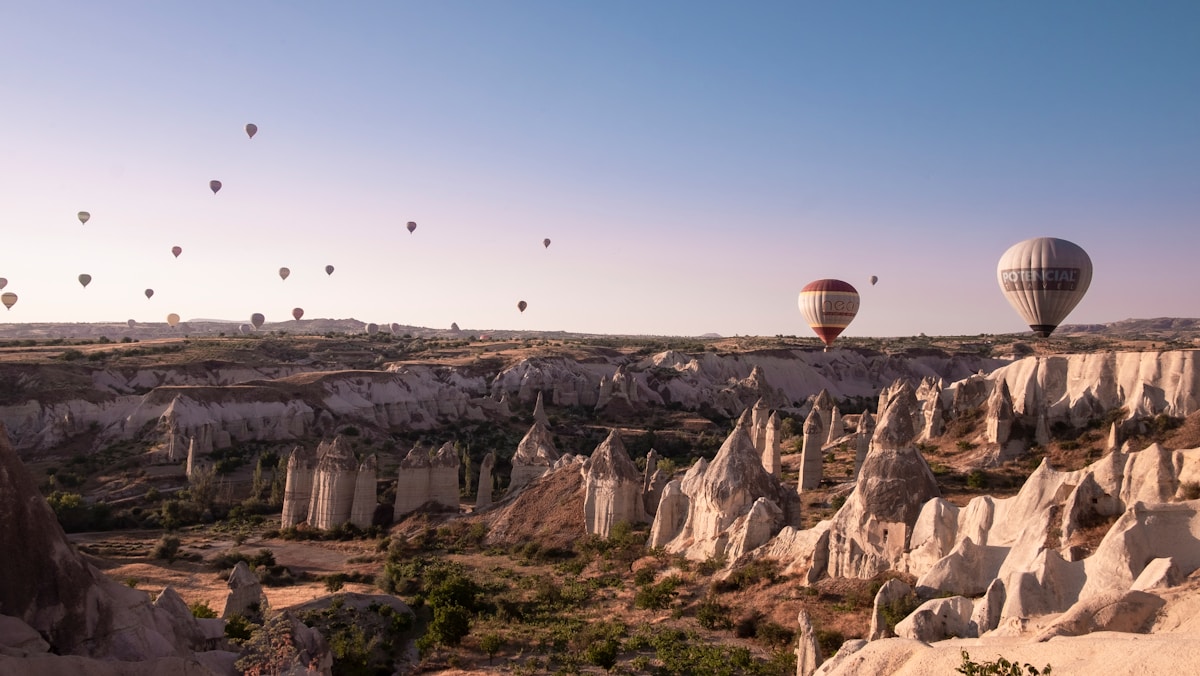
Cappadocia Travel Guide: Fairy Chimneys & Balloon Flights
Cappadocia guide covers hot air balloon flights, fairy chimneys, Derinkuyu underground city, cave hotels and transport from Istanbul and Ankara.
Guides for Cappadocia
Cappadocia is the volcanic plateau of central Anatolia - a region shaped by successive layers of eruption, erosion, and human ingenuity that produced one of the most distinct landscapes on earth. The fairy chimneys (peribacaları) - tall tufa cones with harder basalt caps - are the visual signature, but the substance of a visit is broader: Byzantine rock churches with surviving frescoes, underground cities carved to extraordinary depth, cave monasteries, and the hot air balloon industry that makes the region the most photographed destination in Turkey.
The area sits in Nevşehir Province in central Turkey. It is not a single town but a cluster of villages and valleys, with Göreme as the main hub. Most visitors arrive for two to four nights, see the valleys and the Byzantine open-air museum, take a balloon flight, and eat the region’s distinctive pottery kebab. Done well, it justifies every hour.
The Landscape
The fairy chimneys formed when a resistant cap of harder basalt sat on top of softer tufa. As the surrounding rock eroded faster than the cap, each column was left standing with a dark mushroom-like top. In some areas the caps have fallen, leaving exposed pillars. The colours shift from pale cream to ochre, pink, and rust depending on the mineral content.
The main valleys cluster around Göreme: Love Valley (Aşk Vadisi), Rose Valley (Güllüdere), Red Valley (Kızılçukur), Pigeon Valley (Güvercindere), and Devrent Valley each have a distinct character. Pigeon Valley is named for the dozens of dovecotes carved into the cliffs - farmers collected the droppings for fertiliser. Rose Valley turns deep amber and pink at sunset, which makes it the most photographed viewpoint in the region.
Key Areas
Göreme is the practical base for most visitors - the highest concentration of accommodation, restaurants, tour operators, and transport connections. The Göreme Open-Air Museum sits 1km from the town centre. Most balloon companies launch from fields near Göreme. See our Göreme guide for a full breakdown of where to stay, eat and what to see in the village.
Ürgüp: 6km east of Göreme - larger town with a more local character, the best restaurant and wine-bar scene in the region (Turasan and Kocabağ winery visits available), and upscale cave hotel options. Better base for visitors prioritising food and wine.
Uçhisar: 5km northwest of Göreme - dominated by the Uçhisar Castle, a massive tufa formation converted into a fortress. The highest point in the region with panoramic views across the valleys. Several boutique cave hotels here; quieter than Göreme.
Avanos: On the Red River (Kızılırmak), 10km north of Göreme - known for its pottery tradition (Red River clay), with working ateliers. Less touristy; good budget accommodation.
Zelve Open-Air Museum: 8km from Göreme - a valley of abandoned cave dwellings where people lived until 1952. Fewer visitors than Göreme’s museum; gives a clearer sense of how these spaces were actually used as homes. Entry: ₺300 (as of 2026).
What to Do
Göreme Open-Air Museum: 30+ Byzantine rock churches, chapels, and monasteries painted with frescoes between the 10th and 13th centuries. The Dark Church (Karanlık Kilise) requires a separate entry but has the best-preserved frescoes. Entry: ₺500 (museum), ₺300 additional for the Dark Church (as of 2026). Open daily 08:00–17:00 (winter), 08:00–19:00 (summer). Allow 2–3 hours.
Valley hikes: Rose Valley, Red Valley, Love Valley, and Pigeon Valley - 2–6km round trips through the formations, past carved cave churches and fairy chimneys. Most routes start from Göreme or Çavuşin. Best in late afternoon light. Free.
Hot air balloon flights: The sunrise balloon is the defining Cappadocia experience - 60–90 minutes above the valleys in the first light. Major operators include Royal Balloon, Butterfly Balloons, and Kapadokya Balloons. Standard flight: approximately €155–185 per person (as of 2026). Book 6–8 weeks ahead for April and October. Full guide: Hot air balloons in Cappadocia. Visiting at shorter notice? Browse last-minute Cappadocia deals - operators occasionally release spots as earlier reservations cancel.
Underground cities: Derinkuyu (29km south, 8 levels, 85m deep) and Kaymaklı (20km south, 4 levels) are the two accessible underground cities. Entry: ₺350 each (as of 2026). Full guide: Underground cities of Cappadocia.
Ihlara Valley: 40km southwest of Göreme - a 14km river canyon with 100+ Byzantine cave churches. The 3.5km section between Ihlara village and Belisırma is the standard walk. Entry: ₺150 (as of 2026). Combine with an underground city for a full day trip. Full guide: Ihlara Valley.
Pottery in Avanos: Wheel-throwing sessions at approximately ₺200–400/hour. Gorky Artisan and the Avanos Ceramic Centre are the most established.
Soğanlı Valley: 30km southeast of Göreme - two parallel valleys with cave churches, fewer tourists. Entry: ₺100 (as of 2026).
Top Cappadocia tours
Five of the most-booked tours in Cappadocia — covering the key experiences at different price points:
| Tour | Duration | From | Best for |
|---|---|---|---|
| Full-Day Cappadocia Red Plus Tour | 7–8 hrs | €35 | First-timers |
| Green Tour with Entry Fees & Lunch | 8 hrs | €50 | Nature & history |
| Göreme Open-Air Museum Tour | 3 hrs | €30 | Short visit |
| Ultimate Red & Green Tour in One Day | 10 hrs | €65 | One-day visitors |
| Hot Air Balloon + Red & Green Day Tour | Full day | €220 | Bucket-listers |
See our complete Cappadocia tours guide for the full breakdown by traveller type.
Where to Stay
Cave hotels are the regional speciality - rooms carved directly into the tufa, cool in summer, warm in winter. The range runs from budget hostels to design hotels with infinity pools cut into cliff faces.
Budget (₺1,200–2,000/night): Family-run guesthouses in Göreme. Kelebek Special Cave Hotel (₺1,800–2,500) is among the most established at the lower mid-range.
Mid-range (₺3,000–6,000/night): Sultan Cave Suites (Göreme, ₺3,500–5,500), Cave Hotel Saksagan (Ürgüp, ₺2,800–4,500), Gamirasu Cave Hotel (Ayvali, ₺3,500–7,000 - a converted Byzantine cave monastery).
Luxury (₺8,000–25,000+/night): Museum Hotel (Uçhisar, ₺12,000–25,000+), Argos in Cappadocia (Uçhisar, ₺8,000–18,000), Kayakapi Premium Caves (Ürgüp, ₺10,000–20,000).
Full guide: Where to stay in Cappadocia.
Search hotels in Cappadocia on Booking.com
Food and Drink
Testi kebabı (clay pot kebab) is the regional speciality - meat and vegetables sealed in a clay pot, cooked slowly, broken open at the table. Approximately ₺250–450/person. Seten Restaurant (Ürgüp) and Dibek Restaurant (Göreme) are reliable choices.
Cappadocian wine: Kocabağ Winery and Turasan Winery (both in Ürgüp) use Emir (white) and Öküzgözü/Boğazkere (red) grapes. Cellar visits and tastings approximately ₺150–250/person.
Getting Here
By air: Kayseri Airport (ASR) is 75km from Göreme; Nevşehir Kapadokya Airport (NAV) is 40km away. Istanbul–Kayseri: ₺400–1,200 (as of 2026). Shuttle to Göreme: ₺250–400 per person.
By overnight bus: Istanbul Esenler → Göreme: 10–11 hours, ₺350–600. Ankara → Göreme: 4–5 hours, ₺200–350. Konya → Göreme: 3–4 hours, ₺150–280.
By rail: YHT from Ankara to Kayseri (~2.5 hours), then minibus or taxi to Göreme.
Daily Costs
| Category | Budget | Mid-range |
|---|---|---|
| Accommodation | ₺1,200–2,000 | ₺3,000–8,000 |
| Food | ₺250–450 | ₺450–900 |
| Activities | ₺500–1,000 | ₺5,000–8,000 (balloon day) |
| Transport | ₺100–250 | ₺250–600 |
| Total/day | ₺2,050–3,700 | ₺8,700–17,500 |
Getting Around
Local dolmuş connect Göreme to Ürgüp, Avanos, and Nevşehir (₺20–40 per journey, as of 2026). Scooter rental: ₺400–800/day. Car hire in Turkey from Kayseri or Nevşehir: ₺600–1,200/day. Day tours from Göreme including underground cities + Ihlara Valley: ₺500–1,000/person including entry.
When to Visit
April–May and September–October are the best months - balloon reliability peaks, temperatures are comfortable for hiking (15–25°C), and crowds are manageable. July–August is hot and crowded with higher balloon cancellation rates. January–February has the most cancellations but snow-covered fairy chimneys create exceptional photography conditions.
Full seasonal guide: Best time to visit Cappadocia.
Connections
Cappadocia is centrally positioned for combining with Konya (3–4 hours - Mevlâna Museum, Sema ceremony), Ankara (4–5 hours - Anatolian Civilisations Museum, Anıtkabir), or the Mediterranean coast via Antalya (8–9 hours).
- Hot air balloons in Cappadocia
- Where to stay in Cappadocia
- Underground cities of Cappadocia
- Best time to visit Cappadocia
- Things to do in Cappadocia
- Food to try in Cappadocia
- Day trips from Cappadocia
- Göreme village guide
- Ihlara Valley guide
- Cappadocia tours
- Getting around Cappadocia
- Cappadocia food guide
- How many days in Cappadocia
- Kayseri airport transfer
- Best photography spots in Türkiye
Getting there: Flights to Turkey connect via Istanbul with most European carriers. For a door-to-door arrival, pre-book an airport transfer for fixed-price, hassle-free pickup. An eSIM for Turkey activates before you land and keeps you connected from the moment you clear arrivals.
Book an experience
Top experiences in Cappadocia
Explore the best tours and activities in Cappadocia, with instant confirmation and free cancellation on most bookings.
Find hotels in Cappadocia
Explore accommodation in Cappadocia →We earn a small commission at no cost to you.