Turkish food is one of the world’s great cuisines, yet it rarely gets the credit it deserves. Centuries of empire, trade routes, and pastoral tradition have produced a table that stretches from Thrace to the Tigris: meze small plates, charcoal-grilled kebabs, slow-cooked stews, freshly baked bread at every meal, and sweets that make baklava look like just the beginning.
This guide walks through the essential dishes, the regional differences that make eating in Turkey so rewarding, and the practical details — where to eat, what to order, and roughly what it costs — so you arrive knowing what you are looking at when you sit down.
The Meze Culture
Meze are small plates served before the main course, and in Turkey they are a meal in themselves. At a traditional meyhane (tavern), a waiter rolls a tray of cold meze to your table: you point, they plate, and the dishes keep arriving until you say stop.
Cold meze staples include haydari (thick strained yoghurt with garlic and dill, around TRY 80-120 as of 2026), patlican salatasi (smoky grilled aubergine puree, TRY 80-100), and tarama (salted roe whipped with olive oil and bread). Warm starters add sigara boregi — cigar-shaped fried filo filled with white cheese (around TRY 90-130 for four) — and midye dolma, mussels stuffed with spiced rice and pine nuts sold street-side for TRY 10-15 each.
The default drink at a meyhane is raki, Turkey’s anise spirit. It turns milky white when you add water (locals call it “lion’s milk”) and pairs with meze far better than wine. A meyhane dinner with raki typically runs TRY 600-900 per person at mid-range venues, more in Istanbul’s waterfront spots.
Kebabs: More Than Doner
Most visitors’ knowledge of Turkish kebabs begins and ends with doner. The rotating meat stack shaved into a flatbread is real and satisfying, but it is the entry point, not the destination.
Adana kebab is the one to seek out: long hand-minced lamb mixed with red pepper flakes and tail fat, shaped onto wide skewers and charcoal-grilled. It arrives on a bed of sumac-rubbed onions with flatbread and grilled tomato. A plate costs TRY 300-450 at a proper ocakbasi (grill restaurant) as of 2026. Gaziantep versions are spicier; Adana versions are the benchmark.
Iskender kebab belongs to Bursa — thinly sliced doner laid over torn flatbread, drenched in tomato sauce and brown butter, topped with yoghurt. It is rich, messy, and worth the calorie debt. Expect TRY 250-380 per portion.
Beyti kebab wraps minced lamb in thin lavash and grills it, then slices the rolls and serves with tomato sauce and yoghurt. It was invented at the Beyti restaurant in Istanbul’s Florya neighbourhood, where it still costs around TRY 500 per person for a full set.
Cop sis (pronounced “chop shish”) are small lamb cubes grilled on thin skewers over hot coals. They are the workhorse of Aegean coastal towns — cheap, fast, consistently good.
Breakfast Culture: Kahvalti
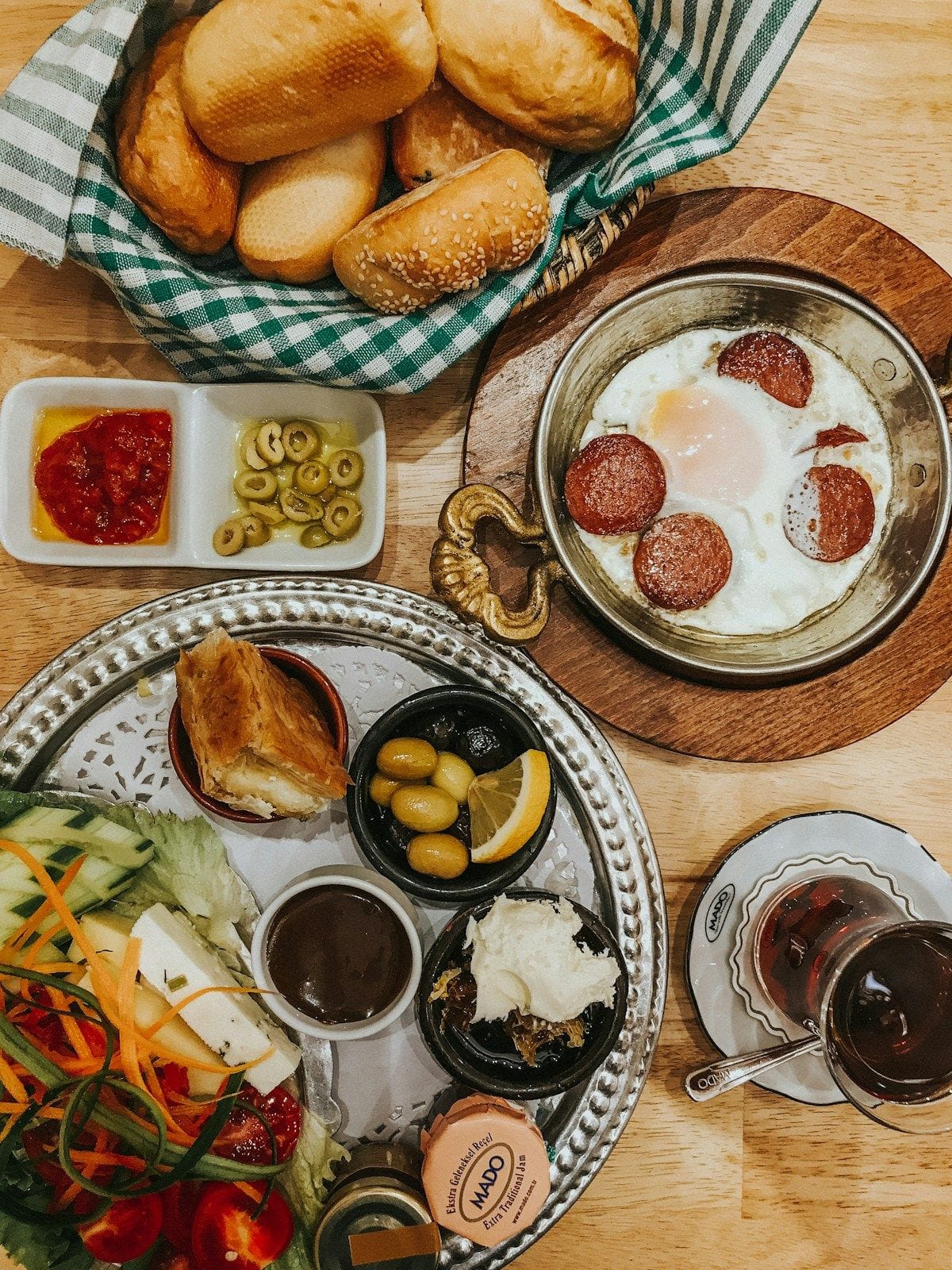
The Turkish breakfast (kahvalti, literally “before coffee”) is one of the most elaborate morning rituals in the world. It is not a quick meal. It is an event.
A full spread covers: white cheese (beyaz peynir), aged kasar cheese, black and green olives, tomatoes, cucumber, honey still in the comb, clotted cream (kaymak), a soft-boiled or pan-fried egg, butter, several jams, fried sucuk (spiced beef sausage), menemen (eggs scrambled with tomatoes and peppers), fresh bread, and a stack of simit (sesame seed rings). Pots of black tea arrive continuously.
The Van breakfast in eastern Turkey is the pinnacle of this tradition — villages around Lake Van produce ten or more local cheeses, mountain herbs, and honeys that appear on a single table. A Van kahvalti for two runs TRY 400-600. More on this in our dedicated Turkish breakfast guide.
Regional Specialities Worth Planning Trips Around
Turkey’s regional food differences are sharp enough to plan a route around.
Gaziantep (Antep) is the culinary capital of the southeast. The city holds UNESCO Creative City of Gastronomy status. Its baklava is made with local Antep pistachios — green, sweet, and nothing like the honey-soaked versions sold elsewhere. A kilo from Ali Haydar or Imam Cagdas runs TRY 600-900. The kebabs here use local spices and lamb from the surrounding plateau. A day trip from Cappadocia or Adana is worth it for food alone.
Trabzon and the Black Sea coast are where the cuisine turns green and buttery. Kuymak is the signature dish: melted local kolot cheese stirred into cornmeal porridge with butter until it pulls into long strands. It is served in the pan, accompanied by tea, and eaten for breakfast. Around TRY 120-180 at local lokantas (canteen restaurants).
Aegean coast (Izmir, Bodrum, Kusadasi) leans heavily on olive oil, herbs, and vegetables. Zeytinyagli dishes — vegetables braised slowly in olive oil and served at room temperature — are a tradition here. Artichokes, broad beans, and wild greens cooked this way are subtle but deeply satisfying.
Hatay province near the Syrian border produces possibly the most complex Turkish cuisine of all. The dishes here — acili ezme (fresh tomato and pepper salsa), hummus made with early-harvest olive oil, and kunefe (shredded pastry filled with stretchy cheese soaked in syrup, served hot) — reflect centuries of Arab and Levantine influence. Kunefe from Hatay costs TRY 100-150 per portion and tastes unlike anything you will find elsewhere in Turkey.
Street Food Essentials
Simit is the session snack: a circular bread ring coated in sesame seeds, baked in communal bakeries and sold from red carts on every major street corner. It costs TRY 15-25 and goes well with a glass of tea from a nearby cay evi (tea house).
Borek is layered filo pastry filled with white cheese, spinach and cheese, or minced meat. The best versions are freshly baked in a large tray and sold by weight. A thick slice runs TRY 50-80. Bakeries open early; by 9am the best borek is gone.
Lahmacun is the thin flatbread topped with finely minced lamb, onion, tomato, and parsley, then fired in a wood oven. Squeeze lemon over it, roll it up, and eat it standing at the counter. TRY 60-100 at a proper lahmacun shop.
Balik ekmek (fish sandwich) is the quintessential Istanbul street food: a mackerel fillet grilled on a rocking boat moored by the Galata Bridge, stuffed into half a bread loaf with lettuce and onion. TRY 100-150. The atmosphere of eating it on the waterfront is as important as the fish.
Sweets and Desserts
Turkish desserts deserve a separate afternoon. Baklava (TRY 120-200 per 250g) is available everywhere but tastes best from pastane (patisserie) shops in southeast Turkey. Sutlac (rice pudding baked until the top is speckled brown) is a comfort dessert found in pudding shops called muhallebici. Asure (Noah’s Pudding) is a thick porridge of grains, beans, dried fruit and nuts, made communally and traditionally shared with neighbours during Muharram month.
Dondurma is Turkish ice cream made with mastic resin and salep, giving it a stretchy, elastic texture. Maras is its home city; street vendors theatrically stretch and twirl it before serving. TRY 30-60 for a cone.
Where to Eat: Practical Guide
A lokanta is a no-frills canteen with pre-cooked dishes in trays behind glass. You point and pay. Lunch for two costs TRY 300-500. These are where Turks eat weekday meals.
A restoran implies table service, menus, and higher prices. Expect TRY 500-900 per person for a full meal with drinks.
A kebapci specialises in grilled meat and usually has an open kitchen. Order by the portion (porsiyon) or half-portion (yarim porsiyon) if you want to try multiple things.
A pastane is a patisserie for sweets and cakes. Stop at one every afternoon.
Tipping is customary at sit-down restaurants: 10-15% of the bill, left in cash. Card payments are widely accepted at city restaurants; smaller lokantas and street stalls are cash only.