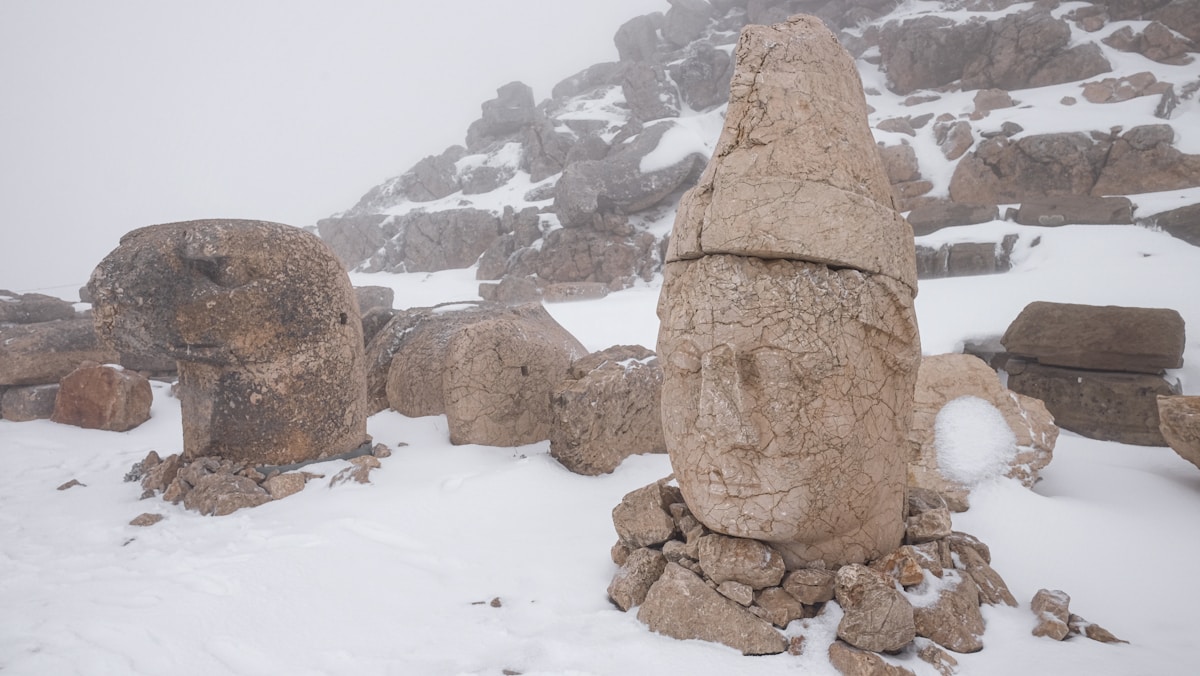
At 2,150 metres above sea level in the Anti-Taurus mountains of southeast Turkey, Mount Nemrut holds one of the ancient world’s most peculiar and dramatic monuments. Across two stone terraces on the summit, colossal heads of gods and kings - each standing 1.5 to 2 metres tall - lie toppled and scattered where earthquakes brought them down from their original thrones. They have been here since the first century BCE, staring across the Euphrates valley in various directions, and they remain one of Turkey’s most visually striking archaeological sites.
UNESCO added Nemrut Dağı to the World Heritage List in 1987, recognising it as an outstanding example of the syncretism of Hellenistic and Persian religious traditions in the late Hellenistic period.
What Is Mount Nemrut?
The site was built by Antiochus I Theos of Commagene (69–34 BCE), ruler of a small but prosperous kingdom that occupied a strategic position between the Roman and Parthian empires. Antiochus was a shrewd political survivor who blended the divine traditions of both his patrons, presenting himself as equal to the gods of both east and west.
The summit construction is a funerary mound (tumulus) some 50 metres high, created by piling crushed limestone rock. Antiochus built the tumulus over what he intended as his own burial chamber - though the tomb itself has never been found inside, despite multiple excavations. Around the base, on both the eastern and western flanks, he created artificial terraces flanked by rows of seated colossal statues representing himself alongside deities drawn from Greek and Persian traditions: Apollo-Mithras, Zeus-Oromasdes, Heracles-Artagnes, and the goddess Tyche of Commagene.
The original statues stood roughly 8–9 metres tall, seated on thrones. When earthquakes brought them down - probably multiple times over the centuries - the heads broke away from the bodies and tumbled to the terrace floor. The seated torsos remain in place, while the heads lie on the ground nearby in various states of preservation.
The Eastern and Western Terraces
The site has two main areas, accessible via a 600-metre path across the summit ridge.
The Eastern Terrace is the larger and more visited. Here the heads are arranged in a row along the base of a stone-lined terrace: Apollo, Fortuna, Zeus, Antiochus himself, and Heracles, plus the remains of eagle and lion statues at each end. The heads are well-preserved - particularly the Apollo head, with its serene expression and tiara of sun rays intact. This terrace faces east and catches the first light of sunrise directly, which is why it is the focus of sunrise visits.
The Western Terrace is slightly smaller and less visited by tour groups, but arguably more atmospheric in the late afternoon. The statues here are in a similar arrangement to the east, though in a more weathered state. A famous eagle head sits prominent on a plinth. The terrace faces southwest and glows in warm light for the hour before sunset.
A 10-minute walk along the ridge path connects the two terraces, crossing the loose-scree summit of the tumulus. The path is well-marked and requires no special equipment, though the altitude and cold can make it tiring for visitors not acclimatised.
Sunrise vs Sunset - Which to Choose
Sunrise: Tour operators from Adıyaman and Kahta typically depart between 02:30 and 03:30 to reach the summit before dawn. The eastern terrace comes alive as the first light hits the stone heads - photographically the more dramatic option, with the statues silhouetted then lit in warm gold. Crowds are smaller, particularly on weekday mornings. Temperatures at this hour in summer hover around 8–12°C; in spring and autumn, dress for near-freezing conditions.
Sunset: Afternoon departures leave around 14:00–15:00, reaching the summit in time to watch the western terrace catch the final hour of daylight. Logistically easier - no middle-of-the-night start, no concern about clouds obscuring the sunrise. The western terrace light is warm and long in summer evenings. Crowds are larger, especially on weekends in July and August.
Both are valid. If you can only visit once and prioritise photography, sunrise on the eastern terrace on a clear weekday is the peak experience. If you value sleep and an easier itinerary, sunset works well.
Getting There
Mount Nemrut sits within the Adıyaman province, closest to three towns:
From Adıyaman (the provincial capital, 75 km from the summit): Adıyaman has an airport (ADF) with connections to Istanbul, Ankara and İzmir. Daily tour departures operate from Adıyaman in summer, typically including hotel pickup, transport and sometimes an English-speaking guide. Expect to pay approximately ₺500–800/person for a guided tour as of 2026. The drive from Adıyaman to the summit takes approximately 90 minutes on winding mountain roads.
From Kahta (30 km from the summit): The small town of Kahta is the closest base to Nemrut and the departure point for most independent travellers. In summer (roughly June–September), shared minibuses run from Kahta to the summit for approximately ₺200–300/person return, timed for sunrise or sunset. Outside the high season, a private taxi from Kahta to the summit and back runs approximately ₺600–900 as of 2026. Kahta has several budget and mid-range hotels.
From Malatya (160 km away): Malatya is a larger city with better flight connections and a good base for travellers combining Nemrut with the Eastern Express train journey. Tour operators in Malatya run full-day Nemrut excursions for approximately ₺600–900/person including transport. The drive to the summit from Malatya takes 2.5–3 hours via the northern route through Sincik, adding to the total time commitment.
From Şanlıurfa or Diyarbakır: Both cities are 2.5–3 hours from Kahta by road, making a Nemrut day-trip very long but possible. Bus connections from both cities to Adıyaman run frequently (approximately ₺150–200 as of 2026), from where a tour or taxi can take you up.
Entry and Access
The national park entry fee is approximately ₺120–150 per person as of 2026, paid at the gate on the mountain road above Kahta. The road to the summit is a paved single-track mountain road with switchbacks; a standard car handles it in dry conditions, but a high-clearance vehicle is more comfortable. The final section above the parking area is a 600-metre footpath with some loose stone.
Seasonal access: The summit is generally accessible from April to November. Snow typically closes the road from December through March. May and October can still have snow on the summit itself, and temperatures are cold; the site is open but conditions are harsh. July and August are the main season for all operators.
Opening hours: The national park gates are open from approximately 07:00 to 19:00 in summer. Sunrise tours enter before official opening - this is standard practice managed through guides and operators. Verify current access arrangements with your operator before booking.
What to Bring
- Warm layers: Even in August, summit temperatures can be 10–15°C cooler than the valley towns. A fleece or light jacket is the minimum; a wind-proof shell is better.
- Sturdy footwear: The summit path is rocky. Trainers or hiking boots work; sandals are a bad idea.
- Water and snacks: There are no facilities on the summit. Bring at least 1.5 litres per person and something to eat.
- Headlamp or phone torch: Essential for sunrise visits - the path is not lit and you will be walking in the dark.
- Camera with wide-angle lens: The statues are closely spaced; a wide lens captures more of the heads in context. At sunrise, a tripod is useful for long exposures in the pre-dawn light.
Tour Options
Most visitors use an organised tour from Adıyaman or Kahta. Key operators include:
- Nemrut Tour (Adıyaman): Full-day tours including accommodation pickup, transport and guide from approximately ₺600–800/person as of 2026. English-speaking guides available on request.
- Kahta-based minibus tours: The most affordable option for budget travellers already in Kahta. Shared minibuses timed to sunrise and sunset for ₺200–300/person return. No guide included; the summit is accessible and signed well enough for independent exploration.
- Private taxi from Kahta: For flexibility on timing and stops, a private taxi return costs approximately ₺600–900 as of 2026. Drivers in Kahta are familiar with the route and can wait at the summit for 1–2 hours.
For travellers with more time, multi-day tours from Adıyaman or Şanlıurfa combine Nemrut with other southeast Turkey sites: the Karakuş tumulus (another Commagene royal monument 12 km from Kahta), the Cendere Roman bridge (2nd century CE, 15 km from Kahta), and Arsameia (Commagene summer capital, 7 km from Kahta). These combine into a half-day circuit that significantly deepens the Commagene context before or after the summit visit.
Best Time to Visit
July and August are the busiest months, with the most reliable access and the most operator departures. If possible, aim for a weekday to reduce crowds at the summit.
May and June offer the advantage of fewer visitors, wildflowers on the mountain slopes and dramatic cloud formations that can add atmosphere to photographs - though also the risk of cloud obscuring the views. Temperatures are cool to cold at the summit.
September and October are excellent: crowds thin significantly after August, the air is clear, and the mountain light is warm without the summer heat of the lowlands. This is our recommended window for a Nemrut visit.
Winter (November to March): the summit is typically inaccessible or hazardous. The surrounding region - including Adıyaman town and the valley archaeology - remains accessible, but the summit experience is the core reason to visit and not available in deep winter.
Combining Nemrut with the Eastern Express
One of Turkey’s most popular train journeys, the Eastern Express (Doğu Ekspresi) runs from Ankara to Kars in eastern Turkey, passing through Malatya. Many travellers combine an overnight train journey with a Nemrut day trip from Malatya before continuing east. The train departs Ankara every evening (check timetables and book seats in advance - the Eastern Express sells out weeks ahead in summer, particularly Friday and weekend departures). Malatya is approximately 10–11 hours from Ankara by train; from there, a Nemrut day tour adds 6–7 hours including the mountain drive. This combination covers two of southeast Turkey’s most distinctive experiences in a single loop.
For the full guide to the Eastern Express train and for planning a broader eastern Turkey trip, see our 3-week Turkey itinerary. Nemrut pairs well with Şanlıurfa (Gobekli Tepe, Balıklıgöl) - around 3 hours southwest of the mountain. From Şanlıurfa you can continue northwest to Gaziantep (Turkey’s food capital, 145km) and loop back through Mardin for a complete southeast Turkey circuit.
Booking in advance: Browse tours and activities in eastern Turkey on GetYourGuide to compare operators and read recent reviews - booking ahead is strongly recommended in peak season (July–August) as slots fill quickly.
See also: Eastern Turkey guide · Mardin travel guide · Gaziantep travel guide · Turkey in September