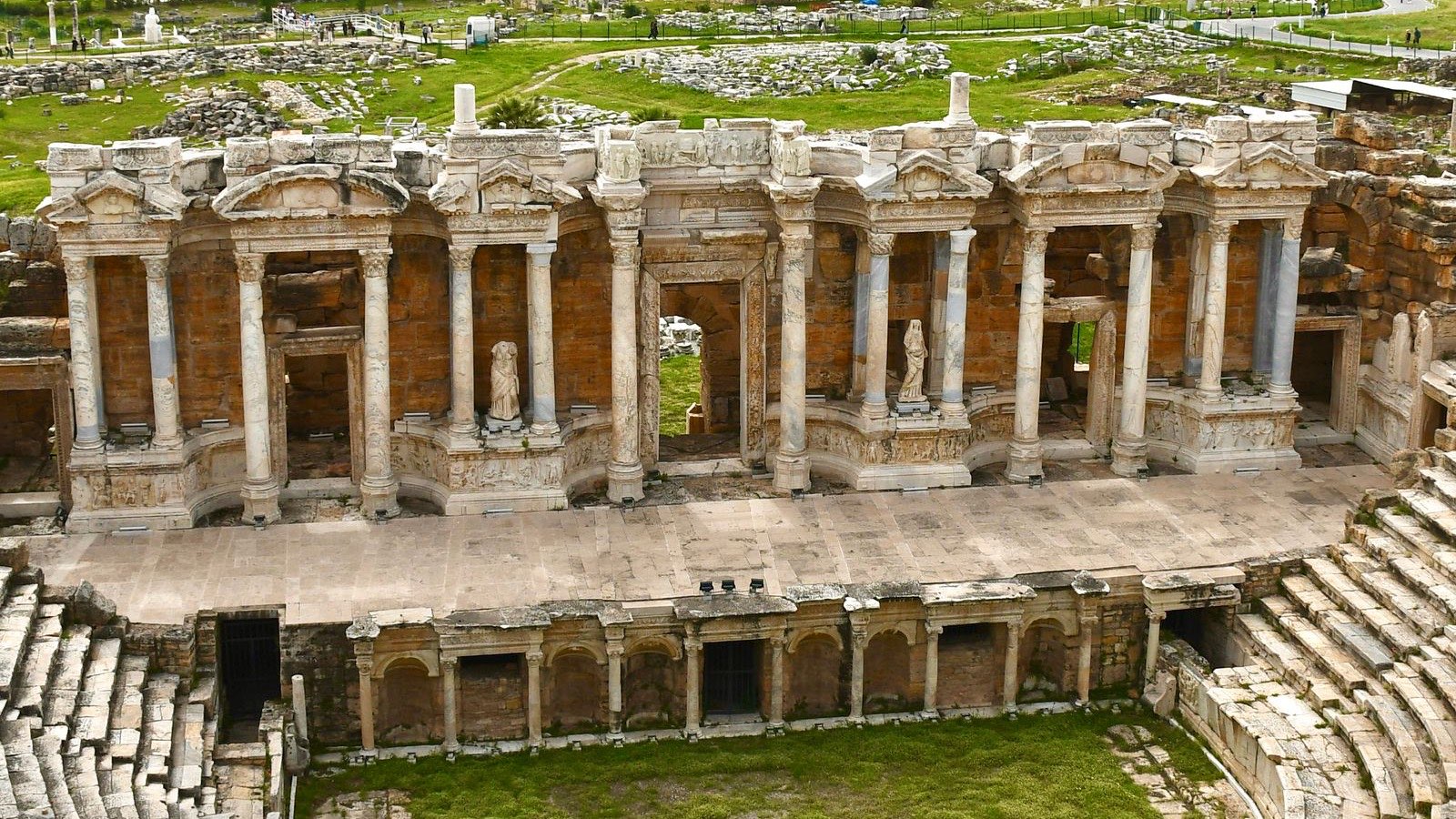
Hierapolis is the Greco-Roman city built on the plateau above Pamukkale’s white terraces. Most people arrive for the travertines and treat the ruins as a bonus, which is a mistake: the 2,000-year-old theatre, the huge necropolis and the thermal pool scattered with ancient columns are some of the best-preserved Roman remains in western Türkiye, and the ticket covers them all. Our Pamukkale guide covers the terraces, winter visits and timing. This page is about the ancient city itself.
Quick facts
| Location | Pamukkale, Denizli Province, about 20 km from Denizli |
| Status | UNESCO World Heritage Site (Hierapolis-Pamukkale, listed 1988) |
| Combined ticket | About 30 euros reported for 2026 (terraces, ruins, museum) |
| Antique (Cleopatra) Pool | Separate fee, reported from about 6 to 14 euros |
| Hours | Roughly 08:00 to 20:00 in summer, 08:00 to 17:00 in winter |
| Time needed | 2 to 3 hours for the ruins; half a day with terraces and pool |
Sources disagree on both fees and hours, and the Ministry’s own pages do not publish a stable foreigner price. Treat the numbers as a range as of October 2026 and confirm at the gate. The UNESCO entry for Hierapolis-Pamukkale has the heritage background, and Go Türkiye carries official visitor information.
A short history
Hierapolis (“holy city”) was founded around 190 BC by the Attalid kings of Pergamon, probably Eumenes II, and passed to Rome in 133 BC. A major earthquake in AD 60 destroyed it, and the city was rebuilt in grand Roman style, much of which survives. Hierapolis was a spa town, a textile and dyeing centre and, later, an important Christian city. The apostle Philip is traditionally said to have been martyred here. Repeated earthquakes, the last major one in the 14th century, ended it, and the ruins slowly filled with travertine.
What to see
Roman theatre. The most imposing structure: a steep auditorium that held about 12,000 people, with a restored stage building decorated with reliefs of Apollo, Artemis and Dionysus. Climb to the top rows for a view across the Büyük Menderes plain.
Necropolis. One of the largest ancient cemeteries in Anatolia, with more than a thousand tombs of every type: tumuli, sarcophagi and house-shaped tombs, spread along the old road to the north gate. It is quiet and photogenic, and most day trippers skip it.
Frontinus Street and gates. The colonnaded main street ran north to south between two gates. The North Roman Gate, a two-towered structure from the Domitian era, and the Byzantine gate at the south end bracket the walk through town.
Plutonium. A cave and enclosure associated with a sulphur-rich gas that supposedly killed those who entered, regarded in antiquity as a gateway to the underworld. Visitors are kept at a distance, because the gas is real.
Martyrium of St Philip. An octagonal 5th-century building on a hill, marking the traditional site of Philip’s death. It is a 15 to 20 minute walk up from the theatre, so it gets fewer visitors.
Hierapolis Archaeological Museum. Housed in the old Roman baths, with sarcophagi, reliefs and a good display of statues found at the site. Allow 30 to 45 minutes.
Antique Pool (Cleopatra’s Pool). A thermal pool at roughly 36 C where marble columns and capitals lie on the bottom, toppled by earthquakes. The “Cleopatra” name is marketing, and no source ties her to the site. Swimming costs extra, and lockers and changing rooms are on site. It is crowded at midday, so go early or late. Bring a swimsuit and check whether you need to pay by the hour.
Getting there and entering
From Pamukkale village. The south gate is a short walk from the village. Walk barefoot up the terraces, since shoes are not allowed on the travertine, then enter the ruins at the top.
From Denizli. Dolmuş minibuses run from Denizli’s Çardak and city terminals to Pamukkale village in about 30 to 40 minutes, usually under 100 TL. Denizli has the major bus and train links; buses from Antalya take about 4 hours and from Selçuk and İzmir about 3 to 4.
By tour. Day trips run from Antalya, Kuşadası, Marmaris and Bodrum, typically 10 to 12 hours. A guide is useful for the theatre and necropolis, which have little signage. See Pamukkale tours for options, and our best Pamukkale tours guide for operators.
Where to stay. Overnighting lets you see the site early or late without the crowds. See Pamukkale hotels for places by budget, and the full Pamukkale city guide.
Best time to visit
Spring and autumn are best for walking the ruins in comfort. July and August are very hot on the exposed plateau, with little shade among the ruins, so start by 08:00. Late afternoon gives soft light on the theatre and the terraces. Winter is quiet, but the pool is the main attraction when it is cold, and the walkways can be slippery.
Practical tips
- Start from the north gate for a downhill route: A taxi from the village to the north gate takes about 15 minutes. You then walk through the ruins and down the terraces.
- Water and shade: Bring plenty of water and a hat. There is almost no shade among the ruins, and a cafe sits near the Antique Pool.
- Comfort: The terraces are slippery when wet. Wear sandals you can carry, and don’t wear them on the travertine.
- Combine with: The ruins of Ephesus are about 3 hours away by road, so the two are usually done on separate days.
- Pass: Check whether your Museum Pass is accepted when buying at the gate.
Tickets and tours
Skip-the-line tickets and guided combinations that include Hierapolis can be reserved ahead through Tiqets Turkey, a convenient way to fix a date in summer.