Pamukkale: Cotton Castle, Thermal Terraces and Hierapolis
Pamukkale travel guide: white travertine terraces, Hierapolis Roman ruins, Cleopatra's Pool and how to get there from Istanbul, Izmir and Antalya.
Guides for Pamukkale
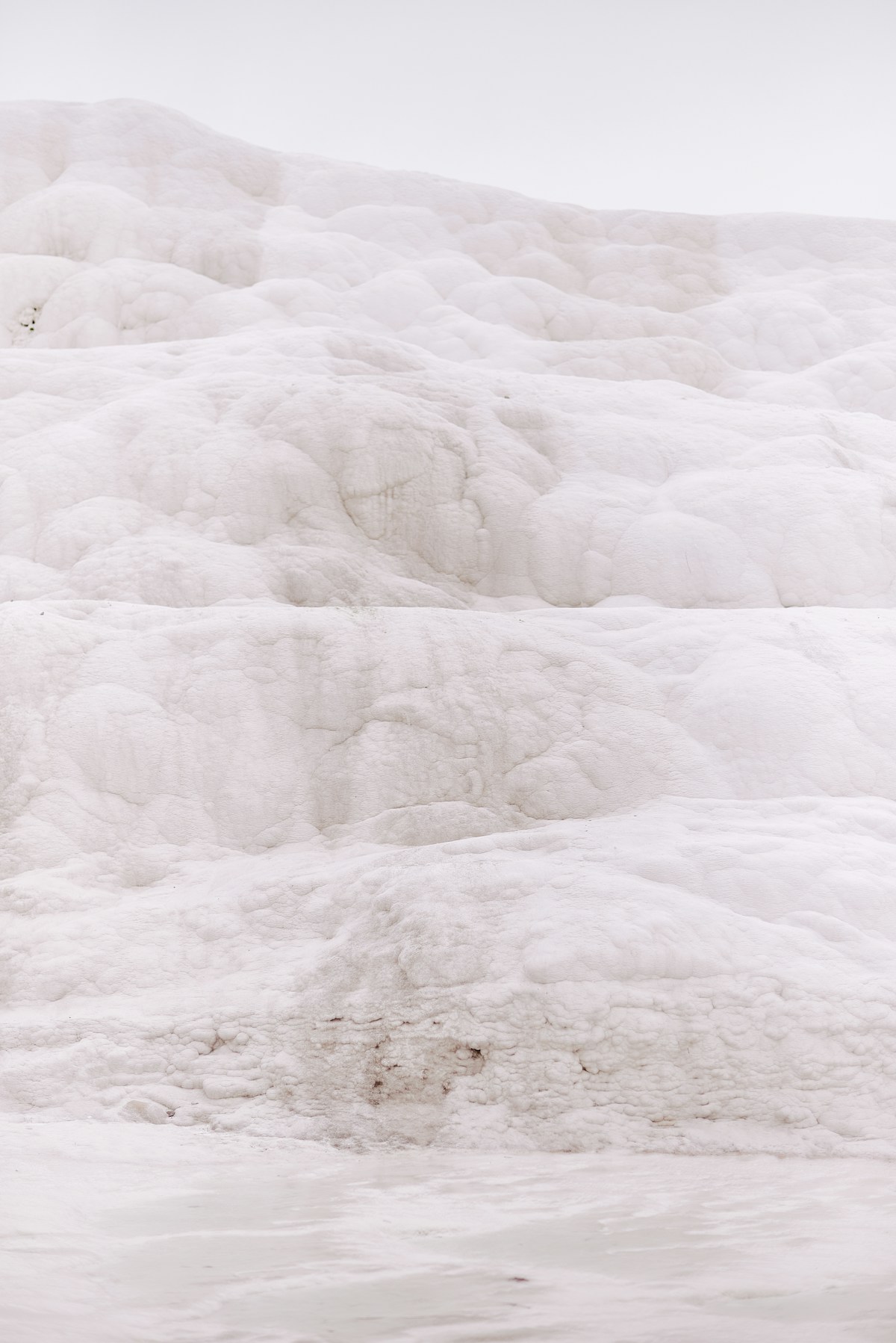
Pamukkale means “cotton castle” in Turkish, and the name describes exactly what you see from a distance: a white hillside that appears to be covered in snow or cotton. Up close, the white surface is mineral-rich travertine - calcium carbonate deposited over thousands of years by thermal spring water flowing down the slope. The terraces are shallow pools, warm to the touch, ringed by white mineral formations. You walk barefoot across the surface.
The site sits in western Turkey’s Denizli Province, 20km from Denizli city. Combined with the Roman city of Hierapolis directly above the terraces, it is one of Turkey’s most visited UNESCO World Heritage Sites and one of a small number of places that genuinely looks like its photographs.
The Travertine Terraces
The thermal springs at Pamukkale release water at approximately 35°C, rich in dissolved calcium bicarbonate. As the water flows over the hillside and contacts the air, carbon dioxide escapes, the calcium carbonate precipitates out of solution, and the white mineral crust builds up layer by layer. The process has been ongoing for at least 400,000 years. The terraces are still actively forming today - fresh deposits appear as a thin, smooth white film on the pool edges where water is flowing.
The result is a hillside roughly 160 metres high and 2,700 metres long, covered in shallow pools separated by white mineral walls. From below, the effect is genuinely striking - a white cliff face that looks like frozen water or, as the Turkish name suggests, cotton. Browse Pamukkale tours and activities on GetYourGuide to arrange early-morning visits that beat the crowds, guided Hierapolis tours, and thermal pool experiences with free cancellation.
Walking the terraces
Shoes must be removed at the entrance gates. Bags for shoes are provided. The travertine surface varies: smooth and slippery where water is flowing, rough and sharp-edged where the deposits have dried. Both conditions require care. We recommend bringing a small towel to dry your feet before putting shoes back on.
The water in the active pools is shallow, typically 5-20cm deep, and warm. Children can wade safely but the surface is uneven. The pools are not deep enough to swim in - the Antique Pool (below) is the only swimming option on site.
Photography tips
The terraces face southwest. Morning light (before 9am) produces the best photographs - the pools reflect blue sky and the white surface glows without harsh shadows. Sunset is the second-best window, with warm golden light across the terraces. Midday sun in summer creates flat, overexposed images and the white surface becomes painfully bright.
Drone use is prohibited on site.
Water management and restoration
The terraces were significantly damaged in the 1980s and 1990s when hotels were built directly on the hillside and thermal water was diverted to fill hotel pools. Large sections turned grey and cracked. Following UNESCO intervention, all hotels on the travertine were demolished in the 1990s and water flow was systematically restored. The site has been recovering since, but some sections remain dry or partially calcified. The active, water-filled pools are concentrated in the northern and central sections - route yourself through these for the full experience.
Hierapolis Ancient City
Hierapolis was founded as a spa city by the Attalid kings of Pergamon around 190 BC, later passed to Rome, and thrived for several centuries as a healing resort. The thermal waters were believed to have curative properties, and wealthy Romans came to bathe, live and die here - the necropolis at Hierapolis is one of the largest ancient cemeteries in Asia Minor, with hundreds of stone sarcophagi and tombs spread across a wide hillside.
The theatre: Hierapolis’s Roman theatre dates from the 2nd century AD and was reconstructed under the emperor Septimius Severus. Its capacity reached approximately 15,000. It is remarkably intact - the stage building (scaenae frons) retains carved reliefs and architectural details that rarely survive at other Roman sites. Entry is included in the combined Pamukkale/Hierapolis ticket.
The Plutonium: Near the Apollo temple, a small cave vent emits carbon dioxide at concentrations lethal to birds and small animals. Ancient writers described priests leading animals to the Plutonium to demonstrate divine power - the animals died, the priests did not (they held their breath and stood above the CO₂ layer, which is heavier than air). The vent is now fenced but still active.
The necropolis: Walking through Hierapolis’s cemetery is an unusual experience - stone sarcophagi sit at ground level along the old Roman road, some intact, some broken open. Allow 30–45 minutes to walk the main section.
The museum: The Hierapolis Archaeological Museum is housed in old Roman baths on site. It contains finds from the excavations including a marble statue of Apollo and Roman-era sculptures. Entry included in the combined ticket.
Entry Fees and Opening Hours
The combined ticket covering both the Pamukkale travertine terraces and Hierapolis costs approximately TRY 800 as of 2026. This is valid for the full day and covers re-entry through the main gates. The Museum Pass Türkiye (approximately TRY 4,000 as of 2026) also covers entry.
Opening hours: The site opens at 6:30am daily. Closing time varies by season - approximately 7pm in summer (April-October) and 5pm in winter (November-March). Arrive at opening for the best experience: fewer people, cooler temperatures, and better light.
Three entrances: The main entrance is at the bottom of the terraces in Pamukkale village (the classic barefoot walk up). The north entrance is at the top of the hill near the Hierapolis museum. The south entrance is near the Hierapolis theatre. If you arrive by tour bus, you will likely enter from the top - walk down through Hierapolis, descend the terraces, and exit at the village. If staying in Pamukkale village, enter from the bottom and walk up.
Cleopatra’s Pool (Antique Pool)
The Antique Pool is a thermal swimming pool inside the Hierapolis archaeological zone, fed by the same mineral-rich springs that created the travertines. The pool sits among the ruins of an ancient Roman bath complex. During a Byzantine-era earthquake, marble columns and architectural fragments from the surrounding buildings collapsed into the water - they are still there on the pool floor, which makes swimming here an unusual experience.
Entry: Approximately TRY 600 additional on top of the site ticket as of 2026. This is the only place at Pamukkale where you can actually swim in the thermal water - the terrace pools are too shallow.
What it is like: The water is approximately 35°C year-round, clear, and slightly fizzy from dissolved carbon dioxide. Depth varies from 0.5m to about 3m. The pool is not large - approximately 50m long - and it gets crowded between 10am and 3pm. Arrive early or late for a more relaxed swim. Changing rooms and lockers are available on site.
Is it worth the extra fee? If you are interested in thermal bathing in a genuinely ancient setting, yes. The sensation of swimming over Roman columns in warm mineral water is specific to this place. If you are short on time and focused on the terraces and Hierapolis, the pool can be skipped.
Karahayit Red Springs
5km north of Pamukkale village, Karahayit has thermal springs with a different mineral content: iron-rich water has stained the formations red, orange and brown. Less photogenic than white Pamukkale but the thermal facilities here are more developed, with large spa pools open to visitors. Some travellers stay in Karahayit to access both sites. Day entry to the thermal pools: approximately TRY 200–400 depending on the facility.
Getting to Pamukkale
From Denizli (20km): Dolmuş minibuses run between Denizli otogar (bus station) and Pamukkale village every 30 minutes, approximately TRY 30 and 40 minutes. Denizli is the main transport hub for the region.
From Istanbul (580km): Overnight bus to Denizli takes approximately 9–10 hours, TRY 600–900. Several bus companies serve this route; Kamil Koç and Pamukkale Turizm are reliable options.
From Izmir (230km): Bus to Denizli takes approximately 3 hours, TRY 200–350. Day trip from Izmir is feasible but rushed.
From Antalya (185km): Bus to Denizli takes approximately 3 hours, TRY 180–300. Day trip possible but leaving early morning is necessary.
From Istanbul as a day trip: Technically possible by flying to Denizli (Turkish Airlines operates the route, ~1h), taking the bus to Pamukkale, visiting and returning. In practice this is expensive (flights add €80–150+ return) and leaves limited time at the site. An overnight stay is a much better use of the journey.
When to Visit
September to April gives the most comfortable temperatures for walking the terraces barefoot. July and August are hot - the white rock surface reflects heat and the terraces can feel uncomfortably warm. Winter is quiet and prices drop, but some facilities in the village close.
The site is at its most atmospheric at opening (6:30am) and in the hour before sunset, when the terraces glow against the light. Avoid 10am–3pm in summer; this is when the coach tours arrive.
Where to Stay
There are two options: Pamukkale village (directly below the terraces) or Denizli city (20km away). Each has advantages.
Pamukkale Village
The village has approximately 30 guesthouses and small hotels, most family-run. The main advantage is proximity - a 5-minute walk to the lower entrance gates, meaning you can arrive at the terraces at 6:30am opening before the tour buses from Denizli and the coast.
Budget (TRY 800-1,500/night): Simple family pensions with clean rooms, breakfast included. Melrose House is a well-regarded backpacker-friendly option with a pool and free Denizli bus station pickup, from approximately TRY 900 as of 2026. Hal-Tur Hotel offers similar value with a rooftop terrace and thermal pool access.
Mid-range (TRY 1,500-3,000/night): Several properties have private thermal pools filled from the same spring system that feeds the terraces. Doga Thermal Health & Spa has its own thermal pool complex and spa facilities, from approximately TRY 2,000 as of 2026. Venus Hotel is a long-established property with a thermal pool, garden restaurant, and free airport/bus station transfers.
Most village hotels offer free pickup from Denizli otogar (bus station). Confirm this when booking.
Denizli City
Denizli is a working Turkish city of 600,000 with better restaurants, shopping, and transport links. The trade-off is the 40-minute minibus ride to the terraces each way.
When Denizli makes sense: If arriving late at night by bus, if you want a wider range of restaurants, or if Pamukkale is a day trip within a longer itinerary. Denizli has chain hotels (Hilton Garden Inn Denizli, from approximately TRY 2,500 as of 2026) and budget business hotels (from TRY 600) near the otogar.
Karahayit Option
Karahayit village, 5km north of Pamukkale, has thermal spa hotels with more developed bathing facilities than Pamukkale village. The thermal springs here are iron-rich (the formations are red and orange rather than white). Several mid-range to upscale thermal hotels operate here, from approximately TRY 1,500-4,000 as of 2026. Good option if thermal bathing is a priority alongside the terraces.
Search hotels in Pamukkale on Booking.com
Common Mistakes to Avoid
Not bringing water shoes or a towel. Shoes come off at the entrance. The walk across the terraces is long, and the surface alternates between wet-slippery and dry-sharp. A small towel to dry your feet before re-shoeing is valuable.
Arriving mid-morning. Tour buses from Antalya, Izmir, and the coast arrive between 10am and 11am. The site goes from quiet to crowded in 30 minutes. Arrive at 6:30am opening or after 4pm for a better experience.
Trying to do it as a rushed day trip from Istanbul. The flight plus bus plus visit plus return is technically possible but exhausting and expensive. One overnight in Pamukkale village gives a far better experience.
Skipping Hierapolis. Many visitors walk the terraces, take photographs, and leave without exploring the ancient city above. Hierapolis deserves at least 90 minutes - the theatre alone is worth the walk.
Not bringing sunscreen. The white travertine reflects UV strongly. Sunburn happens fast, especially on feet and legs that are normally covered.
Pamukkale is well placed within a western Turkey itinerary - İzmir is 230km north (3 hours), Antalya is 185km east (3 hours), and Bodrum is reachable in under 3 hours. If you’re combining Pamukkale with ancient sites, Ephesus near İzmir (accessible via Kuşadası) is 4 hours west and forms a natural continuation. For a longer self-drive trip, rent a car in Turkey and continue to Kuşadası on the Aegean coast, 3 hours northwest.
Getting there: Flights to Turkey connect via Istanbul with most European carriers. For a door-to-door arrival, pre-book an airport transfer for fixed-price, hassle-free pickup. An eSIM for Turkey activates before you land and keeps you connected from the moment you clear arrivals.
See also: 1 week in Turkey itinerary · İzmir travel guide · Kuşadası travel guide · Turkey in spring
Explore Pamukkale
Book an experience
Top experiences in Pamukkale
Explore the best tours and activities in Pamukkale, with instant confirmation and free cancellation on most bookings.
Find hotels in Pamukkale
Explore accommodation in Pamukkale →We earn a small commission at no cost to you.