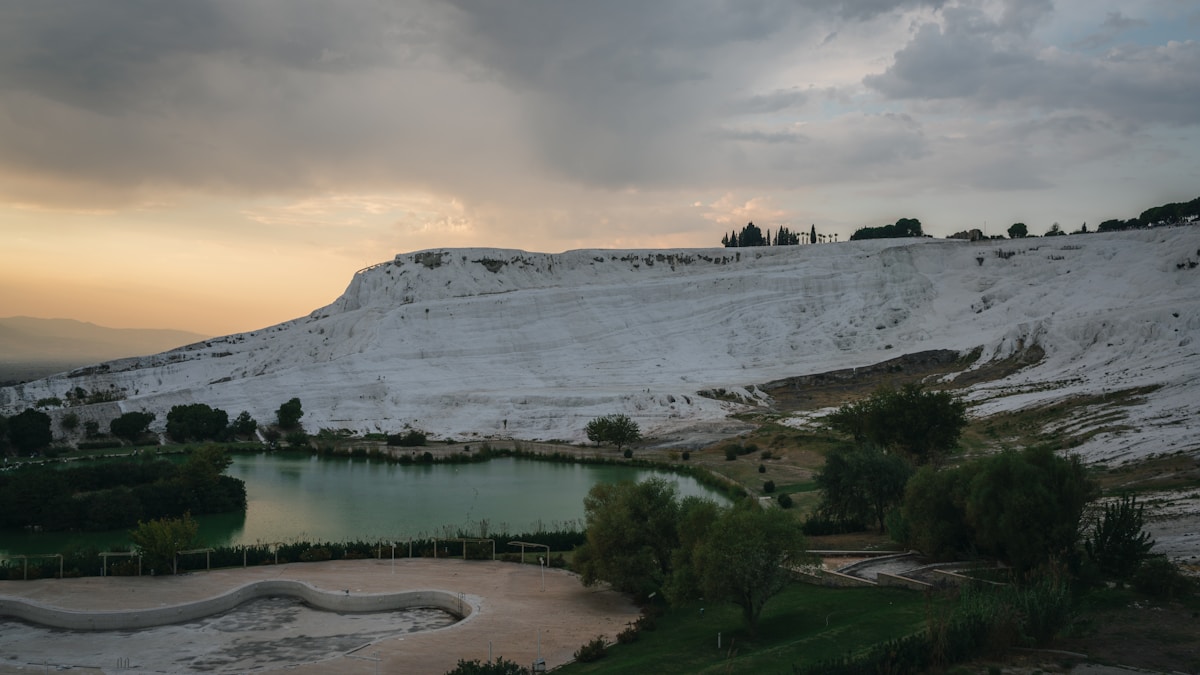
Pamukkale — “Cotton Castle” in Turkish — is a UNESCO World Heritage Site in Denizli province where hot springs deposit calcium carbonate down a limestone hillside, building up the white stepped terraces and shallow thermal pools that make it one of the most recognisable natural sights in Turkey. Directly above the terraces sit the ruins of Hierapolis, a Greco-Roman spa city founded in the 2nd century BC. The two form a single site on one ticket.
The short verdict: Pamukkale is genuinely worth visiting, but the experience varies enormously depending on when you arrive. Get the timing right and you will have the terraces nearly to yourself; arrive at midday in July and you will share a crowded path with several coach-loads of tourists.
Is Pamukkale Worth Visiting?
The honest answer is yes — with conditions.
The travertine terraces are real and striking. Barefoot walking through the calcium-white pools at ankle depth, with the Denizli plain 160 metres below, is an experience that photographs don’t fully capture. The site is also more substantial than social media implies: Hierapolis adds two to three hours of genuine archaeological interest, and the Antique Pool — where you can swim among submerged Roman columns at 36°C — is one of the more unusual things you can do in Turkey.
The caveats are real too. The pools are shallower than older photographs suggest. Water flow is managed by the Turkish Ministry of Culture to preserve the calcium formations, which means some terraces are dry and the deepest you’ll wade is knee-deep. The midday crowd is significant in peak season — tour coaches from Bodrum, Kuşadası, and Antalya converge between 10:00 and 14:00. And the site, while visually strong, is not large: the travertines and the main Hierapolis sites can be done comfortably in a full morning.
Pamukkale is worth visiting if: you arrive early, stay overnight in Pamukkale village, and combine it with Hierapolis. It is less rewarding if you arrive at 11:00 by tour bus and leave at 14:00.
Pamukkale vs Hierapolis: What Is the Difference?
Many first-time visitors arrive confused about whether Pamukkale and Hierapolis are two different places requiring separate tickets. They are not.
Pamukkale refers strictly to the travertine terraces — the white calcium formations and the thermal pools you walk through. These are the natural feature.
Hierapolis is the ancient city built above the terraces, initially founded as a spa resort by the kings of Pergamon in the 2nd century BC, then expanded and rebuilt under Roman rule. The city was positioned here deliberately: the thermal springs were considered sacred and the site had a sanctuary to the god Pluto. Hierapolis continued as a Byzantine city until a major earthquake in the 12th century.
The single entrance ticket (approximately ₺750 per person as of 2026) covers both. The usual order is to walk the travertines first, bare feet on calcium, and then move up to Hierapolis for the ruins. Allow the full day for both.
Key Hierapolis sights included in the ticket:
- Great Theatre (2nd century AD): Capacity around 12,000 and among the best-preserved in Turkey; views from the upper tiers across the terraces and the Denizli plain are exceptional.
- Necropolis: The largest ancient cemetery in Anatolia, stretching north of the city gate with sarcophagi, tumuli, and tomb monuments. Many inscriptions remain legible.
- Martyrium of St Philip: Octagonal early Christian structure on the hillside, said to mark the site of the Apostle Philip’s martyrdom in 80 AD.
- Hierapolis Archaeology Museum: Housed in the former Roman Baths. Entry included in the site ticket.
Antique Pool (Cleopatra’s Pool): This is separate and charged at approximately ₺500 per person (as of 2026). Located inside the Hierapolis Hotel compound, it is a geothermal pool at 36°C with ancient Roman columns lying on the pool floor. The Cleopatra connection is a later legend with no historical basis, but the pool itself is genuinely Roman and genuinely warm.
Tickets and Entry (as of 2026)
Site entry: approximately ₺750 per person. Covers both travertines and Hierapolis ruins.
Antique Pool: approximately ₺500 per person additionally. Lockers and changing rooms available poolside.
Tickets sold at all three entrance gates (South Gate, North Gate, and East Gate via Pamukkale village). Book through Tiqets or GetYourGuide to skip the box office queue, which runs 20–30 minutes in peak season.
Opening Hours (as of 2026)
- Summer (April–October): approximately 06:00–21:00
- Winter (November–March): approximately 07:00–19:00
The two best windows are early morning (06:00–08:00) when thermal mist rises from the pools and the white terraces glow gold, and late afternoon (17:00 onwards) when coach groups depart and the light turns warm on the calcium. Avoid 10:00–15:00 in July and August.
Day Trip to Pamukkale from Denizli
Denizli is the closest city and the main transport hub for Pamukkale. The site is 20km from Denizli city centre — a straightforward half-hour journey.
By dolmuş (shared minibus): Frequent services from Denizli Otobüs Terminali (bus station) and from Denizli city centre directly to Pamukkale village, which sits at the South Gate. Journey time approximately 30–40 minutes; fare approximately ₺35–50 (as of 2026). Dolmuş run from approximately 07:00 to 20:00 in summer. Return from Pamukkale village to Denizli on the same route.
By taxi: Approximately ₺250–350 for the 20km journey (as of 2026, meter-based). Useful if you are arriving early at 06:00 before dolmuş services are running.
Arriving in Denizli:
- From İzmir by bus: approximately 2.5 hours, regular coaches from İzmir Otogar
- From Antalya by bus: approximately 3.5 hours
- From Istanbul by overnight coach: approximately 8–9 hours
- From İzmir by train (Denizli railway station): approximately 3.5–4 hours on the İzmir–Denizli line; from Denizli station take dolmuş or taxi to Pamukkale village
By domestic flight: Cardak Airport (DNZ), 60km from Pamukkale, has connections from Istanbul. Transfer to Denizli by bus or shuttle; total journey approximately 70 minutes from the terminal.
Organised day trips from Aegean resorts: Full-day tours from Kuşadası, Bodrum, İzmir, and Selçuk (Ephesus) are widely available and include transport, site entry, and a guide — typically €40–65 per person (as of 2026). A day trip from İzmir (250km round trip) makes for a long day but is workable. From Kuşadası it is the standard day-trip pairing with Ephesus.
A Denizli day trip (arriving at Pamukkale by 07:00, leaving by 15:00) gives enough time for the travertines, Hierapolis, and a swim in the Antique Pool — comfortably in eight hours.
Pamukkale in Winter
Winter (November–March) is genuinely underrated for Pamukkale.
The crowds are a fraction of summer. Coach groups from the coastal resorts thin dramatically once the beach season ends; on a weekday in December or January you may have the terraces nearly to yourself. Ticket queues are non-existent.
The travertines look different in winter but not worse. Cloud and grey skies reduce the calcium’s brilliant white to a paler tone, but morning mist from the thermal springs intensifies. Pool water temperature stays at 32–36°C regardless of season — the thermal source does not cool. Wading through warm water while the air is at 8–10°C is an unexpectedly pleasant experience.
Winter-specific notes:
- Some terrace pools are drained for maintenance in the off-season. The lower slope pools near the South Gate are the most reliably filled year-round.
- Opening hours are shorter (07:00–19:00); plan arrival for 07:30 to catch the early light.
- Hierapolis ruins: unaffected by season and easier to appreciate in uncrowded conditions.
- Denizli itself is a working provincial city with year-round transport. No seasonal closures affect bus or dolmuş services.
- Pamukkale village has fewer open restaurants and pensions in winter; book accommodation in advance.
Average temperatures in Denizli province: December–February highs around 10–13°C, rarely dropping below 3–4°C. Snow on the travertines occurs occasionally and is spectacular for photography; it cannot be planned for but is worth knowing is possible.
What to See: The Travertines
The cascading terraces cover approximately 2,700 metres of slope. You walk barefoot — shoes must be left at the base — on a designated path over the calcium surface. Some pools hold water for wading; others are dry depending on flow management. The most reliably filled pools are near the South Gate and midway up the slope.
At peak season, water is ankle to knee deep in the active sections. Pool temperature is 32–36°C depending on position. The calcium surface is slippery; a walking pole is provided free at the entrance and genuinely useful. The path is around 1km one way; allow 45–60 minutes to walk and pause.
Best Time to Visit
- April–May and September–October: manageable temperatures (22–28°C), full water flow, substantially fewer crowds than midsummer. The best combination overall.
- Early morning (06:00–08:00): the most rewarding window year-round. Golden light, thermal mist, and minimal visitors.
- Late afternoon and sunset (17:00–21:00 in summer): tour groups leave after 17:00; the terraces in orange light are excellent.
- July–August midday: the worst window. Large coaches from Bodrum and Antalya arrive 10:00–14:00; the pools become muddied and the path crowded.
Staying Overnight
Pamukkale village sits directly at the South Gate with numerous small pensions and hotels — many with their own thermal pools. An overnight stay lets you reach the terraces at 06:00 before day-trip coaches arrive, which is by far the best Pamukkale experience available.
Budget pensions from approximately ₺800–1,200 per night; mid-range thermal hotels with pool access from approximately ₺1,800–3,000 (as of 2026). Our Pamukkale hotels guide covers options by tier with named properties.
Nearby Sites Worth Adding
Laodicea on the Lycus: Roman city 5km south of Denizli with a large theatre and well-preserved streets. Entry approximately ₺150 (as of 2026). Useful stop en route from Denizli.
Aphrodisias: Major archaeological site approximately 100km west of Pamukkale with an exceptionally preserved Roman stadium and sculpture museum. A full half-day destination; reach it by hire car from Denizli or on a specific Aphrodisias day tour. One of Turkey’s finest sites and significantly less visited than Ephesus.
Karahayıt: Village 5km north of Pamukkale with red mineral springs (iron rather than calcium). The colour contrast with Pamukkale’s white is striking. Worth an hour if you have an extra half-day.
Book a Pamukkale Tour via GetYourGuide
Most visitors combine Pamukkale with a guided day trip from the nearest coastal resort. These are the most popular options, all with free cancellation:
| Tour | Departs from | Duration | From | What’s included |
|---|---|---|---|---|
| Pamukkale & Hierapolis Day Trip | Kuşadası | 10 hours | €45/person | Return transport, entry fees, guided tour of Hierapolis, lunch, thermal pool stop |
| Pamukkale & Hierapolis Day Trip | İzmir | 11 hours | €40/person | Return transport, entry fees, guide, lunch; departs İzmir city centre |
| Pamukkale & Hierapolis Day Trip | Antalya | 14 hours | €60/person | Long day but comprehensive; return transport, entry fees, guide, lunch included |
| Pamukkale & Hierapolis Day Trip | Bodrum | 13 hours | €55/person | Return transport, entry fees, guide, lunch; includes Antique Pool stop |
| Pamukkale Local Guided Tour | Pamukkale village | 3 hours | €25/person | Expert local guide through travertines and Hierapolis ruins; entry fees included; ideal if already based nearby |
Prices are approximate as of 2026. Book at least 48 hours ahead in peak season — day trips from coastal resorts sell out regularly in July and August.
Browse all Pamukkale tours on GetYourGuide →
For broader trip planning, see our 1-week Turkey itinerary and the Pamukkale destination hub for full accommodation and day-trip options.