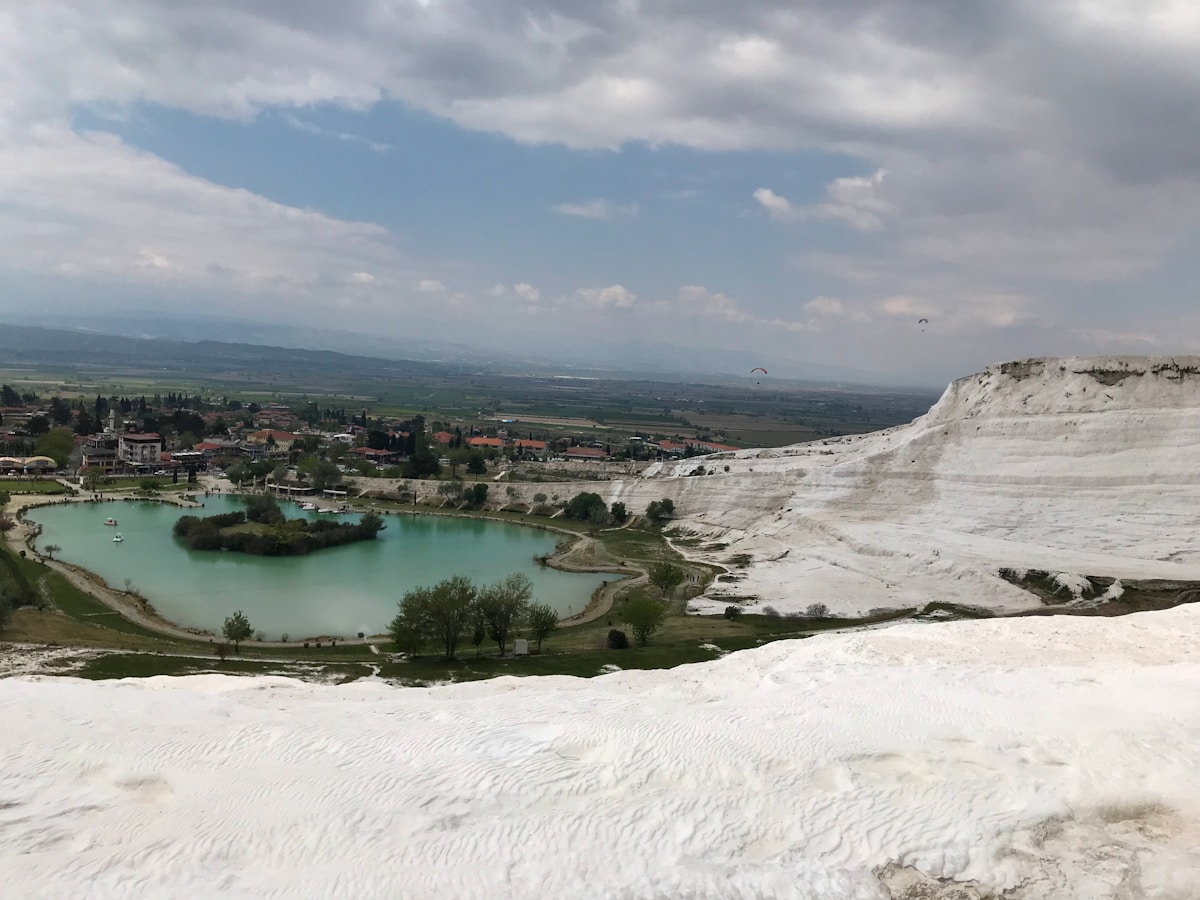
Two of Turkey’s most photographed landscapes, and two completely different experiences. Cappadocia means fairy chimneys, underground cities, cave hotels, and hot air balloons drifting over volcanic rock at sunrise. Pamukkale means calcium terraces that glow white like snow, ancient Roman ruins at Hierapolis, and thermal pools above a cliff edge. If you have to pick one, the choice depends on what you’re after. If you have time, you can do both in a single trip.
The Landscapes
Cappadocia is volcanic. The Erciyes and Hasan volcanoes deposited thick ash over millions of years; wind and water carved it into the surreal formations known as fairy chimneys, cone-shaped pillars of tufa with harder basalt caps. The Rose Valley, Love Valley, and Devrent Valley each have their own character. The scale surprises people - you can hike the valleys for days without repeating the same trail.
Pamukkale is geological in a different way: a limestone hillside where 17 thermal springs (around 35°C) deposit calcium carbonate as the water cascades down. Over millennia this built the white terraced pools - “pamukkale” means “cotton castle” in Turkish. Photographs tend to look bigger than the reality; the active travertines where you can walk barefoot through the pools are a contained section of the hillside. The site also includes Hierapolis, a substantial Greco-Roman city at the top of the cliff with a theatre, necropolis, and the Antique Pool where you can swim among ancient columns for approximately ₺700 as of 2026.
Hot Air Balloons vs Travertines
The hot air balloon flight over Cappadocia at sunrise is one of the signature travel experiences in Turkey - arguably the best hot air balloon flight in the world. Operators launch from Göreme and drift over the fairy chimneys, valleys, and cave villages as the light changes from pink to gold. Standard flights run approximately €150–€250 per person as of 2026 (usually in USD/EUR from the operators). See our detailed hot air balloon guide for operator recommendations, cancellation policies, and what to expect.
Pamukkale’s travertines are free to walk (included in the site ticket, approximately ₺550 as of 2026 for Hierapolis + terraces). The pools are shallower than they look in old photographs - water diversion policies introduced to preserve the calcium deposits mean you walk through ankle-deep water rather than swim. The visual effect is still striking, particularly in early morning before crowds arrive or in the golden hour before closing.
If the balloon flight is the kind of experience you travel for, Cappadocia wins this round clearly. The travertines are beautiful but the experience has more limited ceiling - you walk through them in 30–45 minutes.
Accommodation Styles
Cappadocia has Turkey’s most distinctive accommodation: cave hotels carved into or built inside the volcanic tufa. Where to stay in Cappadocia covers the spectrum from budget cave hostels in Göreme (from approximately ₺1,200/night) through mid-range cave hotels with valley views (₺2,500–₺5,000) to luxury suites with private terraces and pool access (₺8,000–₺20,000). Staying in a cave room is genuinely different - the thick rock walls mean consistent temperature year-round and nearly complete silence. Book the popular places 2–3 months ahead for summer and the balloon season.
Pamukkale has a smaller hotel inventory, mostly standard mid-range hotels in Pamukkale village and a cluster of better options in nearby Karahayıt (another thermal area with red mineral springs). Some hotels have thermal pools on-site. Prices are moderate: from approximately ₺1,500–₺3,000/night for a decent hotel as of 2026. There is no Cappadocia-equivalent “destination stay” here - the hotel is functional rather than the attraction itself.
Search hotels in Turkey on Booking.com
Cost Comparison
Cappadocia costs more overall. The balloon flight alone adds €150–€250 to your budget. Cave hotels charge a premium for the experience. Tours (ATV, horseback, guided valley hikes) add ₺800–₺2,500 per activity.
Pamukkale is cheaper. The entrance ticket covers the main site. Day trips to Aphrodisias (excellent ancient ruins, 1 hour away) add ₺300–₺500 for transport. Hotel prices are lower. Eating in Pamukkale village is straightforward and inexpensive.
If budget is a constraint, Pamukkale delivers more per lira spent.
How Long to Spend at Each
Cappadocia: Allow at least 2 nights, ideally 3. One day for a hot air balloon at dawn (book 24 hours in advance), one day for valley hiking (Rose Valley → Çavuşin → Devrent takes a full day), one evening for the underground city at Derinkuyu (₺340 as of 2026) or Kaymaklı. The Cappadocia hub covers day trip options if you have longer.
Pamukkale: 1–2 nights is sufficient. The travertines and Hierapolis occupy a full morning; the Antique Pool fills an afternoon. Aphrodisias day trip is worth it if you have an extra night. Most people are satisfied after 2 nights.
Best Season for Each
Cappadocia:
- Best: April–June and September–October. Hot air balloons fly year-round but cancellations are highest in winter (high winds) and summer (occasionally too hot at launch time).
- Summer (July–August): Very hot (30–35°C), dusty, and crowded. Balloons still fly but early mornings are the only comfortable outdoor time.
- Winter (December–February): Snow transforms the fairy chimneys into something spectacular. Fewer balloons, fewer tourists, and cave hotels keep you warm. Worth considering.
See our best time to visit Cappadocia guide for month-by-month detail.
Pamukkale:
- Best: April–May and September–October. The terraces photograph best in clear morning light.
- Summer: Very hot (35–40°C); the white terraces reflect heat intensely. Go very early.
- Winter: Uncrowded and cool, but the pools can look grey under cloudy skies.
Can You Do Both in One Trip?
Yes - and it’s a natural combination. The two most common routes:
Option 1 - Via Konya (overland): Cappadocia → Konya (3 hours by bus or private transfer) → Pamukkale (4 hours by bus). Konya makes a worthwhile overnight stop - the Mevlâna Museum is Turkey’s most visited cultural site and the city of Konya warrants half a day. Total overland time: 7–8 hours spread over 2 days.
Option 2 - Domestic flight: Fly Kayseri (Cappadocia gateway) to Denizli Airport (Pamukkale gateway). Flight is approximately 1 hour 15 minutes. Turkish Airlines and Pegasus both serve this route. Check current prices - domestic flights in Turkey are often ₺800–₺2,500 and can be cheaper than the bus once you factor in time.
A practical 10-day itinerary: 3 nights Cappadocia → overnight Konya → 2 nights Pamukkale → continue to Bodrum or Antalya coast.
Frequently Asked Questions
Is Cappadocia or Pamukkale more impressive? They are impressive in different ways. Cappadocia’s fairy chimney landscape and the hot air balloon experience are more immersive and memorable overall. Pamukkale’s travertines are spectacular for a few hours but the site is smaller. Most people who visit both rate Cappadocia higher as a destination.
How far apart are Cappadocia and Pamukkale? Approximately 550km by road (6–7 hours direct) or 7–8 hours via Konya. A domestic flight from Kayseri to Denizli takes about 1 hour 15 minutes.
Can I do Pamukkale as a day trip from Cappadocia? Not practically - the journey takes too long for a return in one day. Spend at least one night near Pamukkale to see the terraces properly in the morning light.
How much does the Pamukkale entrance cost? Approximately ₺550 as of 2026, which covers both the travertines and Hierapolis. The Antique Pool (swimming among Roman columns) costs approximately ₺700 additionally as of 2026. Prices are set by the Turkish Ministry of Culture and change annually.
Is a hot air balloon flight worth the price? For most people, yes - the Cappadocia balloon experience is unlike anything else in Turkey and is consistently rated among the best in the world. Book with a reputable operator (we recommend Royal Balloon, Butterfly Balloons, or Kapadokya Balloons) and understand the cancellation policy before paying. See our full balloon flight guide for detail.
What is there to do in Pamukkale beyond the travertines? Hierapolis (the Greco-Roman city at the top of the cliff) is extensive and takes 2–3 hours. The Antique Pool is worth the extra ticket. Aphrodisias, a 1-hour drive away, is one of Turkey’s finest and least-crowded ancient sites (you can rent a car in Turkey from Denizli to reach it independently). Karahayıt village has red mineral springs for an afternoon dip.
Which is better for photographers? Both are exceptional. Cappadocia at balloon launch time (approx 5:30–6:30am) in autumn or spring is the most photographed scene in Turkey. Pamukkale’s terraces photograph best in the golden hour before the site closes - crowds thin and the white calcium glows warm. Go at opening time (8am) to avoid the main crowds.
Book tours: Browse Cappadocia tours - hot air balloon slots, underground city tours, and guided valley hikes fill quickly in peak season. For Pamukkale, Pamukkale tours cover day trips from Antalya, Izmir, and Denizli with transport included.
Essential extras: An eSIM for Turkey from Airalo gives you mobile data from the moment you land - no airport SIM queue, no physical card. Travel insurance for Turkey should cover medical costs; Turkish private hospitals charge full rates for uninsured visitors.
See also: Cappadocia travel guide · Pamukkale travel guide · Hot air balloon flights in Cappadocia · İzmir travel guide · 1 week in Turkey itinerary
Plan Your Trip
✈️ Book your flights to Türkiye 🛡️ Get travel insurance 📱 Stay connected with an eSIM 🚗 Rent a car