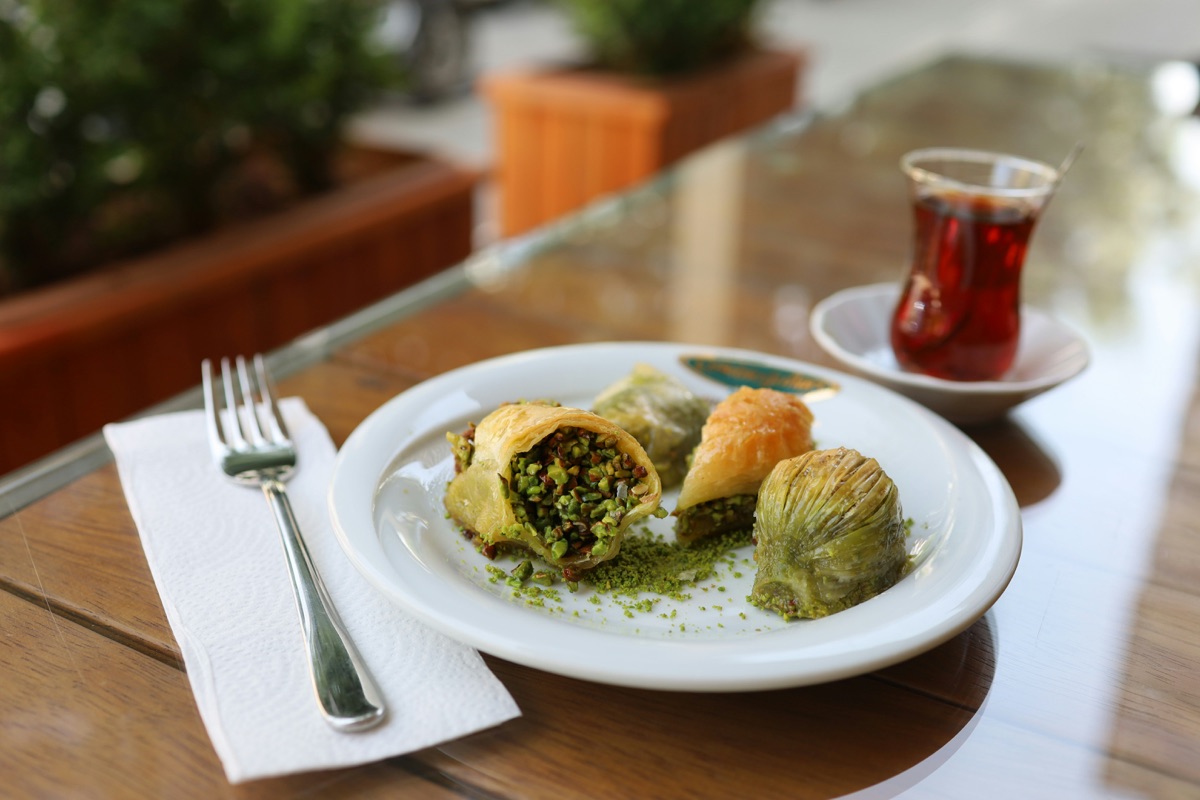
Turkish food is not one cuisine. It is a continent of cuisines compressed into a single country. The food of Gaziantep has more in common with Syrian Aleppo than with the olive oil dishes of Izmir. The Black Sea coast cooks with cornmeal, butter, and local cheese in ways that have no equivalent on the Aegean shore. Central Anatolia’s hearty meat stews and tarhana soups reflect the logic of highland winters, not Mediterranean abundance.
Understanding the regional differences is the key to eating well in Turkey. Here is a region-by-region breakdown of what actually defines each food culture.
Gaziantep and Southeastern Turkey: The Kebab and Baklava Belt
Gaziantep - shortened to Antep by locals - is the most important food city in Turkey. It holds UNESCO Creative City of Gastronomy status and earns it. The city’s cuisine is built on three pillars: kebab, baklava, and spice.
Baklava here is categorically different from the honey-drenched tourist-shop versions sold elsewhere. Antep baklava uses local Antep (Aleppo) pistachios - intensely green, with a richer flavour than Iranian or Californian varieties - in thin-layered pastry soaked in clarified butter and a light sugar syrup that does not cloy. The benchmark is Güllüoğlu (the Istanbul branch is the most accessible) or any of the century-old pastaneler in Antep itself. A kilo costs approximately ₺600–₺900 as of 2026.
Katmer is the breakfast version - a flaky griddle pastry filled with clotted cream (kaymak) and crushed pistachio. Eaten warm, it is unreasonably good. Available at dedicated katmercis from early morning.
Kebab culture reaches its apex in the southeast. Antep kebab (also called Buryan or Beyran depending on preparation) uses lamb, red pepper paste, and long cooking times. Adana kebab - from the city of Adana, 1.5 hours to the west - is a hand-minced lamb and hot pepper kebab moulded onto wide skewers, grilled over charcoal, and served with charred peppers, tomatoes, and flatbread. The proper version is notably spicy; tourist-adapted versions often tone it down.
Şanlıurfa (Urfa), further east, is the home of Urfa biber - a dark, smoky, mild chilli pepper that flavours its own regional kebab style. Urfa also gave Turkey çiğ köfte, originally made from raw lamb hand-kneaded with bulgur and spices (now a legal food product sold in packaged vegetarian form across the country, the original raw meat version still exists in small Urfa restaurants).
Lahmacun - often mislabelled “Turkish pizza” - is a thin, crispbread-based flatbread covered with a minced lamb, tomato, onion, and pepper mixture, then baked and rolled with parsley and a squeeze of lemon. The Antep and Urfa versions are notably better than the Istanbul adaptations.
Black Sea Coast: Cornmeal, Anchovy, and Cheese
The Black Sea coast - Trabzon, Rize, Giresun - developed a food culture shaped by mountain passes, rain, and limited arable land. The result is hearty, dairy-rich, and built around two local staples: cornmeal and hamsi (Black Sea anchovy).
Kuymak (sometimes called mıhlama) is the region’s signature dish. Cornmeal is slow-cooked in butter with a local fresh cheese - traditionally Trabzon or Rize tulum peyniri - until the cheese melts into golden, stretchy pools. Eaten for breakfast or as a side dish, it is intensely caloric and profoundly satisfying on a cold morning. Find it at any kahvaltı salonu in Trabzon for approximately ₺150–₺250 per serving.
Hamsi (Black Sea anchovy) season runs October through February. During those months, hamsi dominates the region: hamsi pilav (anchovies layered into rice and baked), hamsi çorbası (anchovy soup), hamsi tava (pan-fried in cornmeal). Locals say you can eat hamsi 40 different ways and some have tried.
Laz böreği is the Black Sea’s contribution to the börek canon - a sweet pastry filled with muhallebi (milk pudding) rather than the savoury fillings found elsewhere. The dough is rolled thin, the custard filling is set during baking, and the result is a dessert that tastes nothing like you expect from something called börek.
Trabzon butter (Trabzon tereyağı) deserves mention - made from the milk of cows that graze highland meadows, it has a distinctly yellow colour and nutty flavour that makes it a sought-after product across Turkey. The Trabzon breakfast spread (kahvaltı) built around this butter, local honey, and muhlama is one of the country’s best morning meals.
Aegean Turkey: Olive Oil Dishes and Meze Culture
The Aegean coast - Izmir, Bodrum, Muğla, Çeşme - eats light and vegetable-forward. The defining principle is zeytinyağlı (cooked in olive oil): dishes prepared with olive oil, served at room temperature, and eaten without meat or with minimal meat as a garnish.
Zeytinyağlı enginar (artichokes braised in olive oil with lemon, dill, and peas) and zeytinyağlı kereviz (celeriac cooked similarly) are the Aegean spring standards. Zeytinyağlı taze fasulye (runner beans long-cooked in olive oil with tomato) is eaten across Turkey but reaches its best form here. These are not side dishes - in Izmir homes, they often are the meal.
Meze culture is at its most sophisticated on the Aegean coast. A proper meyhane dinner starts with 8–12 cold meze: haydari (thick yogurt with garlic and herbs), patlıcan ezmesi (smoked aubergine purée), tarama (fish roe spread), arnavut ciğeri (Albanian-style fried liver with onions), ahtapot salatası (octopus salad with vinegar and parsley), midye dolma (stuffed mussels). Followed by hot meze: sigara böreği (fried cheese cigar pastries), hamsi tarator or karides güveç (prawn casserole). Rakı - the aniseed spirit - is the table companion. Budget ₺600–₺1,000 per person at a mid-range Izmir meyhane with drinks.
Izmir’s street food culture centres on boyoz (a plain, flaky Sephardic pastry eaten at breakfast, originally brought by Sephardic Jews expelled from Spain in 1492) and kumru (a cheese and sucuk sandwich on a specific local bread roll, unique to Çeşme). The Kemeraltı bazaar in Izmir has the best boyoz bakeries, open from around 07:00.
Central Anatolia: Tarhana, Mantı, and Hearty Stews
Central Anatolia - Konya, Kayseri, Ankara, Sivas - developed a cuisine for cold winters and agricultural plenty. The dishes are built to sustain, not to impress.
Tarhana çorbası is Turkey’s most ancient soup - a fermented mixture of yogurt, tomatoes, peppers, onion, and flour dried in the sun and powdered. Reconstituted in hot water with a knob of butter, it is earthy, tangy, and warming. Every household has a recipe; every region has a variation.
Mantı - Turkish dumplings - originates from Kayseri. Kayseri mantısı are legendarily tiny: tradition says a proper woman’s hands can fit 40 dumplings per spoon. Made from thin pasta dough folded around a minimal meat filling, boiled, and served with yogurt, garlic butter, and red pepper flakes. The Kayseri version uses the smallest folds in the country; larger regional variants exist in Ankara (where the dumplings are pan-fried after boiling - called kuru mantı).
Konya and Beyşehir are the home of etli ekmek - a metre-long flatbread topped with minced lamb and onion, cooked in a wood-fired oven. Also fırın kebabı (slow-oven-roasted whole lamb shoulder), which is Konya’s centrepiece dish for special occasions.
Ankara’nın tavası - Ankara’s pan dish - is a slow-braised lamb shank with vegetables, a hearty weekday staple that rarely appears in restaurants outside the city.
Marmara and Istanbul: The Crossroads Cuisine
Istanbul is a receiver as much as a creator - centuries of migration from every corner of the empire mean the city’s food is an edit of Turkey’s best regional traditions, plus Balkan, Greek, Jewish, and Armenian threads.
Balık ekmek - a grilled mackerel or sea bass fillet in a bread roll - is Istanbul’s street food signature. Best eaten from the boats moored at Eminönü, with a squeeze of lemon and a glass of ayran (salted yogurt drink). The stand quality varies; the ones with the longest queues among local commuters are the reliable ones.
İskender kebab technically originates in Bursa (a 90-minute drive from Istanbul), named after the 19th-century butcher İskender Efendi who invented it. Thin döner lamb slices over torn pide bread, doused in hot tomato sauce and browned butter, with yogurt on the side. Eat it in Bursa if you can; Istanbul’s versions are competent but diluted by scale.
Kokoreç - grilled lamb intestines wrapped around sweetbreads and lungs, seasoned with oregano and red pepper, chopped fine and stuffed into a half-baguette - is Istanbul’s most divisive street food. The Beyoğlu and Karaköy versions are the benchmarks. Eat one at midnight after rakı. You will understand.
Turkish breakfast (kahvaltı) in Istanbul has become a cultural phenomenon in its own right. A full spread includes: olives (green and black), multiple white cheeses, kaymak (clotted cream) with honey, tomatoes, cucumbers, sucuk (spiced sausage), pastırma (cured beef), various jams, menemen (scrambled egg with tomatoes and peppers), and bread. Kadıköy on the Asian side has some of the city’s best breakfast spots, particularly around Moda Caddesi and the market area.
A Note on Turkish Tea and Coffee Culture
No regional food guide is complete without acknowledging that in Turkey, eating and drinking are inseparable from çay (black tea brewed in a double boiler and served in tulip-shaped glasses) and Turkish coffee (finely ground, unfiltered, cooked in a cezve).
Turkey is one of the world’s largest tea consumers per capita - the crop grows along the Black Sea coast near Rize and Artvin. Çay is free at most lokanta lunches, offered at every shop visit, and the accepted social currency for any interaction lasting more than ten minutes.
Turkish coffee (Türk kahvesi) is drunk after meals, not with them - thick, unfiltered, and served with a glass of water. The grounds are left in the cup; in some tea houses, a fortune reader will interpret them for you.
Eat like a local: Browse food tours and culinary experiences in Istanbul to explore the city’s neighbourhood markets, lokanta lunches, and street-food circuits with a local guide.