Sivas Travel Guide: Seljuk Architecture and Divriği UNESCO Site
Sivas: Seljuk seminary complex and Divriği UNESCO Great Mosque, 1919 independence Congress site in high-altitude Anatolia.
Guides for Sivas
Sivas is a high-altitude central Anatolian city (1,285m) that receives a fraction of the visitors its architectural heritage deserves. The city centre has a remarkable cluster of 13th-century Seljuk monumental buildings — seminaries, hospitals, and mosques built during the Anatolian Seljuk Sultanate’s most productive architectural period — alongside the 1919 Sivas Congress buildings where Mustafa Kemal launched the Turkish War of Independence. Gateway to the UNESCO-listed Divriği complex 113km west, Sivas makes an excellent one to two-night stopover for travellers on the Ankara–Sivas YHT rail line.
Browse Sivas and Divriği tours on GetYourGuide to book guided visits and day trip arrangements.
The Seljuk seminary complex
The historic core of Sivas contains the highest concentration of 13th-century Seljuk architecture in any single Turkish city — three major medrese (seminary) buildings within a 500m radius of each other.
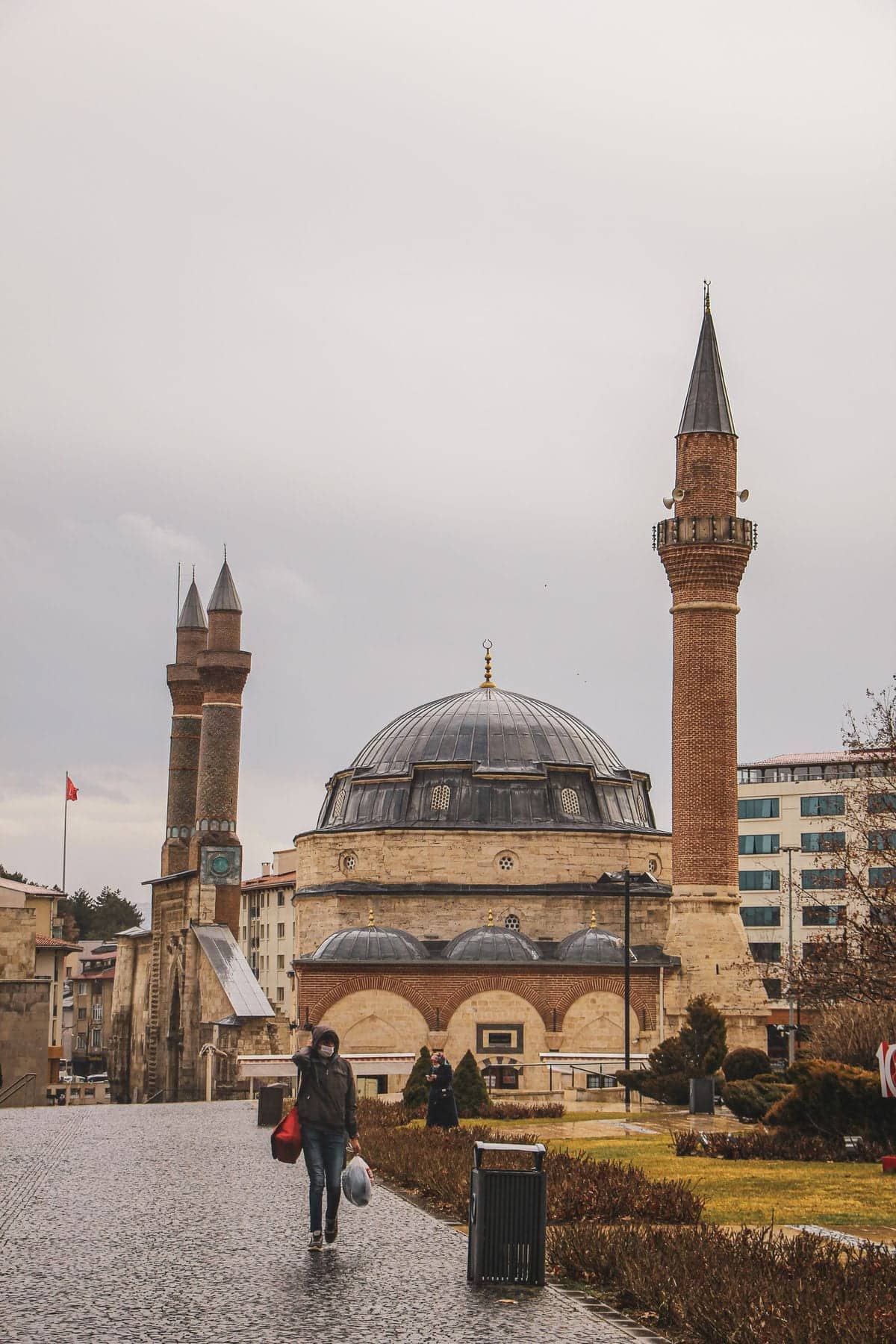
Çifte Minareli Medrese (1271–1272 CE): The Double Minaret Seminary is the defining image of Sivas — the twin minarets with their blue tile banding rise above the city centre and are visible from most of the main streets. Built during the reign of Seljuk vizier Sahib Ata Fahreddin Ali, the portal is decorated with an extraordinarily intricate stone relief programme. The inner courtyard, though roofless, gives a sense of the building’s original scale and organisation. Entry: free (or nominal fee; verify locally).
Gök Medrese (1271–1272 CE): Built in the same period as the Çifte Minareli Medrese by the same patron (Sahib Ata), the Gök Medrese (Blue Seminary) is slightly smaller but has a portal considered by some scholars to be even more technically accomplished — the stone relief carving on the main entrance is of exceptional quality. The building has been used variously as a museum and cultural centre. Entry: nominal fee (verify locally).
Şifaiye Medresesi (1217 CE): The earliest of the three — a Seljuk hospital and medical school built by Sultan Izzeddin Keykavus I. The building includes the sultan’s own türbe (mausoleum) within the complex, making it both a medical institution and a royal funerary monument. One of the best-preserved early Seljuk building complexes in Turkey. Currently operates as part of the Sivas Museum. Entry: approximately ₺50 (verify locally).
Buruciye Medresesi (1271–1272 CE): A fourth significant Seljuk building in the centre — now used as a covered market. The structure is intact and the courtyard is accessible; the commercial use creates an unusual lived-in atmosphere for a 13th-century monument.
Divriği — the UNESCO priority
The Great Mosque and Hospital of Divriği (Divriği Ulu Camii ve Darüşşifası) is a UNESCO World Heritage Site (inscribed 1985) and one of the most significant buildings in Turkey. Built between 1228 and 1229 CE by the Mengujekid ruler Ahmed Shah and his wife Turan Melik, the complex has three portals with carved stone decoration of extraordinary complexity and depth — three-dimensional floral, geometric, and figurative reliefs that push the technical limits of what carved stone can achieve.
Why it matters: Most Islamic architecture of the period uses two-dimensional relief and geometric pattern. The Divriği portals are three-dimensional to a degree rarely seen — undercutting so deep that the forms become sculptural rather than decorative. Architectural historians consider them unique in Islamic art. UNESCO’s description calls the stone carving “one of the highest achievements of Islamic architecture.”
Practical visit:
- Distance: 113km west of Sivas
- Bus from Sivas Otogar: approximately 2 hours (₺80–120 each way; check timetables — services may be limited to 2–3 per day)
- Taxi return trip with waiting time: approximately ₺600–800 — the more flexible option
- Time at site: 1–2 hours
- Entry: approximately ₺50–100 (verify locally)
- The mosque is still actively used for prayer; visits are possible outside prayer times
The Divriği site is not accessible by public transport at a time-efficient pace without either an early bus or a taxi. For most visitors, a taxi from Sivas is the practical solution.
The 1919 Sivas Congress
The September 1919 Sivas Congress was the decisive event of the Turkish War of Independence — the meeting, chaired by Mustafa Kemal Atatürk, that transformed resistance to the post-World War I occupation from regional movements into a unified national organisation.
Sivas Congress Museum (Kongre Müzesi): The building where the congress met is preserved as a museum — the original congress hall is intact, with delegates’ seating and period documentation. The museum provides the essential narrative of how the Turkish Republic emerged from the collapse of the Ottoman Empire. Entry approximately ₺50 (verify locally). For Turkish visitors, this is a significant pilgrimage site; for international visitors, it provides essential context for understanding the Republic.
Atatürk Congress and Ethnography Museum: An adjacent building with the rooms where Atatürk stayed during the congress, preserved as they were in 1919, alongside ethnographic collections from the Sivas region. Entry approximately ₺50 (combined tickets available).
Food and daily life
Sivas cuisine: Central Anatolian food culture — wheat-based dishes, slow-cooked lamb, and the dairy products of the high plateau. Key dishes:
Tarhana çorbası: Dried fermented wheat and vegetable soup, reconstituted and cooked — the defining winter dish of central Anatolia. Available in traditional lokantas throughout the city.
Sivas kebabı: A local variant of the regional kebab tradition — lamb pieces marinated with onion and spices, cooked in a clay pot (güveç). Less charcoal-smoky than coastal varieties; more braised than grilled in character.
Esnaf lokantaları: The working-lunch restaurants near the bazaar and city centre serve the most authentic food at genuine prices — ₺80–150 for a full lunch with soup, main, and bread.
Tea house culture: Sivas has a strong çay ocağı culture — traditional tea houses around the historic monuments and market streets, frequented by locals. An international traveller sitting with a tea and taking in the streetscape from one of these is doing the most honest version of the Sivas visit.
Practical information
Getting around: The city centre is compact — the three main Seljuk medreses, the Congress Museum, and the bazaar are within 1km of each other. The Sivas YHT station is in the city centre (unusual — most high-speed rail stations are built on the outskirts). Airport (VAS) is 25km from the city; taxi approximately ₺200–300.
High-speed rail: Sivas is the eastern terminus of the Ankara–Sivas YHT. Trains to Ankara run multiple times daily (approximately 2 hours 15 minutes, ₺150–400 depending on class and advance booking). This makes Sivas genuinely accessible as an addition to an Ankara or Istanbul itinerary.
Altitude: At 1,285m, Sivas is noticeably cooler than the Turkish coast. Summers are mild (25–30°C); winters are cold (regularly below 0°C from December to February, with snow likely). The high-altitude plateau character is part of the city’s identity — the light, the air quality, and the landscape are different from both coastal Turkey and the Istanbul basin.
Best season: Spring (May–June) and early autumn (September–October) are the most comfortable. Summer evenings are pleasant even if midday is warm. Winter is functional but cold.
Where to stay
The city centre, near the Kale (castle) area and the main medreses, is the most practical base — walking distance to all the main sights and the YHT station.
Where to stay in Sivas — hotel picks for every budget
Budget: 2–3 star central hotels from approximately ₺450–800/night. Mid-range: 4-star business hotels from approximately ₺900–2,000/night. Upscale: 5-star spa hotels from approximately ₺2,000–4,000+/night.
For central Anatolia context, see the Ankara travel guide for the high-speed rail connection, and Kayseri travel guide for the parallel Seljuk architecture tradition further south.
Book an experience
Top experiences in Sivas
Explore the best tours and activities in Sivas, with instant confirmation and free cancellation on most bookings.