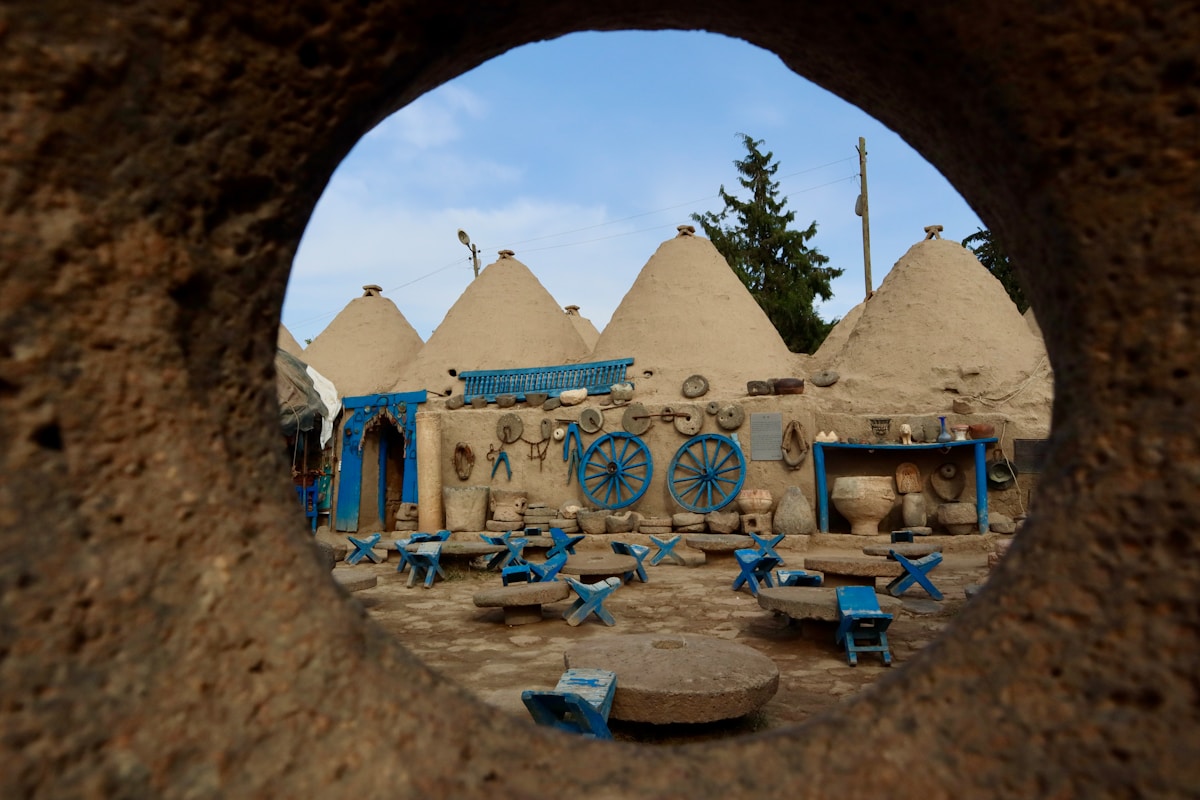
Harran is one of those places that has been continuously inhabited for so long that the concept of “ancient” barely covers it. The site has been settled since at least the third millennium BCE, making it one of the oldest permanently occupied cities in the world. It sits 50km south of Şanlıurfa on a flat, parched plain that ends at the Syrian border — an exposed, timeless location that immediately distinguishes it from anything you will see elsewhere in Turkey.
The Beehive Houses
The architectural signature of Harran is its conical mud-brick houses, known locally as kümbet evleri — beehive houses. Their distinctive conical roofs are built without timber supports: the corbelled brickwork spirals inward as it rises until the courses meet at the top, forming a stable dome without internal framework. The design is brilliantly adapted to the climate: the thick mud walls absorb heat through the day and release it slowly at night, keeping interiors several degrees cooler than the outside air during Şanlıurfa’s brutal summers.
Some archaeological scholarship argues that beehive construction here dates back thousands of years, though the buildings you see today are largely from the 19th and early 20th centuries — the technique has been continuously passed down and the houses rebuilt as needed. The last families living in traditional beehive dwellings moved out in the later 20th century; most structures visible to visitors today are either partially reconstructed or maintained as cultural heritage sites.
The Harran Culture House (Kültür Evi) is the most organised entry point. A local guide walks you through a traditional dwelling, explaining the construction method, the cooling properties of the design, and how a family would have distributed different activities (sleeping, cooking, storage) across the connected cluster of domes. Photography is welcomed throughout and the experience is more personal than a standard museum visit.
Harran Castle
At the southeastern corner of the ancient walled city, a substantial fortified mound rises above the plain. This is the Harran Kalesi — a castle with layers of occupation spanning Fatimid (10th–11th century), Ayyubid, Seljuk and later periods. The association with Crusader forces is indirect rather than structural: Harran was a staging point and contested territory during the Crusader era rather than a Crusader fortress per se, though the castle walls absorbed the attention of multiple medieval powers.
Climbing to the top is worth the effort despite the rough surface. The views across the Harran plain are extraordinary — a vast, pancake-flat expanse extending south toward the Syrian border, broken only by the occasional tell (an archaeological mound) rising from the earth. On clear days you can see for 30 to 40 kilometres in multiple directions. The scale makes the ancient trade routes that ran through here — connecting Mesopotamia to Anatolia, caravans carrying grain, wool and luxury goods — feel tangible.
The walls are unrestored and require careful footing. Wear shoes with grip; do not visit in wet weather.
The Abraham Connection
Harran’s place in the Abrahamic scriptures is significant. In the Book of Genesis, Harran (written as Haran) appears as the city where Terah, father of Abraham, settled after leaving Ur of the Chaldees, and where he died. Abraham subsequently departed from Harran toward Canaan — making the city a key waypoint in one of the foundational narratives of Judaism, Christianity and Islam.
Scholars debate the exact historical basis of the biblical account, but the geography is consistent with the ancient trade network: Harran was a major junction on the Mesopotamian route north and west, and a city of genuine significance during the second millennium BCE. The Sabian Harranians — a non-Abrahamic religious community that survived into the medieval period — kept Harran as a centre of astronomical and philosophical learning, continuing a tradition of moon-god worship (the city was an important cult centre for Sin, the Assyrian moon deity) that predates the biblical period.
The convergence of all these threads in one small, still-inhabited settlement in southeastern Turkey gives Harran an atmospheric density that rewards slow exploration.
The Ruins of Ulu Cami
At the heart of the archaeological zone stand the remains of the Ulu Cami (Great Mosque), one of the oldest mosques built in Anatolia. It was constructed in the 8th century by the Umayyad Caliph Marwan II, who briefly established Harran as his capital. The mosque is now ruined — only portions of the walls, the base of a distinctive cylindrical minaret, and some arched passageways survive — but the scale is impressive and the stonework still legible. The cylindrical minaret form, unusual for Anatolian mosques, reflects the Umayyad architectural tradition of the Levant and Egypt.
Entry to the mosque ruins is free and the site is unwalled.
What Else to See
The ancient university site: Harran was home to what some historians describe as the first Islamic university, established in the 9th century CE under the Abbasid caliphate. Scholars working here translated Greek philosophical and scientific texts into Arabic — a crucial link in the chain that preserved classical knowledge through the medieval period. The physical remains of the university buildings are fragmentary and not formally presented, but the site is marked and visible adjacent to the castle mound.
The city walls: Harran’s ancient fortification circuit can be partly traced around the outer edge of the settlement. Sections of the mudbrick walls survive at varying heights, along with several of the original gates, including the Aleppo Gate on the south side.
The Harran plain tells: The flat landscape around Harran is dotted with archaeological mounds — tepes or tells — marking buried settlements that predate the visible city. These are not visitor sites but add to the atmosphere of a landscape that has been continuously worked and settled for millennia.
Getting There
By taxi from Şanlıurfa: The most practical option. Allow approximately 45 minutes each way on the D895 road south from the city. Negotiate a total round-trip fare with waiting time — approximately ₺400–700 for 2–3 hours at the site. A combined Harran and Göbekli Tepe day trip with a private driver costs approximately ₺800–1,200 for the full day, split between 2–4 people.
By guided tour: Combined Harran + Göbekli Tepe day trips are offered by most Şanlıurfa tour agencies. This is a good value option and provides English-language context for both sites. Browse tours in Şanlıurfa for current options with free cancellation.
By minibus: Services from Şanlıurfa otogar toward Harran run approximately every 1–2 hours during daylight (approximately ₺20–30). Services drop you at the main road, a short walk from the beehive house cluster. Return services can be unreliable in the afternoon — a taxi back is worth having as a fallback plan.
Practical Information
Entry fees: The ancient ruins and castle are freely accessible. The privately operated beehive house compound charges approximately ₺100 per person as of 2026; the Culture House accepts tips (₺50–100). Confirm fees at the entrance — they vary between operators and are not standardised.
Opening hours: The outdoor sites are accessible during daylight hours year-round. The Harran Culture House typically operates from approximately 08:00 to 18:00 in summer, shorter in winter.
Time required: 1.5–2.5 hours for a thorough visit. Plan for 45 minutes at the beehive houses, 30 minutes at the castle, and 20–30 minutes at the mosque ruins.
Season: Autumn (September–October) and spring (April–May) are the best times to visit. Summers on the Harran plain are extreme — 40°C+ is common in July and August, with very little shade. The flat terrain offers no natural shelter. Go early in the morning or in the late afternoon if visiting in summer.
What to bring: Hat, sunscreen, plenty of water. There are a couple of small tea houses and souvenir stalls near the beehive house area, but no substantial restaurants or large shops.
Combining Harran with Other Şanlıurfa Sites
Harran pairs naturally with a full-day Şanlıurfa itinerary. The two obvious combinations:
Harran + Göbekli Tepe: A long but rewarding day. Head to Göbekli Tepe first (northeast of the city, open from 8am) for the cooler morning hours, then drive to Harran in the afternoon. The contrast between the two sites — one a ritual hilltop complex, the other a lived agricultural city — is one of the most thought-provoking archaeological juxtapositions in the region.
Harran + Şanlıurfa city: A half-day at Harran combined with the Şanlıurfa Archaeological Museum and the Balıklıgöl fish pools in the city is manageable in a single day without a car.
- Göbekli Tepe — 12,000-year-old Neolithic ritual site, 15km northeast of Şanlıurfa
- Karahantepe — active Neolithic excavation site with carved human-face pillars, 46km southeast
- Şanlıurfa city hub — Balıklıgöl, the bazaar, and the Archaeological Museum
Search hotels in Sanliurfa on Booking.com
An eSIM for Turkey is useful for navigation on the roads south toward the Syrian border region. Travel insurance covers the unexpected on remote-site day trips.