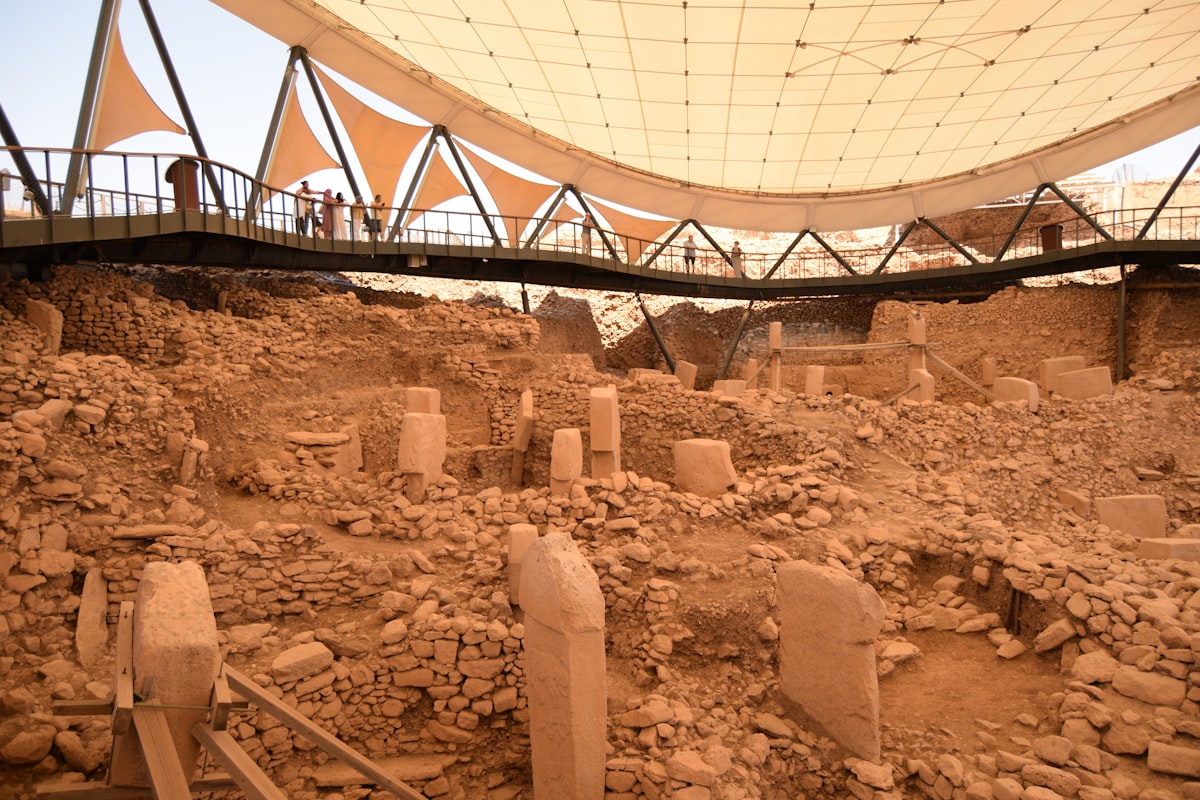
Göbekli Tepe is, without exaggeration, one of the most significant archaeological sites ever discovered. Built approximately 12,000 years ago - around 10,000 BCE - it predates Stonehenge by at least 6,000 years and the pyramids at Giza by more than 7,000. When German archaeologist Klaus Schmidt began excavations here in 1994 on a hilltop the local farmers had called “potbelly hill,” the accepted view was that organised, monumental construction required settled agricultural communities. Göbekli Tepe demolished that theory: the people who built it were hunter-gatherers.
The site received UNESCO World Heritage status in 2018. It sits on a ridge 15km northeast of Şanlıurfa at an elevation of 760 metres, with panoramic views across the Harran plain toward the Syrian border.
What Göbekli Tepe Is
The site consists of multiple circular and oval enclosures, each defined by T-shaped limestone pillars set into the bedrock and arranged in concentric rings. The largest pillars - the two central ones in each enclosure - reach up to 5.5 metres tall and weigh as much as 20 tonnes. They were quarried from the limestone plateau approximately 500 metres from the hill using flint tools.
The T-shape is deliberate: the top of the T represents a head, the vertical shaft a body. Many pillars are carved with low-relief animal imagery - foxes, vultures, scorpions, cranes, aurochs, lions, snakes and abstract symbols. Some pillars have stylised arms carved along their sides. The figures are not random - there are recurring patterns across different enclosures that suggest a coherent symbolic vocabulary.
Most importantly: the enclosures were not dwellings. There are no hearths, no rubbish pits, no domestic debris. Current interpretation holds that Göbekli Tepe was a ritual or ceremonial centre, probably used for communal gatherings by hunter-gatherer groups from across a wide region. The site may have played a role in the emergence of agriculture in this part of the Fertile Crescent - rather than settlement leading to monument-building, the monument-building may have driven people to settle nearby.
Approximately 5% of the site has been excavated. Ground-penetrating radar surveys have identified at least 16 additional enclosures still buried underground.
The Excavated Enclosures
Enclosures A–D were excavated first and are the most developed in terms of infrastructure. These are now covered by a large protective roof structure - the shade is welcome in summer but reduces the visual drama somewhat. Enclosure D is the largest and contains the most elaborately carved pillars, including a vulture relief on one of the central stones that has generated significant academic debate about its possible astronomical meaning.
Enclosures H and L (and others in the northwest cluster) are more recently excavated and partially open to the sky. The newer excavation zones show variations in pillar style and enclosure shape that suggest the site evolved over centuries.
The quarry is visible on the ridge nearby: a partially detached T-shaped pillar, still connected to the bedrock, gives a vivid sense of the logistical challenge involved in construction. It would have been the largest pillar on site had it been extracted.
The On-Site Museum
The small museum at the entrance is worth 20–30 minutes before you walk the site. Panels explain the chronology, the excavation history, and current interpretations of the pillar symbolism. Several original pillar fragments and carved stones are displayed here - including a carved boar and a carved stone ball whose purpose is unknown. The museum provides context that makes the outdoor site significantly more legible.
The original large T-shaped pillars removed during early excavations are now in the Şanlıurfa Archaeological Museum in the city centre, along with the remarkable Urfa Man statue - a 1.8-metre basalt figure dating to approximately 9,000 BCE. If you’re visiting Göbekli Tepe, the Şanlıurfa museum is a mandatory complement.
Getting There
By taxi: The most straightforward option from Şanlıurfa. Agree on a total return fare with waiting time before departing - approximately ₺400–600 for 2–3 hours at the site. Most drivers near the hotel district are accustomed to this arrangement.
By guided tour: Several agencies in Şanlıurfa offer half-day tours combining Göbekli Tepe with a brief stop at the Şanlıurfa Museum or Harran. Prices start from around ₺400–600 per person including transport and a guide. Worth considering for first-time visitors who want English-language interpretation.
By dolmuş: Shared minibuses run from Şanlıurfa’s otogar toward the village of Örencik (approximately ₺15–20). From Örencik you can take another local vehicle or walk the remaining few kilometres to the site - this is feasible but adds significant time.
By rental car: If you have a rental car in Turkey, the drive is simple. Head northeast on the D400 road and follow signs for Göbekli Tepe from the outskirts of the city.
Visitor Tips
Arrive early. In summer months (June–September), the site is exposed and extremely hot. The main enclosures have roof cover, but walking between areas and queuing at the ticket office is in full sun. Aim to arrive at opening time (8am) - you’ll have 1–2 hours of comfortable conditions before the heat and the tour buses both arrive.
Wear a hat and carry water. There is a small café and shop at the entrance, but bottled water prices are elevated and the café has limited shade seating.
Download the free audio guide before you visit - the Göbekli Tepe Archaeological Park has an official audio guide app (search “Göbekli Tepe” in your app store) that provides commentary on each enclosure. Mobile signal at the site is variable.
Photography is permitted throughout the outdoor areas and in the museum. No tripods in the covered enclosures. Drone flight requires a permit obtained in advance from the relevant Turkish authority - spontaneous drone flying is not permitted.
Budget 2–3 hours minimum. The site rewards slow looking. The carved reliefs are subtle - a raptor on one pillar, a snake spiralling down another - and easy to miss if you rush.
Why the UNESCO Listing Matters
Göbekli Tepe’s 2018 inscription on the UNESCO World Heritage List secured it against the kind of uncontrolled development that has damaged other significant sites in Turkey. The German Archaeological Institute (DAI) and Turkish authorities jointly manage the site under a long-term excavation and conservation plan. The protective roof structures over the main enclosures - divisive aesthetically - are the direct result of UNESCO-standard conservation requirements.
The listing also helped fund the visitor infrastructure: the access road, the car park, the museum building and the protective canopies. Before excavations began in earnest, local farmers were removing the limestone pieces as building material.
Combining Göbekli Tepe with Other Sites
Karahantepe (46km southeast of Şanlıurfa): a recently excavated sister site dating to roughly the same period. Unlike Göbekli Tepe, Karahantepe’s pillars include carved realistic human faces — a discovery that reframes the symbolic vocabulary of the whole Taş Tepeler network. Entry approximately ₺200 as of 2026; best reached with a private driver or guided tour.
Harran (50km south): the ancient city of mud-brick beehive houses, Crusader-era castle walls, and deep biblical connections as the city where Abraham’s father Terah settled. Easily combined with Göbekli Tepe as a full-day trip.
Şanlıurfa city centre (15km): Balıklıgöl sacred fish pools, the bazaar, and the Archaeological Museum. All are within walking distance of each other and take a full half-day. See our Şanlıurfa travel guide for the full city overview.
Search hotels in Sanliurfa on Booking.com
For your visit: Browse tours and activities in Şanlıurfa for guided experiences in Şanlıurfa - walking tours, day trips, and activity bookings are available with free cancellation. An eSIM for Turkey keeps you connected without airport SIM queues, and travel insurance covers medical costs and cancellations.