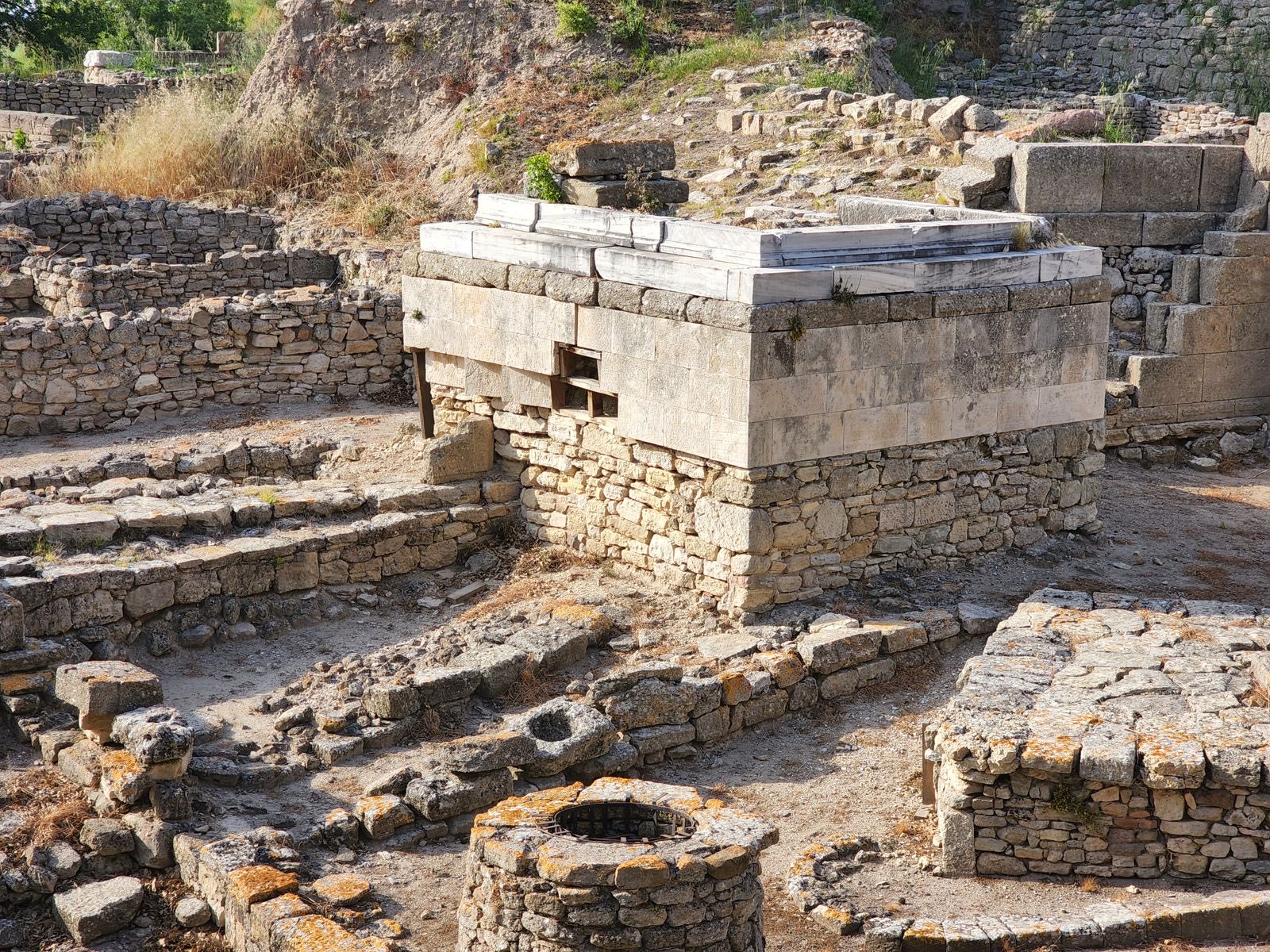
Troy is the best known archaeological site on the Aegean coast of Türkiye and one of the least obvious on first sight: low stone walls, ramps and foundations on a windy ridge, rather than standing temples. What makes it worth the trip is the layering. Nine main settlements were built on top of each other over some 4,000 years, and the new Troy Museum next door is the key to reading them. This page covers what to see, tickets, hours and how to get there. For the wider Çanakkale area, see our Çanakkale things to do guide.
Quick facts
| Location | Tevfikiye, Çanakkale Province, about 30 km south of Çanakkale |
| Status | UNESCO World Heritage Site since 1998 |
| Site entry (foreign adult) | About 27 euros reported for 2026 |
| Troy Museum | About 14 euros reported; combined ticket about 38 euros |
| Hours | Roughly 08:30 to 20:00 from 1 May to 1 October, 08:30 to 17:30 otherwise |
| Time needed | 3 to 4 hours including the museum |
These figures come from unofficial 2026 listings, which disagree with each other and with older guides, and the ministry does not publish a clear foreigner price. Treat them as a planning range and confirm at the ticket office. For official museum information, start at the Ministry’s muze.gov.tr and the UNESCO listing for Troy.
What Troy actually is
Troy sits on a hill overlooking what was once a bay at the entrance to the Dardanelles, a position that controlled trade between the Aegean and the Black Sea. Archaeologists label the layers Troy I to Troy IX, running from the early Bronze Age (around 3000 BC) to the Byzantine period. The Homeric story of the Trojan War is generally linked to the late Bronze Age levels, usually Troy VI or VIIa, though whether the war happened as told is unproven and scholars still argue about it.
The site was identified as Troy by the British diplomat Frank Calvert, who owned part of the mound, and excavated from 1871 by Heinrich Schliemann, whose rough trenching damaged much of what he sought. Modern excavation has continued for decades under the Çanakkale Onsekiz Mart University and international teams.
What to see at the site
A marked circuit of about 1 km takes in the main sights. Expect to spend 90 minutes to two hours.
- Fortification walls: The thick limestone walls of Troy VI, with a sloping base and a ramp, are the most impressive original remains.
- Ramp and gate: The paved ramp from Troy II and the tower gate show how the citadel was approached.
- Houses of Troy VI: Foundations of the large houses inside the walls, with limited reconstruction.
- Sanctuary and Odeon: Roman-era remains of the Athena sanctuary, a small council hall (bouleuterion) and an odeon, from when the city was called Ilion.
- The wooden horse: A multi-storey wooden replica stands near the entrance. It is a photo stop, and visitors can climb inside.
- The trench section: A cutaway through the mound that shows the stacked layers, best seen with the museum’s maps in mind.
Information boards are in Turkish and English. Shade is scarce, so bring water and a hat from late spring.
The Troy Museum
The Troy Museum (Troya Müzesi) opened in 2018 close to the site entrance and won a Council of Europe Museum Prize in 2020. Its dark, stepped building is designed to echo the excavation layers. Displays follow Troy I to IX with pottery, jewellery, tools, Roman sculpture and models of the citadel. Allow 90 minutes. Visit the museum first, then walk the ruins, and the stones make more sense. The museum has a cafe and a shop.
How to get there
From Çanakkale. The simplest base. A minibus (dolmuş) to Tevfikiye leaves from the Çanakkale bus terminal area and takes about 40 minutes, running less often in winter. A taxi costs more but can wait; agree the waiting time and the fare before leaving. Çanakkale also has a wider choice of hotels, restaurants and the ferry to Eceabat for Gallipoli. See Çanakkale for neighbourhoods and places to stay.
From Istanbul. There are three options. Day tours run daily in season, usually combining Troy with the Gallipoli peninsula or Çanakkale town and lasting 12 to 14 hours. By bus, services from Istanbul to Çanakkale take about 5.5 to 6 hours, including a ferry or the 1915 Çanakkale Bridge, followed by a dolmuş or taxi to the site. By car, allow a similar time and read our renting a car in Turkey guide first. If you can spare a night, stay in Çanakkale and spend one day on Gallipoli and another on Troy.
With a guide. Troy’s stones are low and an expert adds a lot. Browse Çanakkale and Troy tours for guided half and full days, including combined routes with Gallipoli and Assos.
Best time to visit
April, May and October give mild weather and thinner crowds. July and August are hot with little shade, and cruise and tour groups arrive in the late morning. Arrive when the site opens, or after about 15:00 in summer, when light is also better for photographs. In winter, hours are shorter and the ground can be muddy.
Practical tips
- Combine with Gallipoli: The two sites are about 45 minutes apart by road and cover very different history. Most visitors give each a full day.
- Order: Do the museum first. The site itself is exposed, so keep it for the cooler part of the day.
- Accessibility: The circuit has ramps and walkways but some uneven stone and slopes. The museum is accessible.
- Photography: Allowed at the site and in most museum galleries. Check signs for restricted cases and drones, which are not allowed.
- Food: A cafe operates near the museum entrance. For a proper meal, return to Çanakkale.
Tickets and tours
Tickets and day trips that include entry can be reserved ahead through Tiqets Turkey, which is useful in summer if you want to fix a date and avoid the queue.