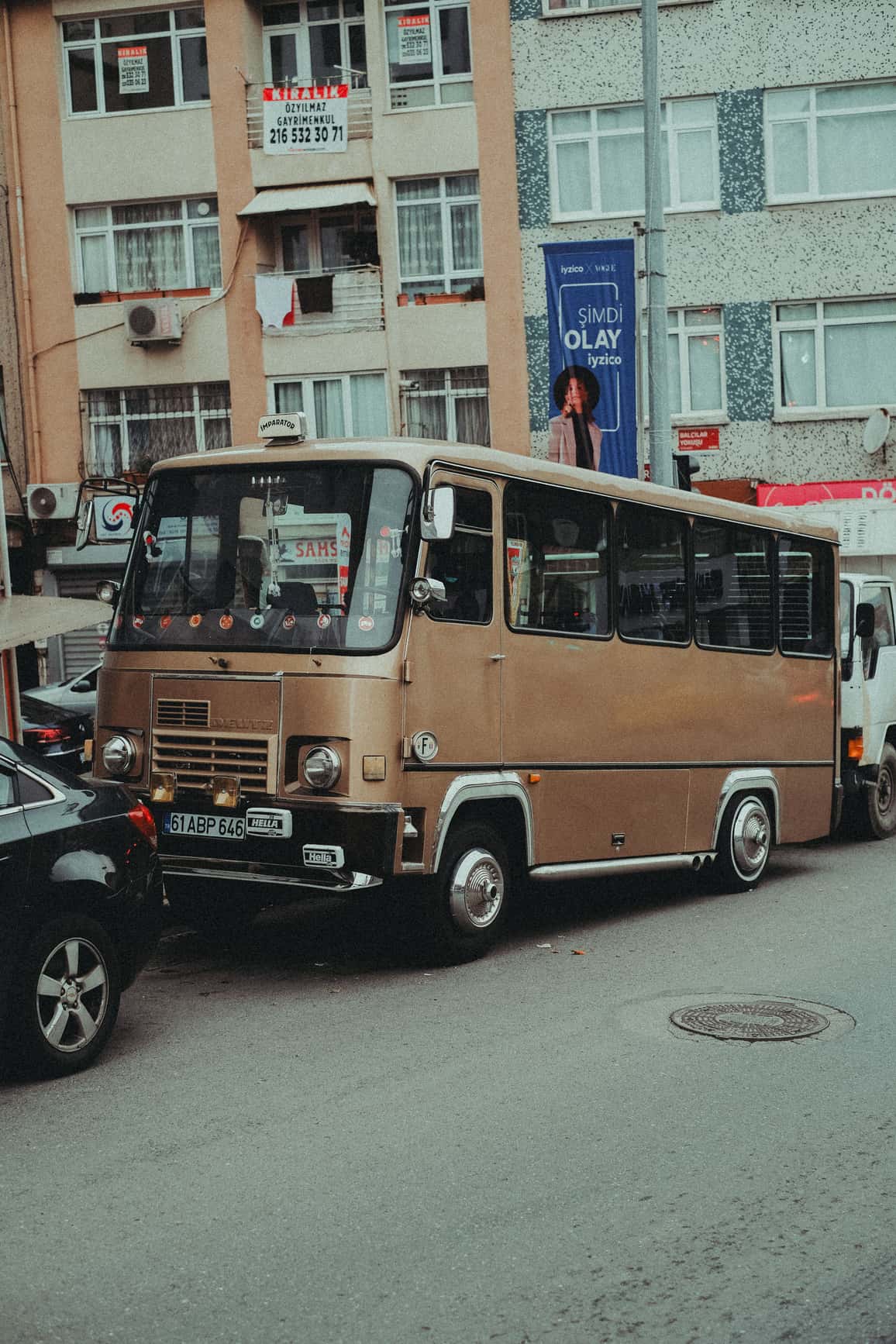
The dolmuş (pronounced dol-MOOSH, meaning “stuffed” in Turkish) is the backbone of local transport across Türkiye. It costs a fraction of a taxi, runs far more frequently than buses on many routes, and drops passengers off at any point along the route - not just at fixed stops. Once you understand how they work, you’ll wonder why you ever took a taxi.
What Is a Dolmuş?
A dolmuş is a shared minibus that runs a fixed route but picks up and drops off passengers anywhere along that route. Drivers wait at the start point until the vehicle is reasonably full, then depart - hence the name “stuffed.” In practice, on busy urban routes, they run almost continuously and rarely make you wait more than a few minutes.
Traditional dolmuş vehicles are vintage American-style cars or minibuses, though modern vans have replaced them in most cities. In rural areas and smaller towns, the dolmuş is often the only public transport option between settlements.
Istanbul: A Different System
Istanbul’s dolmuş operates differently from the rest of Türkiye and is worth understanding separately.
In Istanbul, yellow shared taxis called taksi dolmuş operate on fixed routes between major hubs. You’ll spot them at designated stands - commonly at Taksim, Beşiktaş, Kadıköy, and Üsküdar. The route and destination are displayed on a sign in the windscreen. You board, state where you want to get off, and pay the driver or assistant.
Istanbul fares are approximately 20–50 TRY per trip as of 2026, depending on the route length - though fares update frequently given Turkey’s inflation rate, so check the posted tariff on boarding. The taksi dolmuş doesn’t accept Istanbulkart (the transit card used on buses and the metro), so carry cash.
For most tourism-heavy routes in Istanbul, the ferry, metro, or tram will serve you better. Dolmuş in Istanbul are most useful for cross-neighbourhood journeys not served by rail - Taksim to Beşiktaş, or Kadıköy to Bostancı on the Asian side.
Outside Istanbul: The Dolmuş in Action
Across the rest of Türkiye - from Antalya to Trabzon, Cappadocia to Bodrum - the dolmuş is the workhorse of daily transport. Routes connect town centres to beach areas, villages to district hubs, and neighbourhoods within cities.
Fares outside Istanbul typically run 10–30 TRY for short urban hops (as of 2026), and up to 60–80 TRY for longer intercity or resort-to-town runs. Prices are fixed per route, not metered. Cash only.
In coastal resort towns like Bodrum, Marmaris, and Alanya, dolmuş run along the main seafront road and between the centre and beach areas on a near-continuous loop during summer. The route is usually painted on the side of the van or displayed in the window.
How to Hail a Dolmuş
- Find the route. Look for clusters of vans with signs in the windscreen, or ask a local “dolmuş nerede?” (where’s the dolmuş?). At major stands, different routes depart from different bays.
- Flag it down. On the road, raise your hand. The driver will stop if there’s space.
- Board and state your destination. Say the neighbourhood or landmark: “Merkeze” (to the centre), “Sahile” (to the beach), “Otogar” (bus station). The driver or a helper collects payment.
- Pass money forward. On fuller vans, hand your money to the person in front of you - it gets passed to the driver. Change comes back the same way. It works.
- Ask to get off. When you’re near your stop, say “İnecek var” (someone’s getting off) or simply “Burada” (here). The driver will pull over.
Paying the Fare
Always carry small notes and coins - 50 TRY and under is ideal. Drivers don’t appreciate breaking large notes, and some will tell you to board and sort it out at the destination. Payment is per person; if you’re in a group, state your number as you board.
There’s no app, no ticket machine, no Istanbulkart. Cash is the only accepted payment on virtually every dolmuş in the country.
Practical Tips
- No fixed timetable. Dolmuş depart when full or near-full, particularly in rural areas. On popular urban routes, frequency makes timetables unnecessary.
- Women can request to sit next to other women. On longer intercity routes, this is common practice and drivers accommodate it.
- Luggage. Backpacks and day bags are fine. Large suitcases work if there’s a boot/trunk space - best avoided on busy urban runs.
- Language. Outside tourist areas, drivers speak little English. Having your destination written down in Turkish is useful. A local eSIM for Turkey with data means you can use Google Maps to confirm routes and translate on the go.
- Intercity dolmuş. On routes between towns (e.g. Göreme to Avanos in Cappadocia, or Fethiye to Ölüdeniz), these operate more like a minibus shuttle. Depart from the main otogar (bus station) or a designated town square stand. For routes with infrequent dolmuş or heavy luggage, car hire gives you the flexibility the dolmuş lacks.
Dolmuş vs. Bus vs. Taxi
| Dolmuş | City Bus | Taxi | |
|---|---|---|---|
| Cost | Low | Very low | High |
| Frequency | High on key routes | Varies | On demand |
| Flexibility | Drop anywhere on route | Fixed stops | Door to door |
| Cash needed | Yes | No (Istanbulkart) | Yes |
The dolmuş sits between bus and taxi: more flexible than a bus, far cheaper than a taxi. For beach trips, neighbourhood hops, and short intercity runs, it’s the smartest choice. If you’re arriving at a major airport with lots of luggage, an airport transfer is the easier first leg - switch to dolmuş once you’re settled.
Where to Find Dolmuş Stands
At most town centres, the dolmuş stand is near the main square (meydan) or the central market. Ask at your hotel or guesthouse - staff will know the nearest stand and which route serves your destination. In resort towns, the seafront road is usually the main dolmuş corridor.
Once you’ve used a dolmuş once, you’ll be reaching for it instinctively. It’s how most of Türkiye actually gets around. Round out your transport planning with travel insurance - dolmuş rides are low-risk, but it’s good to have cover for the rest of your trip.
Plan Your Trip
✈️ Book your flights to Türkiye 🛡️ Get travel insurance 📱 Stay connected with an eSIM 🚗 Rent a car