Eastern Turkey’s activity map is unlike anywhere else in the country. The sites are physically large, historically layered, and separated by long drives across high plateau. What follows is the practical breakdown for each major experience - how to get there, what to pay, what to see, and how much time to allocate.
Exploring Ani ruins (43 km from Kars)
Ani is the site that makes the long journey to eastern Turkey worth it. The ruined medieval capital of the Bagratid Armenian kingdom sits on a dramatic plateau above the Arpaçay gorge, with the Armenian border running along the river below. What survives includes some of the finest medieval architecture in Asia Minor.
Key monuments:
- Cathedral of Ani (1001 AD): Built by the architect Trdat (who also repaired the Hagia Sophia dome), the cathedral is roofless but the walls stand nearly intact. The blind arcading on the exterior and the proportions of the nave demonstrate the technical ambition of the Bagratid court. Allow 30–40 minutes here alone.
- Menüçehr Mosque (1072 AD): Built immediately after the Seljuk conquest of Ani, this is claimed to be the oldest mosque in Anatolia. The minaret base is well-preserved.
- Church of St Gregory of the Abughamrents: Contains fragments of frescoes - faint but readable - depicting biblical scenes. One of Ani’s most intimate monuments.
- City walls and Kars Gate: The main entry gate to the medieval city is still an imposing structure; the walls run for kilometres across the plateau.
- Armenian Silk Road bridge: At the gorge edge, a single arch of the medieval bridge survives over the Arpaçay. The view down into the gorge and across to Armenia is one of eastern Turkey’s most affecting sightlines.
Practicalities: Entry approximately ₺300–400 as of 2026, open daily 08:00–19:00 (shorter hours November–March). From Kars: by taxi approximately ₺300–500 return including waiting time (negotiate before departure). By dolmuş: occasional departures from Kars otogar - ask locally as frequency varies by season. Allow 3–4 hours minimum on site.
Akdamar Island ferry and Church of the Holy Cross
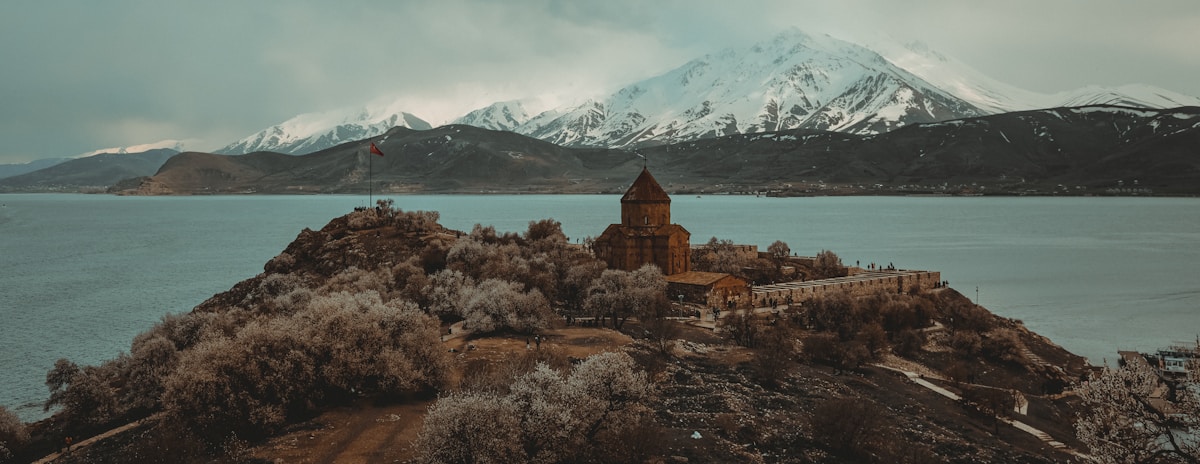
The Church of the Holy Cross on Akdamar Island (Akdamar Kilisesi) is a 10th-century Armenian church on a small rocky island in Lake Van, backed by the snow-streaked peaks of the Artos massif. The exterior bas-relief carvings - Old Testament scenes, hunting friezes, peacocks and lions - are extraordinarily detailed for a church built in 915–921 AD.
Getting there: Drive or take a dolmuş from Van towards Tatvan (ask for Akdamar iskele, near Gevaş village, approximately 40 km from Van city). The ferry takes 20–30 minutes. Combined ferry + island entry approximately ₺150–200 per person as of 2026. Departures roughly every 2 hours in summer (first around 09:00); frequency drops in shoulder season - arrive early to avoid waiting.
On the island: The church’s interior was restored and reopened as a place of worship in 2010. Beyond the church, the island has a small café and walking paths through the rocky shoreline. The views of Lake Van from the island are the best available - the alkaline water is a distinctive turquoise-blue at this angle. Allow 1–2 hours on the island.
Combined day from Van: Van city → Akdamar Island → Van Kalesi (Van castle, free entry) → Van breakfast. A reasonable day’s programme with a car (you can rent a car in Turkey for the drive); by dolmuş allow 4–5 hours for the island round-trip alone.
Ishak Pasha Palace, Doğubayazıt
Ishak Pasha Palace (İshak Paşa Sarayı) is an 18th-century Ottoman palace perched on a rocky spur 1,900 m above sea level, 5 km from Doğubayazıt town. The palace combines Ottoman, Seljuk, Armenian, Georgian and Persian architectural elements - a compressed record of the empires that have passed through this mountain corridor.
What to see: The main gate, mosque with the original intact minaret, harem quarters, reception halls, the mausoleum, and the central courtyard. The golden gates were removed by Russian forces in 1917; the originals are reportedly in the Hermitage Museum in St Petersburg. The replica gates installed during restoration are visible at the main entrance.
Views: The palace’s position above the plain provides panoramic views toward Mount Ararat (Ağrı Dağı) on clear days. The combination of the palace silhouette and the mountain backdrop is one of eastern Turkey’s most photogenic moments - best light in early morning before afternoon cloud builds on the summit.
Practicalities: Entry approximately ₺200–250 as of 2026. Open daily 08:00–19:00 (shorter in winter). From Doğubayazıt town: 5 km uphill, taxi approximately ₺100–150 return. The site is walkable from town if you have energy - about 1 hour uphill on a paved road.
Mount Ararat trekking
Mount Ararat (Ağrı Dağı) at 5,137 m is Turkey’s highest peak and one of the most recognisable mountains in the world. For observational purposes, the view from the plain around Doğubayazıt requires no permit; for climbing, permits are mandatory.
Permit and guide requirement: All trekking on Ararat requires a permit issued through a licensed guiding company - independent climbing is prohibited. The permit process is tied to your guide company; they handle the paperwork. Expect to pay approximately ₺5,000–12,000 per person for a full guided ascent (3–5 days) including permits, as of 2026. Several operators in Doğubayazıt and online (search “Mount Ararat trekking permit” for current licensed operators) manage this.
The route: The standard south-side route from Doğubayazıt climbs to two camps (Camp 1 at approximately 3,200 m; Camp 2 at approximately 4,200 m) before summit day. The upper section involves glacier travel and requires crampons and ice axe. This is not a walk - it is a serious high-altitude climb requiring fitness and some cold-weather experience. Best season: July–August, when the upper glacier is most stable.
Just for the view: If climbing is not the goal, Doğubayazıt on a clear day delivers Ararat views from the plain without any permit. The mountain is visible from 50+ km away; early morning gives the clearest sight of the summit before daily cloud builds.
The Eastern Express experience
The Doğu Ekspresi from Ankara to Kars is a 24-26 hour train journey through some of Turkey’s least-visited terrain - Central Anatolia’s grain plains, the Taurus mountain passes, the high northeastern plateau approaching Kars. It became a social media phenomenon around 2016–17 for winter photography: the train silhouetted in snow, the frost-covered windows, the isolation.
Classes and booking: Couchette (kushetli) compartments (6 berths with bedding) are the target booking; private sleeper (yataklı, 2 berths) books out fastest. Prices approximately ₺600–2,500 depending on class as of 2026. Book via TCDD website (tcdd.gov.tr) or the mobile app - an account is required. Book 2–3 months ahead for autumn–winter departures.
What the journey covers: The train passes through Ankara, Kayseri, Sivas, Erzincan, Erzurum and several smaller stations before reaching Kars. The mountain sections between Erzincan and Erzurum (the Çoruh valley and the climb to the Anatolian plateau) are the scenic highlight; try to be awake for these if you take a daytime departure.
Practical: Bring warm layers (the train traverses temperature zones from Ankara’s mild climate to Kars’s cold plateau), snacks and water (the dining car exists but is inconsistent), and something to read. Delays of 2–4 hours are not uncommon on the return westbound journey.
Cheese tasting and the Kars food culture
Kars sits at 1,750 m on highland pastures that produce some of Turkey’s finest milk. The result: Kars Gravyer (a gruyère-style hard cheese, aged 6 months to 3 years) and Kars Kaşarı (a denser variant of Turkey’s ubiquitous kaşar yellow cheese). Both are made in small quantities by local dairies and sold directly from the peynirciler (cheese shops) along Atatürk Caddesi.
What to buy: Aged Kars Gravyer (approximately ₺200–400/kg as of 2026, depending on aging), Kars Kaşarı (₺80–150/kg), Kars highland honey (sold in the same shops, approximately ₺120–200 per jar). Most shops will vacuum-seal purchases for transport; a well-aged gravyer travels fine for a week or more at ambient temperature.
The Kars breakfast: Less famous than Van’s breakfast but worth seeking. The table-spread tradition - multiple small dishes of cheese, honey, clotted cream, eggs, and warm bread - takes a specific form in Kars with the local gravyer and kaşar as centrepieces. The Katerina Palace hotel restaurant does a competent Kars breakfast; budget approximately ₺100–180 per person.
Lake Van and Van Castle
Van city is the urban base for Lake Van. Beyond Akdamar Island, the area offers:
Van Kalesi (Van Castle): A massive Urartian rock citadel immediately outside Van city, overlooking the lake. The rock was carved and built upon by the Urartian kingdom (9th–7th century BC), later used by Armenians, Arabs, Ottomans and Russians. Free entry; accessible by taxi from the city centre (approximately ₺50–80 one-way) or a 20-minute walk from the old town area.
Van breakfast street: The Van breakfast (Van kahvaltısı) is one of Turkey’s most celebrated regional food traditions - a multi-dish spread including Van otlu peyniri (herb cheese), clotted cream, honey, eggs, tomatoes, and warm bread. The best breakfast restaurants are concentrated around Cumhuriyet Caddesi; budget approximately ₺150–250 per person. Allow 1–2 hours; it is not a quick meal.
Lake swimming: Lake Van’s high alkalinity (pH ~9.8) makes the water buoyant and gives it an unusual silky texture. The water is not drinkable but swimming is popular at designated spots around the lake. Edremit district (10 km south of Van city) has the most accessible swimming facilities.
Planning eastern Turkey
| Activity | Location | Time needed | Approx. cost (2026) |
|---|---|---|---|
| Ani ruins | 43 km from Kars | 3–4 hours | ₺300–400 entry + taxi |
| Akdamar Island | 40 km from Van | Half day | ₺150–200 ferry + entry |
| Ishak Pasha Palace | Doğubayazıt | 2–3 hours | ₺200–250 entry |
| Eastern Express (one-way) | Ankara → Kars | 24–26 hours | ₺600–2,500 |
| Cheese tasting, Kars | Kars centre | 1–2 hours | ₺200–500 shopping |
| Ararat trekking (guided) | Doğubayazıt | 3–5 days | ₺5,000–12,000 |
See the Eastern Turkey hub and History of Eastern Turkey for full context.
Search hotels in Turkey on Booking.com
Booking in advance: Browse tours and activities in eastern Türkiye - guided walks, skip-the-line tickets, and day tours are bookable ahead with free cancellation.