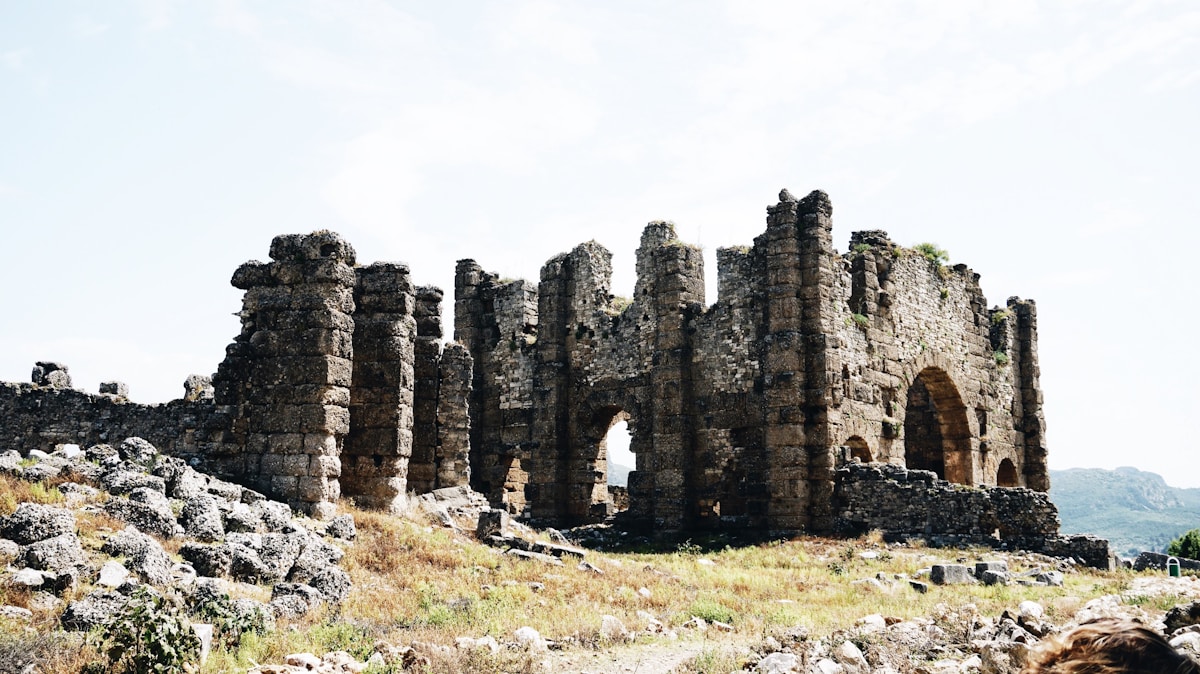
Eastern Anatolia is one of the oldest continuously inhabited regions on earth. The plateau between the Caucasus, the Taurus mountains, and the Zagros range has been the crossing point for migrations, armies, and trade routes since the Neolithic; the civilisations that have left visible traces - Urartu, Armenia, the Seljuks, the Mongols, the Ottomans, the Russians - are only the most recent occupants of ground that has been shaped by human activity for ten millennia.
The Urartian Kingdom (860–590 BC)
The oldest monumental civilisation visible in eastern Turkey today is Urartu - an Iron Age kingdom centred on Lake Van that controlled the highlands from the 9th to the 6th century BC. The Urartians spoke a language unrelated to any surviving tongue; we know them primarily through Assyrian records (who called them enemies worth recording) and their own cuneiform inscriptions carved in the black volcanic rock of the region.
Van Kalesi: The Urartian rock citadel at modern Van is the most accessible Urartian monument. Cuneiform inscriptions of Urartian kings - including the Khorkhor inscription of Argishti I, recording military campaigns and the construction of irrigation canals - are carved directly into the cliff face. The fortress was built and rebuilt by every subsequent occupant: Armenian, Arab, Ottoman, and Russian forces all added layers to the original Urartian core.
Çavuştepe: A less-visited Urartian palace and fortress complex 25 km east of Van city (open daily; entry approximately ₺50–80 as of 2026). The storage rooms and palace foundations are well-preserved; cuneiform inscriptions identifying the complex as built by King Sarduri II (750s BC) are visible on the basalt blocks.
The end of Urartu: The kingdom was destroyed around 590 BC by a combination of Scythian raids from the north and Median expansion from the south. The Urartian population was absorbed into the emerging Median and then Achaemenid Persian empires. The lake basin they had dominated would next be shaped by the Armenians.
The Armenian presence (1st century BC – 1915)
Armenia as a political entity predates the Urartians in name but crystallised as a distinct kingdom during the Hellenistic period. The Kingdom of Armenia under Tigranes the Great (95–55 BC) briefly controlled territory from the Mediterranean to the Caspian - the largest empire in the ancient Near East at its peak, though short-lived. Eastern Anatolia formed the Armenian heartland for two thousand years.
The Bagratid kingdom and Ani: The most significant period for the monuments that survive today was the Bagratid dynasty (885–1064 AD), which established its capital at Ani in 961 AD. The city grew rapidly - its defensive walls enclosed an area of approximately 150 hectares, and contemporary accounts suggest a population of 100,000–200,000 at peak, comparable to Constantinople. The Cathedral of Ani (1001 AD) was designed by the architect Trdat, who had earlier been called to Constantinople to repair the dome of the Hagia Sophia - a mark of his reputation across the medieval world.
Akdamar Church (915–921 AD): Built slightly before Ani’s peak, the Church of the Holy Cross on Akdamar Island was commissioned by the Vaspurakan Armenian king Gagik I Artsruni. The exterior relief carvings - Old Testament scenes including Jonah and the whale, David and Goliath, Adam and Eve - are the finest surviving example of early medieval Armenian stone-carving.
Two thousand years of continuity: The Armenian presence in eastern Anatolia persisted through Seljuk, Mongol, and Ottoman rule, often in a diminished or subordinate position but continuously present. Ottoman records from the 19th century show substantial Armenian populations in Kars, Van, Erzurum, Bitlis, and the surrounding provinces. This continuity ended in 1915.
The Seljuk conquest (11th century)
The Battle of Manzikert (Malazgirt) in 1071 is the hinge event of Anatolian history. The Seljuk Sultan Alp Arslan defeated and captured the Byzantine Emperor Romanos IV Diogenes - the first time a Roman or Byzantine emperor had been taken prisoner in battle by an eastern enemy. The victory opened Anatolia to Turkish migration; within a generation, Turkish-speaking nomadic and semi-nomadic populations had settled across the plateau.
Ani under Seljuk rule: Ani fell to the Seljuks in 1064, seven years before Manzikert. The city continued to function and was administered successively by Seljuk governors, the Kurdish Shaddadid dynasty (who built the Menüçehr Mosque within the city walls in 1072 - claimed as the oldest mosque in Anatolia), and Mongol overlords from the 13th century onward. Its final decline followed the earthquake of 1319, which damaged the cathedral and destabilised the city’s infrastructure. By the Ottoman period, Ani was a ruin.
The Menüçehr Mosque: Built immediately after the Seljuk conquest, this mosque at Ani represents the architectural moment when Islamic religious architecture entered the Armenian Christian cityscape. The minaret base and portions of the prayer hall survive; the building’s proportions suggest it was adapted from an earlier structure.
The Ottoman period and Russian occupation of Kars
Eastern Anatolia came fully under Ottoman control in the 16th century following Sultan Selim I’s campaigns against the Safavid Persians. The region remained an Ottoman borderland - contested, militarised, and economically marginal compared to the empire’s western core - for the next three centuries.
Russian expansion: Russia’s 19th-century southward expansion brought it into direct conflict with the Ottoman Empire in the Caucasus. Following the Russo-Turkish War of 1877–78, Russia captured Kars and held it as part of the Kars Oblast - a Russian administrative region - until 1918. The 40-year Russian occupation left Kars with a distinct urban character: a planned street grid, stone-fronted buildings with arched windows, and a Central European feeling unlike any other Turkish city.
Ishak Pasha Palace: Built over nearly a century (1685–1784) on a rocky spur above Doğubayazıt, the palace was the administrative centre of a semi-autonomous Ottoman provincial dynasty. Its architecture synthesises the cultural currents of the region - Ottoman structural vocabulary with Armenian stone-carving details, Georgian decorative motifs, and Persian spatial organisation. The palace’s blend is not eclectic confusion but a legible record of the overlapping civilisations that have shaped this corner of Anatolia.
The post-WWI settlement: The Treaty of Kars (1921), signed between the Grand National Assembly of Turkey and the Soviet republics of Russia, Armenia, Azerbaijan, and Georgia, established the current borders of northeastern Turkey. Kars, which had briefly become part of independent Armenia in 1920, was returned to Turkey under this settlement. The Armenian SSR and the Turkish Republic have shared a closed border since 1993 - a consequence of the Nagorno-Karabakh conflict rather than any direct bilateral dispute, but one that affects travel in this region: the border crossing at Doğukapı (near Kars) is closed to civilian transit as of 2026.
Eastern Turkey’s historical timeline
| Period | Key event | Visible monument |
|---|---|---|
| 860–590 BC | Urartian kingdom | Van Kalesi, Çavuştepe |
| 915–921 AD | Akdamar Church built | Akdamar Island |
| 961 AD | Ani becomes Bagratid capital | Ani ruins |
| 1001 AD | Ani Cathedral consecrated | Cathedral of Ani |
| 1064 AD | Seljuk conquest of Ani | Menüçehr Mosque |
| 1071 AD | Battle of Manzikert | Malazgirt battlefield |
| 1072 AD | Menüçehr Mosque built | Ani ruins |
| 1685–1784 | Ishak Pasha Palace built | Doğubayazıt |
| 1877–1918 | Russian occupation of Kars | Kars city architecture |
| 1921 | Treaty of Kars establishes current borders | - |
| 2016 | Ani UNESCO World Heritage inscription | Ani ruins |
See the Eastern Turkey hub for planning information, or things to do in Eastern Turkey for site visit practicalities.
Search hotels in Turkey on Booking.com
Exploring the sites: Browse tours and activities in eastern Türkiye for guided historical tours of eastern Türkiye - expert commentary makes a significant difference at layered archaeological sites.