Best Photography Spots in Turkey: 15 Iconic Locations for Stunning Shots
Book an experience
Book this activity
Lock in your preferred date. Prices shown are per person — free cancellation on most bookings.
Contents
- 1. Cappadocia Hot Air Balloons — Göreme, Nevşehir
- 2. Pamukkale Travertine Terraces — Denizli
- 3. Blue Mosque (Sultan Ahmed Mosque) — Istanbul
- 4. Hagia Sophia — Istanbul
- 5. Library of Celsus — Ephesus, İzmir Province
- 6. Butterfly Valley — Faralya, Fethiye
- 7. Sümela Monastery — Trabzon Province
- 8. İshak Pasha Palace — Doğubayazıt, Ağrı Province
- 9. Ölüdeniz Blue Lagoon — Fethiye
- 10. Göbekli Tepe — Şanlıurfa
- 11. Mount Nemrut Sunrise — Adıyaman Province
- 12. Rize Tea Terraces — Eastern Black Sea Coast
- 13. Chimaera (Yanartaş) — Çıralı, Antalya Province
- 14. Antalya Old Town (Kaleiçi) — Hadrian’s Gate
- 15. Bodrum Castle (Castle of St. Peter) — Muğla
- Gear and practical notes
Turkey packs an extraordinary range of landscapes, monuments, and natural phenomena into a single country. Sandstone chimneys glowing at dawn, travertine pools reflecting an impossible white, a 2,000-year-old library facade flanked by cypress trees — the shooting list here is long. Below are the 15 spots we consistently return to, with the practical details that make the difference between a throwaway snapshot and something worth printing.
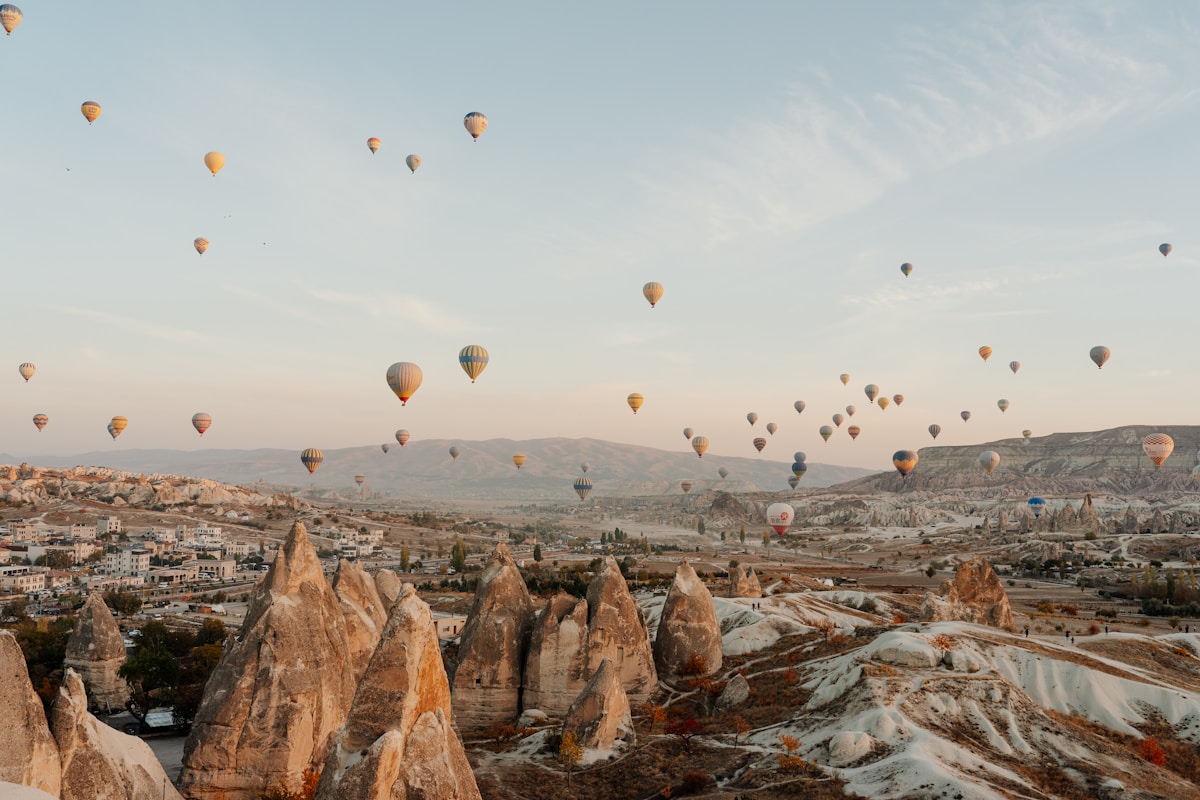
1. Cappadocia Hot Air Balloons — Göreme, Nevşehir
No list starts anywhere else. The hour before and after sunrise over the Rose Valley and Göreme is when scores of balloons lift off against the pink sky and fairy chimney silhouettes. Ground-level balloon shots work from the ridge above Göreme town (walk up from the Göreme Open Air Museum road) or from the saddle between Rose Valley and Meskendir Valley.
Best time: Sunrise, April–October. Balloon flights launch whenever wind is low, typically 05:30–06:30.
Best season: April–June and September–October for mild light and fewer crowds; July–August is busiest but balloons still fly most mornings.
Tripods: Permitted on public lookout ridges; not allowed inside the Open Air Museum without a media permit.
Entry (Open Air Museum): approximately TRY 850 as of 2026 (Dark Church requires an additional TRY 500).
Access tip: Stay overnight in Göreme or Uçhisar to walk to dawn lookouts without hiring a taxi. The ridge behind the Göreme Panorama Hotel is free and uncrowded.
2. Pamukkale Travertine Terraces — Denizli
The calcium-white terraces look best in strong morning or late afternoon light, when shadows define each terrace edge and the thermal pools reflect pale blue sky. Photography is permitted across the open terrace area. You must remove footwear before walking the terraces — factor that in if you’re carrying heavy gear.
Best time: 08:00–10:00 or 16:00–18:00 for angled light. Midday turns the terraces flat white with no dimension.
Best season: April–May and September–October. Summer crowds peak late morning; early entry avoids the tour bus rush.
Tripods: Allowed on the terraces.
Entry: approximately TRY 850 (includes Hierapolis ruins) as of 2026.
Access tip: Stay in Pamukkale village (not Denizli) to walk to the north gate and be first on the terraces. The south gate is closer to the Hierapolis necropolis for wider shots without tourists in frame.
3. Blue Mosque (Sultan Ahmed Mosque) — Istanbul
The six minarets rising above the Hippodrome square make this one of the most recognisable silhouettes in the Islamic world. The best exterior angle is from the Hippodrome gardens at ground level during blue hour (30 minutes after sunset), when the floodlit stone reads warm gold against deep blue sky.
Best time: Blue hour, 20:30–21:00 in summer; 17:30–18:00 in winter.
Best season: Year-round. Summer evenings are warm but crowded; winter gives cleaner angles with fewer selfie sticks.
Tripods: Permitted in the exterior gardens. Interior tripods require a permit — handheld only inside.
Entry: Free (mosque is active; photography during prayer times is not permitted).
Access tip: The raised garden between Blue Mosque and Hagia Sophia gives a wider frame that includes both buildings from above. Arrive 20 minutes before blue hour to lock in your position.
4. Hagia Sophia — Istanbul
The interior is the shot: four enormous medallions, Byzantine mosaics, and columns of light falling through high windows. The best interior light comes through the south gallery windows at around 10:00–11:00 when the sun angles in. The exterior dome, framed from the courtyard, works well at golden hour.
Best time: 10:00–11:30 for interior beams of light. Golden hour for exterior.
Best season: Winter mornings have lower sun angles that drive stronger light shafts through the upper windows.
Tripods: Not permitted inside without a media pass.
Entry: approximately TRY 900 as of 2026. Queue early — lines can reach 90 minutes by mid-morning.
Access tip: Book timed entry online (muze.gov.tr) to skip the external queue and enter at opening.
5. Library of Celsus — Ephesus, İzmir Province
The two-storey Roman facade is one of the most photogenic ruins in the eastern Mediterranean. Shoot from the steps of the agave to frame the full facade. Early morning gives clean light from the east before the crowds arrive; the building faces west, so late afternoon backlight creates drama from behind the columns.
Best time: 08:00–09:30 for low side light; 17:00–18:30 for backlit golden hour (site closes 18:00 in summer, check seasonal hours).
Best season: April–May and September–October. July–August draws huge groups that make wide clean shots difficult.
Tripods: Permitted on site.
Entry: approximately TRY 900 (joint Ephesus site ticket) as of 2026.
Access tip: Enter from the upper (east) gate and walk down to the Library — you hit the best sites before the cruise-ship groups who enter from the lower gate.
6. Butterfly Valley — Faralya, Fethiye
The valley opens abruptly at the cliff edge: a U-shaped canyon dropping to a turquoise bay. The viewpoint above Faralya village (accessible by road) gives a dramatic top-down frame that works well with a wide lens or drone. The beach at the bottom is reachable by boat from Ölüdeniz or by a steep descent path.
Best time: Morning for the valley in shade with lit water; afternoon when the west-facing beach catches direct sun.
Best season: May–October (boats run to the valley floor from May). Winter access is road-only.
Tripods: Permitted.
Entry: No entrance fee for the viewpoint; the valley floor has a small conservation fee of approximately TRY 200 as of 2026.
Access tip: The cliff-top viewpoint 2 km past Faralya village is free, uncrowded, and gives a better composition than the beach itself.
7. Sümela Monastery — Trabzon Province
The Byzantine monastery is built directly into a sheer cliff face roughly 300 m above the valley floor. The classic shot is from the opposite ridge across the Altındere Valley — bring a telephoto (at least 200 mm equivalent) to isolate the monastery against the cliff. The walk up from the lower car park takes 30–40 minutes.
Best time: Late morning when the sun is high enough to light the cliff face (the valley runs north–south and the monastery face is west-facing).
Best season: June–September when the road is reliably open. Snow closes the upper sections November–April.
Tripods: Permitted.
Entry: approximately TRY 450 as of 2026.
Access tip: The opposite ridge viewpoint is accessible via a hiking trail from Altındere village. No entry fee; basic fitness required.
8. İshak Pasha Palace — Doğubayazıt, Ağrı Province
A Baroque-Ottoman palace built into a mountain ridge at 1,900 m, with Mount Ararat (5,137 m) visible behind on a clear day. The classic composition places the palace foreground against the snow-capped peak. The palace faces east — shoot from the road below the entrance gates for the widest frame.
Best time: Morning for Ararat clarity before afternoon haze builds. Golden hour gives warm tones on the palace stone.
Best season: June–September for the clearest Ararat views. Spring brings snow patches that add foreground interest.
Tripods: Permitted outside the palace walls.
Entry: approximately TRY 250 as of 2026.
Access tip: Ararat is clearest at dawn before convective cloud builds. The 6 km road from Doğubayazıt is passable by ordinary car in summer.
9. Ölüdeniz Blue Lagoon — Fethiye
The half-moon lagoon with its calcareous headlands is most striking from above — either from Babadağ Mountain (3,000 m), accessible by cable car or on foot, or from a boat at water level where the turquoise gradient is strongest. Paragliders landing on the beach add movement to shots from the mountain.
Best time: 10:00–14:00 for the deepest turquoise colour in the lagoon.
Best season: May–October. Winter closes the beach park and most boat services.
Tripods: Permitted on the beach.
Entry: approximately TRY 350 for the Ölüdeniz beach park as of 2026. Cable car to Babadağ summit: approximately TRY 700 return.
Access tip: Sunrise from the Babadağ viewpoint gives a mist-free lagoon with no paragliders and no crowds. Arrange transport the night before.
10. Göbekli Tepe — Şanlıurfa
The world’s oldest temple complex (circa 9,600 BCE) sits on a bare ridge above the Harran plain. The T-shaped limestone pillars and circular enclosures are best shot in early morning or late afternoon when long shadows articulate the stone relief carvings. The main dig area is covered by a large protective roof — wide-angle shots work better than telephoto here.
Best time: 08:00–10:00 or 16:00–18:00.
Best season: March–May and September–November. Summer temperatures regularly exceed 40 °C.
Tripods: Permitted on the viewing walkways.
Entry: approximately TRY 500 as of 2026.
Access tip: The site is 15 km northeast of Şanlıurfa city; taxis or the site shuttle run regularly from the museum district.
11. Mount Nemrut Sunrise — Adıyaman Province
Five-metre stone heads — remains of the funerary sanctuary of King Antiochus I — line the east and west terraces of the 2,134 m summit. The east terrace catches first light at sunrise; the west terrace glows at sunset. The heads were toppled from their statues centuries ago and now sit in a row that reads beautifully against the open sky.
Best time: 30 minutes before sunrise (east terrace) or 30 minutes before sunset (west terrace).
Best season: June–September when the summit road is reliably open. Tours from Kahta depart at 02:00–03:00 for sunrise.
Tripods: Permitted.
Entry: approximately TRY 350 as of 2026.
Access tip: The summit can be extremely cold even in summer — bring layers. A wide-angle lens (16–24 mm equivalent) captures the full head row in a single frame.
12. Rize Tea Terraces — Eastern Black Sea Coast
The steep hillsides above Rize and Çaykur are layered with emerald tea terraces from sea level to roughly 1,200 m. The best compositions use a telephoto lens to stack the terraces into compressed layers. Pickers working the rows in traditional dress (most active May–October) add human scale.
Best time: Morning after overnight rain, when the terraces are deepest green and mist clings to the upper slopes.
Best season: May–October for active picking; June–July for the most intense green.
Tripods: Permitted (most terraces are on private farmland — ask permission from the nearest farmhouse).
Entry: No fee.
Access tip: The road above Çamlıhemşin leads to terraced valleys with minimal tourist traffic and excellent composition options.
13. Chimaera (Yanartaş) — Çıralı, Antalya Province
Natural methane flames emerge from cracks in the mountainside on the Lycian coast — the fires have burned for at least 2,500 years and inspired the original Greek myth of the Chimaera. Long-exposure shots at dusk or night capture the flames against star trails or the silhouetted pine forest behind.
Best time: Dusk and night for flame contrast against dark sky.
Best season: Year-round. The flames are visible in all seasons and weather.
Tripods: Essential — this is a long-exposure location.
Entry: approximately TRY 200 as of 2026.
Access tip: The 3 km walk from Çıralı village is unlit — bring a head torch. Allow 45 minutes each way. The upper flame field is larger and more photogenic than the lower grouping near the entrance.
14. Antalya Old Town (Kaleiçi) — Hadrian’s Gate
The triple-arched Roman gate (135 CE) and the narrow Ottoman lanes behind it give a compressed view of layers of civilisation. The gate faces north — it shoots clean in flat morning light. The harbour viewpoint below the clock tower is a wide-angle scene best captured at blue hour when moored boats reflect in the water.
Best time: 08:00–10:00 for Hadrian’s Gate; 19:30–20:00 blue hour for the harbour.
Best season: October–May when crowds are lighter. Summer is hot and lanes fill with tour groups by 10:00.
Tripods: Permitted on public streets.
Entry: No fee.
Access tip: The lane behind Hadrian’s Gate running toward the Kesik Minare mosque has excellent compression potential with a 50–85 mm equivalent lens.
15. Bodrum Castle (Castle of St. Peter) — Muğla
The crusader castle occupies the harbour headland and photographs best from the town waterfront with the castle mirrored in the marina. Interior courtyards and the Underwater Archaeology Museum have strong light from 10:00–12:00. Boats in the foreground of the exterior shot add life and colour.
Best time: Early morning for calm mirror reflections in the marina; late afternoon for lit castle walls.
Best season: April–October. The castle museum closes on Mondays.
Tripods: Permitted in the courtyards; check with staff at the museum entrance.
Entry: approximately TRY 600 (castle + museum) as of 2026.
Access tip: The western marina pier gives a 70–200 mm telephoto frame of the castle above anchored gulets. Dawn arrivals on this pier are rare — it’s a quiet slot for clean reflections.
Gear and practical notes
A 16–35 mm wide-angle covers interiors, terraces, and the palace-and-mountain compositions. A 70–200 mm is essential for Sümela (monastery against cliff) and the Rize tea terraces. A sturdy tripod earns its weight at Chimaera, Nemrut, and any blue-hour harbour shot.
For balloon and sunrise locations, allow extra travel time: Turkish roads in Cappadocia and eastern Anatolia can be slow, and arriving 10 minutes late for sunrise is arriving too late.
Drone regulations: drones require CAA Turkey (SHGM) approval and third-party liability insurance before flight. Many popular sites — including Ephesus and Pamukkale — are in restricted airspace. Check the SHGM portal before flying anywhere on this list.
All entry fees listed are approximate as of 2026 and subject to change. Verify current prices at muze.gov.tr or directly at site ticket offices before visiting.
Booking in advance: Browse tours and activities in Turkey to compare operators and read recent reviews — booking ahead is strongly recommended in peak season (July–August) as slots fill quickly. Tiqets covers mobile entry tickets for major attraction sites, accepted at the gate.
Ready to explore?
Browse hundreds of tours and activities. Book securely with free cancellation on most options.
Browse on GetYourGuide →We may earn a small commission — at no extra cost to you.