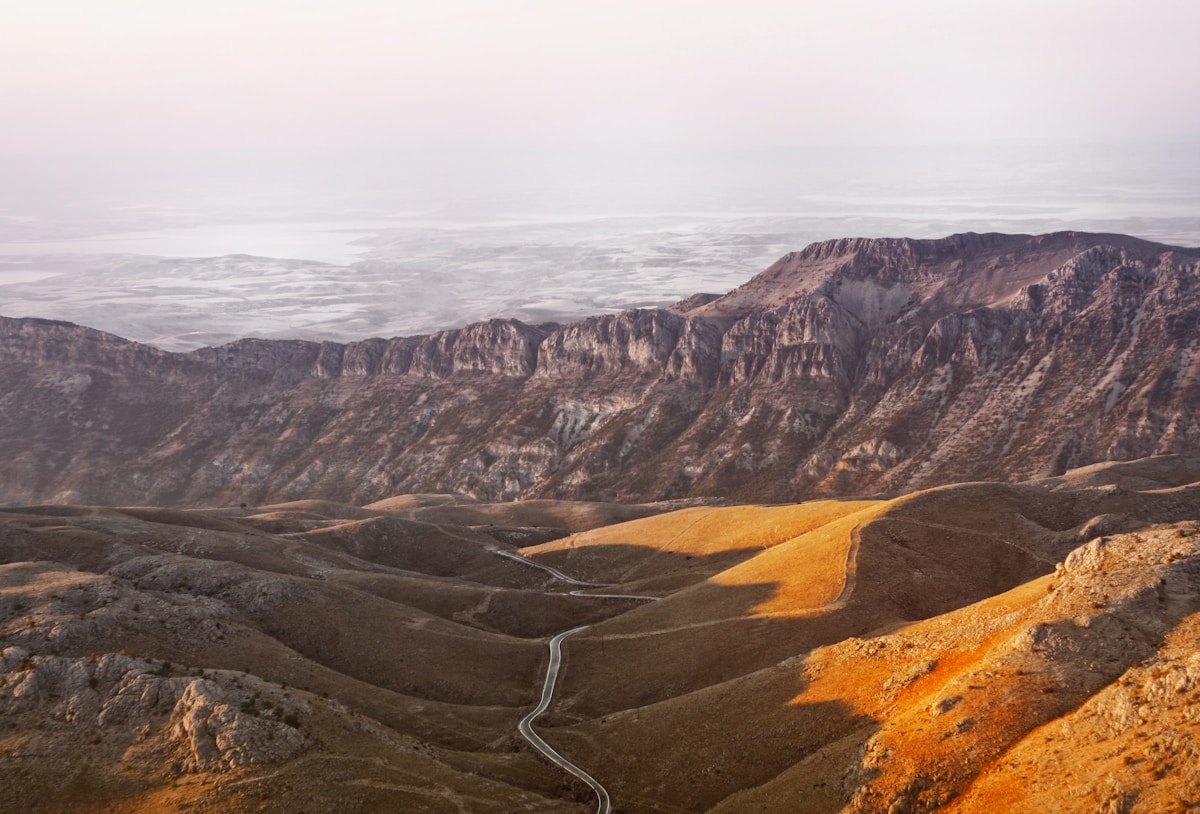
Gaziantep’s position in southeastern Turkey - at the junction of the Anatolian plateau, the Euphrates valley, and the approaches to the Taurus Mountains - places it within reach of some of the region’s most remarkable sites. The city itself warrants days of serious attention (Zeugma Mosaic Museum alone demands a full morning), but the surrounding area contains a submerged village on the Euphrates, one of the most dramatic mountain sanctuaries in the ancient world, a flooded Roman-Byzantine fortress, and a rarely visited border town with its own distinct character.
These are the best day trips from Gaziantep for travellers who have already covered the city’s core attractions.
Nemrut Dağ and Arsameia (170km, 2.5 hours)
Mount Nemrut (Nemrut Dağı) is a UNESCO World Heritage Site and one of Turkey’s most extraordinary ancient monuments - a 2,134-metre summit on which King Antiochus I of Commagene (reigned 70–38 BCE) constructed a massive royal sanctuary. The site consists of a tumulus (burial mound) flanked by two terraces, each lined with colossal stone statues of Greek and Persian gods alongside the king himself. The heads of the statues - up to 2 metres tall, toppled from their bodies by earthquakes - are scattered across the terraces in a composition that is both monumental and oddly intimate. The east terrace catches the sunrise; the west terrace the sunset.
On the approach road to the summit, the ancient capital of Commagene, Arsameia (Eski Kahta), adds further context: rock-cut inscriptions, a relief of Antiochus I shaking hands with Hercules, and a partially excavated palace complex. The site is free and often entirely unvisited.
Getting there: Drive north from Gaziantep toward Adıyaman on the E90 and D360 - approximately 170km, 2.5 hours to the base of the mountain at Kahta. From Kahta, a further 30km of mountain road (paved, some steep sections) reaches the summit car park, from which a 10-minute walk reaches the terraces. Guided tours from Gaziantep and Adıyaman include transport and usually combine Nemrut with Arsameia and Karakuş tumulus in a single day. Without a car, the most practical approach is a tour from Gaziantep (prices from approximately ₺500–800 per person as of 2026 for a day trip including transport and guide) or an independent bus to Adıyaman followed by a local tour.
Entry: Nemrut Dağı summit approximately ₺200 as of 2026. Arsameia entry approximately ₺100. Karakuş tumulus (a roadside monument with eagle columns, 30 minutes from Kahta) is free.
Best time: Sunrise (5–6am in summer) or sunset (7–8pm) visits to the summit are the classic experience - the light on the stone heads is extraordinary. A sunrise visit requires an overnight stay in Kahta or Adıyaman. For a pure day trip from Gaziantep, a sunset visit is feasible but involves a late return; plan to arrive at Kahta by midday to allow time at Arsameia and the summit approach.
Tips: The summit is cold at night year-round and can be cold even in summer mornings - bring a layer regardless of the valley temperature. Snow can close the summit road from November through April; verify conditions before visiting.
Halfeti - Euphrates and the Sunken Village (60km, 1 hour)
Halfeti sits on the banks of the Euphrates River where it backs up behind the Birecik Dam, creating a wide lake that partially submerged the old village of Halfeti when the dam was completed in 2000. The rooftops and minarets of the old village are still visible above the waterline in certain water levels, and the flooded orchards and the peculiar atmosphere of a partially drowned settlement make this one of the most distinctive landscapes in Turkey.
The new town of Halfeti sits on higher ground. Boat trips on the Euphrates depart from the waterfront and take visitors past the submerged structures to the tiny island village of Rumkale (a short stop is usually included - see below). The rose gardens of Halfeti are also famous - the town grows a rare black rose (actually a very deep crimson) that is specific to this microclimate.
Getting there: Drive northwest from Gaziantep on the E90 toward Şanlıurfa, then exit north toward Halfeti - approximately 60km, about 1 hour. Buses run from Gaziantep’s main otogar toward Şanlıurfa; ask for the Halfeti turn-off or a connection service (approximately ₺40–60). Local dolmuş or taxi from the junction to Halfeti adds another 20 minutes.
Boat trips: The river excursions from Halfeti dock cover the flooded village and Rumkale and take 1.5–3 hours depending on the route. Prices approximately ₺100–200 per person as of 2026. Morning departures have better light. Book at the waterfront on arrival - there are multiple operators.
Eating: Fish restaurants along the Halfeti waterfront serve fresh Euphrates river fish (catfish, carp). Expect ₺150–250 for a full meal with fish. The views across the lake from the terrace restaurants are good.
Best time: April–June and September–October - comfortable temperatures and the clearest water. July and August are very hot (35–42°C) in this valley; possible but uncomfortable.
Rumkale (60km from Gaziantep, or combined with Halfeti)
Rumkale (Roman Fortress - Hromgla in Armenian) is a Byzantine and later Armenian fortress built on a dramatic rocky promontory at the confluence of the Euphrates and Merzimen rivers, now an island due to the Birecik Dam. The fortress is one of the most significant sites in Armenian medieval history - it served as the seat of the Armenian Catholicate (the supreme leadership of the Armenian Apostolic Church) from 1149 to 1292 CE. The remains include the castle walls, a chapel, cisterns, and the rock-cut defensive systems.
Getting there: Rumkale is most practically reached by boat from Halfeti (included in most Halfeti river tours, approximately ₺100–200 as described above). By road, a separate route goes via Yavuzeli to the Rumkale car park, from which a short boat transfer is required to reach the island - approximately 60km from Gaziantep, 1 hour. The boat-from-Halfeti approach is simpler.
Entry: Approximately ₺50–80 as of 2026 (verify on site; fees change seasonally). The island visit is typically 30–45 minutes.
What to see: The Armenian chapel carved into the rock face, the Crusader-period defensive walls, the underground cisterns, and the views from the promontory across the Euphrates. An information board in Turkish covers the site’s history. The Armenian Catholicos Grigoris VII was based here during the Crusades period - the site has significant historical and religious importance for Armenian Christians.
Kilis (45km, 45 minutes)
Kilis is a compact border town 45km south of Gaziantep, close to the Syrian border - a place rarely visited by international tourists but with genuine character. The town has a distinct Ottoman and Arab-influenced architectural tradition, a covered bazaar that functions as it has for centuries, and a local cuisine related to but distinct from Gaziantep’s. The Kilis Museum holds regional archaeological finds. The town’s atmosphere - bustling, market-oriented, with a largely Arabic-speaking population - is unlike anything further north.
Getting there: Drive south from Gaziantep on the D400 toward Kilis - 45km, approximately 45 minutes on a straight modern road. Frequent dolmuş and minibus services run from Gaziantep’s otogar (approximately ₺25–40 one way, 45–60 minutes).
What to see: The Kilis Museum (entry approximately ₺50) has well-displayed finds from the surrounding region including Roman-era sculpture and Byzantine mosaics. The covered bazaar (arasta) in the town centre sells spices, dried goods, and local olive oil - Kilis olive oil has a protected designation and is worth buying. The Canbolat Bey Mosque (Ottoman, 16th century) is the main historic monument. The town’s street food - in particular the katmer pastry with pistachio and cream cheese, closely related to Gaziantep’s version - is excellent.
Practical note: The Kilis border crossing with Syria is currently closed to civilian traffic (as of 2026). The town itself is entirely normal and safe to visit; the border area is not a destination.
Best time: Year-round; the town is most animated on weekday mornings when the bazaar is at its liveliest.
Practical Tips
Nemrut logistics: The distance and the summit road make Nemrut the only day trip from Gaziantep that genuinely requires either a car or a guided tour. If you prefer not to drive, several Gaziantep-based tour operators run day trips (departing early morning, returning late evening). The Adıyaman Provincial Tourism Directorate has information on local guides.
Halfeti and Rumkale combined: These two sites work naturally together - drive to Halfeti in the morning, take the 2–3-hour river tour (which includes Rumkale), have lunch on the waterfront, and return to Gaziantep by mid-afternoon. Total day trip time: 7–8 hours.
Kilis half-day: Kilis can be done in half a day - morning departure from Gaziantep, 3 hours in the town (bazaar, museum, lunch), return by early afternoon.
Heat: June through September in this part of southeastern Turkey is extreme - temperatures regularly exceed 38°C in Halfeti and Kilis valleys. Carry water, plan midday rest, and consider limiting strenuous outdoor time to morning hours.
For the full picture on the city itself, see the Gaziantep travel guide.
Search hotels in Gaziantep on Booking.com
Booking trips: Browse tours and activities in Gaziantep for guided day trips with free cancellation on advance bookings. For independent exploration, compare car hire options - a rental gives you full flexibility on timing and stops.