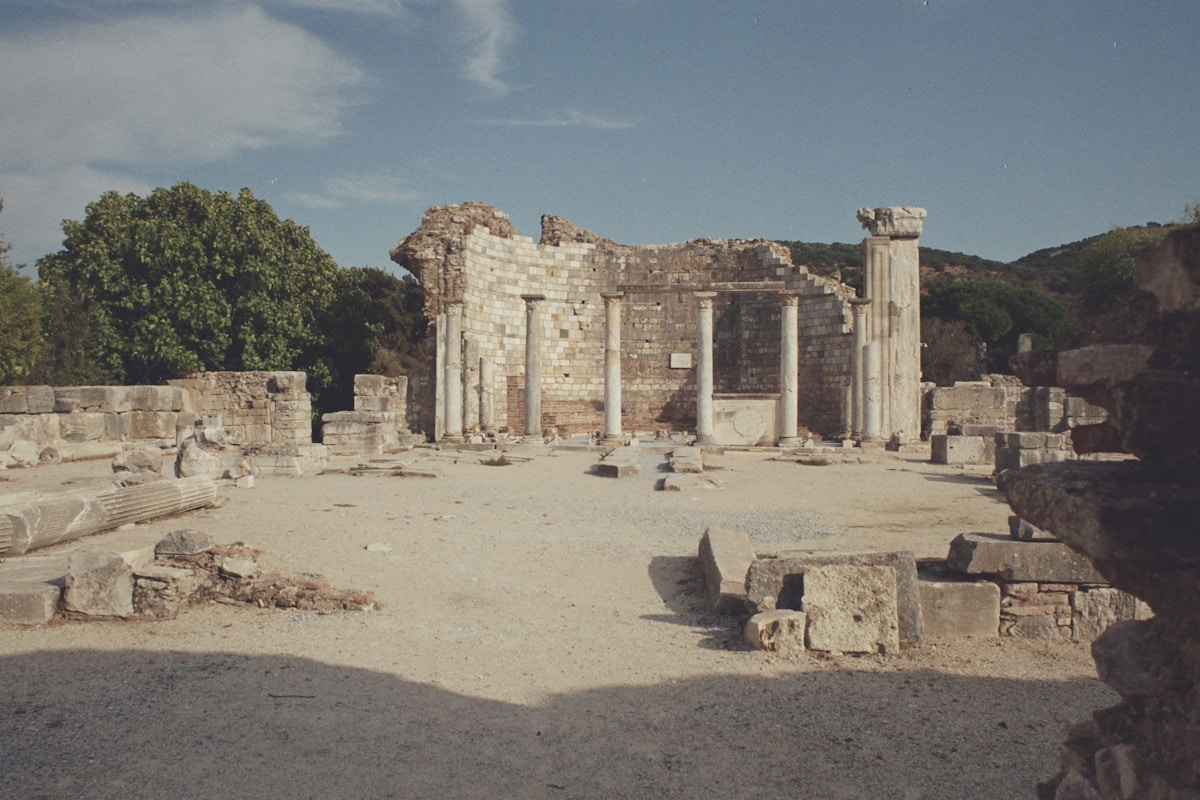
The main Ephesus archaeological site - the Library of Celsus, Great Theatre, Curetes Street, and the Terrace Houses - takes 3 to 4 hours and is covered in detail in our Ephesus travel guide. This article is for what comes next: the sites, villages, and circuits that extend a visit into something genuinely substantial.
Inside the Archaeological Zone: The Essentials
Entry to the Ephesus main site costs approximately ₺600–700 as of 2026. The Terrace Houses require an additional approximately ₺350–400. These are the most significant Roman domestic interiors accessible in Turkey - intact mosaic floors, wall paintings, and hypocaust heating visible in situ - and they are worth every lira of the surcharge.
From the South Gate, the logical route runs uphill through the site, ending at the North Gate near the Odeon and the Prytaneion. Allow at least 3 hours for the main ruins and an additional 45–60 minutes for the Terrace Houses.
Şirince Wine Village
8km east of Selçuk on a winding road through olive groves, Şirince is an Ottoman village of whitewashed stone houses that was largely abandoned when its Greek Orthodox population left in the 1923 population exchange and was subsequently repopulated by Muslim migrants from Greece. The architecture that resulted - Greek stone houses, Orthodox church shells, narrow cobbled lanes - is now a designated heritage area.
The village is best known for fruit wines: cherry, strawberry, pomegranate, blackberry, and blueberry, made by the village women in small batches. Wine tastings cost approximately ₺50–100 per sample as of 2026. There is no entry fee to explore the village - walk in, wander the lanes, and try the wines at the stalls lining the main lane.
Şirince fills up with day-trippers by midday in summer. Arrive before 10am or after 4pm for a quieter experience. Dolmuşes from Selçuk run throughout the day (approximately ₺30–40 each way). A taxi from Selçuk costs approximately ₺80–100.
House of the Virgin Mary (Meryem Ana Evi)
8km from the Ephesus main site on the forested slopes of Bülbüldağı Hill, the House of the Virgin Mary is a small Byzantine chapel built over what tradition identifies as Mary’s final home - she is believed to have been brought to Ephesus by St. John. The Vatican recognises it as an official pilgrimage site; both Catholic and Muslim visitors come regularly.
The building is modest: a stone chapel of approximately four rooms adapted from a 1st-century structure. Outside, a long wishing wall is covered in strips of cloth, paper, and plastic tied by pilgrims. The setting - deep forest, birdsong, almost no retail intrusion - makes this one of the more peaceful sites in the region.
Entry approximately ₺150 as of 2026. Most visitors take a taxi from Selçuk (approximately ₺200–300 return with waiting time) or include it in a guided tour from Kuşadası. There is no public transport.
Basilica of St. John (Selçuk)
On Ayasuluk Hill above Selçuk, 10 minutes’ walk uphill from the town centre, the 6th-century Byzantine basilica built by Emperor Justinian marks the traditional burial site of the Apostle John. The basilica was once one of the largest churches in the world - the nave and transepts still define an enormous floor plan, though most of what survives are column stumps and lower wall courses.
A tomb beneath the nave is venerated as John’s burial place and has been a pilgrimage site since at least the 4th century. The views from the hilltop over the stork-colonised ruins below and across the Ephesus plain are worth the climb independently of the historical significance.
Entry approximately ₺150 as of 2026. Combined with a visit to the Selçuk Archaeological Museum (described below), this fills a comfortable afternoon.
Selçuk Archaeological Museum
The Selçuk Museum holds the portable finds from Ephesus: Roman bronzes, coins, pottery, and most significantly a pair of large marble cult statues of Artemis of Ephesus - multi-breasted, covered in animal reliefs from knees to chin - found during excavations of the Prytaneion. These are the defining images of Ephesian religion and should be seen before the ruins, not after.
Entry approximately ₺100–200 as of 2026 (sometimes included with the main Ephesus ticket - check at the gate). Allow 45 minutes. The museum is small enough to see in full without fatigue.
Priene
40km south of Selçuk (approximately 45 minutes by car), Priene is a Hellenistic city built on a dramatic ridge above the Büyük Menderes valley. Unlike Ephesus, Priene is almost never crowded - even in peak summer. The site requires a short uphill walk through pine forest to reach the main ruins.
What survives: the Temple of Athena (five columns re-erected, the rest collapsed across the hillside), a well-preserved bouleuterion (council chamber) with tiered stone seating, a theatre, and a long section of city wall with visible tower bases. Alexander the Great funded part of the Temple of Athena’s construction, and inscriptions from his dedication survive.
Entry approximately ₺150 as of 2026. Allow 1.5–2 hours. There is no public transport - a rental car or organised day trip is needed.
Miletus
65km south of Selçuk (approximately 1 hour by car), Miletus was one of the great cities of ancient Ionia - the birthplace of Thales, Anaximander, and Anaximenes, and an intellectual centre that shaped early Greek science and philosophy. The harbour that made the city rich has long since silted up; the site now sits in flat farmland.
The standout structure is the Great Theatre, one of the best-preserved ancient theatres in Turkey - three tiers of seating rising steeply, with Byzantine fortifications built into the upper cavea. The site also includes the Baths of Faustina, the Delphinium (sanctuary of Apollo), and a small onsite museum.
Entry approximately ₺150 as of 2026. Allow 1.5 hours.
Didyma
90km south of Selçuk (approximately 1 hour 15 minutes by car), Didyma was not a city but a sanctuary: the Temple of Apollo Didymaios, one of the largest temples ever attempted in the ancient world and home to a famous oracle. Construction began around 300 BC and continued for 600 years - it was never finished. What survives is staggering: two enormous columns still standing to full height with their capitals, dozens more collapsed in enormous sections across the floor, a cult room (adyton) with carved walls, and a sacred well.
The unfinished state of the temple makes it oddly more impressive than a complete building would be: you can see the raw column drums ready to be fluted, the scaffolding holes in the walls, the scale of the project exposed. The oracle here was second only to Delphi in the Greek world.
Entry approximately ₺200 as of 2026. Allow 1 to 1.5 hours.
Day Trip Circuits
Ephesus + Şirince: these sit 8km apart and can be combined in a single morning - visit the Ephesus ruins at opening (8am), exit by 11:30am, and drive or taxi to Şirince for lunch and wine tasting before the afternoon crowds arrive. The Selçuk Museum and Basilica of St. John can fill the afternoon.
Priene-Miletus-Didyma (PMD) circuit: the classic southern Aegean day trip, covering all three sites in sequence from north to south. Allow a full day - approximately 7 to 8 hours including driving. Guided PMD tours run from Kuşadası and Selçuk; check inclusions carefully, as some skip Priene. Driving independently gives more flexibility at each site.
Boat trips from Kuşadası: several operators run half-day or full-day Aegean boat trips from Kuşadası combining coastal swimming, lunch on board, and a stop at a beach. These are a different experience entirely from the archaeological sites but work well as an afternoon complement after a morning at Ephesus.
FAQs
How much time do we need to cover Ephesus and Şirince in one day? A morning at Ephesus (8am–12pm, including Terrace Houses) and an early afternoon in Şirince (12:30pm–3pm) is comfortable. Arrive at Şirince before the midday tour groups. You can add the Basilica of St. John and museum in late afternoon.
Is a rental car needed for Priene, Miletus, and Didyma? For the PMD circuit, yes - a rental car or private driver gives you the flexibility to stay at each site as long as it warrants. Organised guided day trips from Kuşadası also cover the circuit. Public transport connections are poor.
Which site is least crowded in summer? Priene. Even in July and August, the site rarely has more than a few dozen visitors at a time. Miletus is quiet. Didyma receives more visitors, particularly from the resort town of Didim nearby, but is not overwhelming.
Do the outer sites (Priene, Miletus, Didyma) require advance booking? No. All are pay-at-gate. Card and cash accepted. No timed entry system in place as of 2026.
Search hotels in Ephesus Selcuk on Booking.com
Booking in advance: Browse tours and activities in Ephesus - guided walks, skip-the-line tickets, and day tours are bookable ahead with free cancellation.