Ephesus Travel Guide: Ruins, Marble Streets and the Library
Ephesus guide covers the Library of Celsus, Great Theatre, Terrace Houses, entry fees, basing yourself in Selcuk and how to beat the crowds.
Guides for Ephesus
Ephesus is one of the best-preserved ancient cities in the Mediterranean world. At its peak in the 1st and 2nd centuries AD, it was home to around 250,000 people and served as the capital of the Roman province of Asia. What survives today is substantial: paved marble streets, a theatre seating 25,000, public latrines, a brothel with Latin inscriptions, and the Library of Celsus, whose reconstructed façade is the most photographed ancient structure in Turkey.
The ruins sit 3km from the small town of Selçuk in Izmir Province, western Turkey. Getting there is straightforward. Understanding what you are seeing when you arrive takes more preparation.
What to See at Ephesus
The Library of Celsus
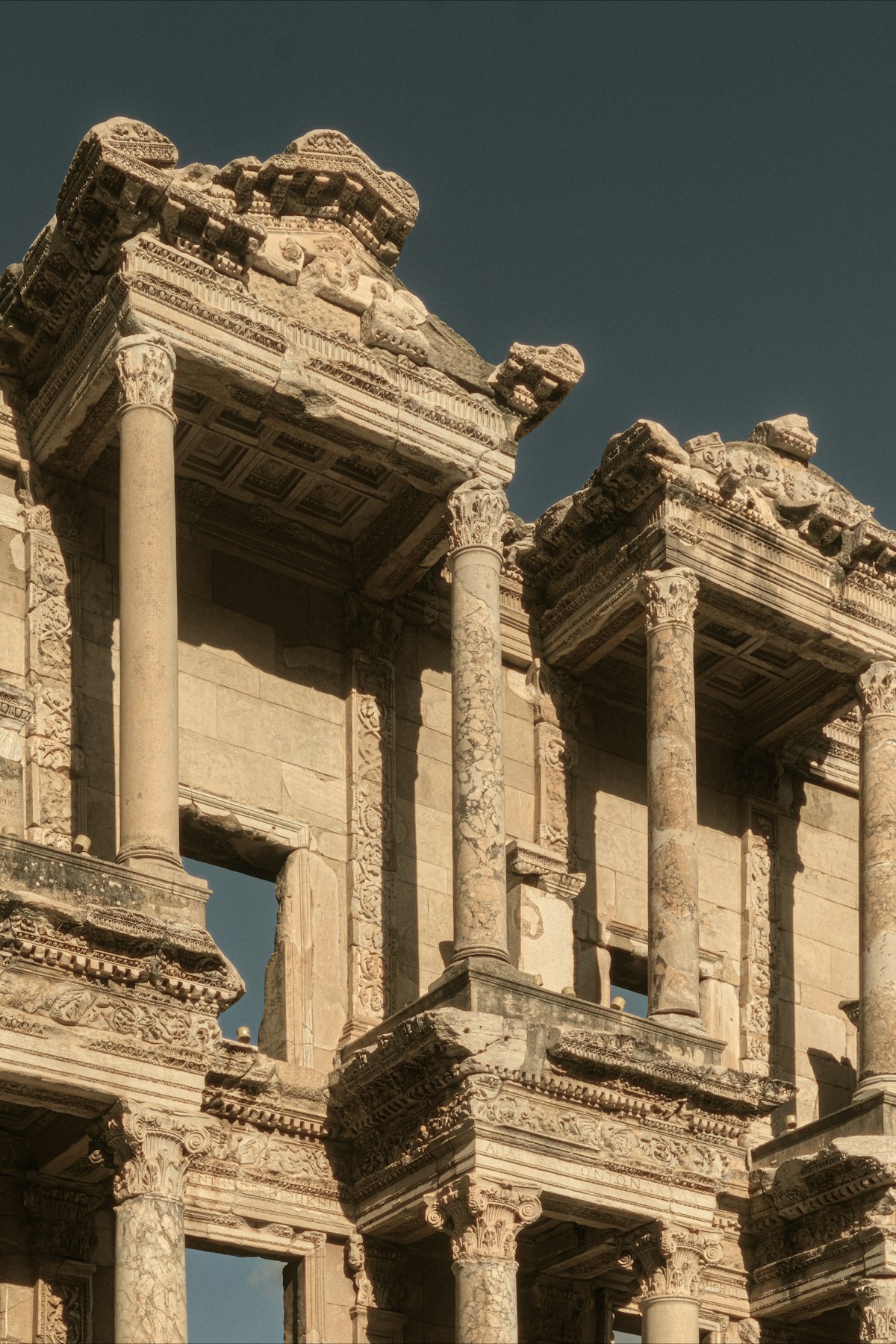
Built around 117 AD as a monumental tomb for the Roman senator Tiberius Julius Celsus Polemaeanus, the Library of Celsus was also a functioning library holding approximately 12,000 scrolls. The building was damaged in a fire in the 3rd century and further destroyed by an earthquake. The façade was reconstructed in the 1970s using original fragments and is one of the most complete ancient façade restorations anywhere.
The two-storey front has four pairs of columns on the lower level, each framed pair slightly advanced or recessed to create depth. Four niches at the base hold marble female figures representing wisdom, knowledge, fate and virtue. The interior is now open to the sky - the walls survive, the roof and shelving are gone.
The Great Theatre
The largest structure at Ephesus, the Great Theatre could seat approximately 25,000 spectators for gladiatorial contests, theatrical performances and public assemblies. The seating bank (cavea) is carved into the slope of Mount Pion and is remarkably intact. The stage building was partially reconstructed in the 20th century; some of the original carved architectural elements are in the Ephesus Museum in Selçuk.
The theatre is the site where, according to the Acts of the Apostles, the silversmith Demetrius organised a demonstration against Paul’s preaching - Paul’s message about idols was threatening his trade selling silver shrines to Artemis.
Curetes Street
The main marble road of ancient Ephesus runs from the Heracles Gate down to the Library of Celsus. The street is paved in large marble blocks, polished by centuries of foot traffic, and lined on both sides with column bases, statue pedestals and the remnants of colonnaded porticos. Walking it gives the clearest sense of the city’s scale. The marble is extremely slippery when wet or cold - wear flat shoes.
Side streets off Curetes lead to the public latrines (still largely intact, including the marble seating), the Temple of Hadrian (mid-2nd century, with a carved arch showing the founding myth of Ephesus) and the slope houses.
The Terrace Houses (Slope Houses)
The Terrace Houses cover a hillside above Curetes Street behind a climate-controlled shelter. Six residential complexes from the 1st to 7th centuries AD are preserved under protective roofing; ongoing excavations continue. Entry costs approximately TRY 400 additional on top of the main site ticket.
The houses contain detailed floor mosaics, wall frescoes, marble revetment and evidence of sophisticated plumbing and underfloor heating. One of the frescoes shows a depiction of Socrates. The Terrace Houses give the most complete picture of how wealthy Romans lived in Ephesus - the main site is all public buildings; these are the homes.
The additional entry fee is worth paying. Budget 45 minutes to 1 hour inside.
The Temple of Artemis
One of the Seven Wonders of the Ancient World once stood 2km from the main Ephesus site. Almost nothing remains: a single reconstructed column stands in a field, surrounded by foundations. The column was assembled from fragments found at the site and gives only a faint impression of what the original temple - four times larger than the Parthenon in Athens - looked like. The Artemision is worth a 20-minute stop if you have your own transport; it is not worth a separate trip.
Entry Fees
Main Ephesus archaeological site: approximately TRY 700 (2026 prices). This covers the entire site including the Library, Great Theatre, Curetes Street and all public buildings.
Terrace Houses: approximately TRY 400 additional. Must be booked or paid at the entrance to the terrace house shelter.
Meryem Ana (Virgin Mary’s House): TRY 150, located 8km from the main site.
Combined tickets are sometimes available at the main gate - check on arrival.
Selçuk: Your Base Town
Selçuk (population ~35,000) is 3km from the South Gate of Ephesus and the natural base for a visit. It has a good range of accommodation at lower prices than nearby Kuşadası, a local market on Saturdays, and the excellent Ephesus Museum on the main street (included in the Ephesus site ticket, or a small separate entry fee - verify on arrival).
The Ephesus Museum holds the finest finds from the excavations: two statues of Artemis with rows of hanging eggs or breasts (the interpretation is debated), carved architectural pieces from the Theatre, a marble statue of Eros on a dolphin, and the fasces of Consul Tiberius Claudius Aristio. Allow 45 minutes.
Selçuk has good train connections: the Izmir–Selçuk rail service runs frequently (1.5 hours, TRY 40–60) and is the most convenient way to arrive from Izmir.
In January, Selçuk hosts the Selçuk Camel Wrestling Festival - Turkey’s largest camel wrestling event, drawing around 20,000 spectators and approximately 100 decorated Tülü camels. It is one of the most distinctive spectacles in western Turkey and worth timing a visit around if you are in the region in mid-January.
Getting to Ephesus
From Izmir (55km): Train from Basmane or Alsancak station to Selçuk, then a 10-minute dolmuş or taxi to the site. Total journey approximately 1.5–2 hours. This is the most practical option for a day trip.
From Kuşadası (18km): Dolmuş runs frequently to Selçuk, TRY 20–30. Many visitors staying on the Aegean coast use Kuşadası as a base.
From Istanbul: Fly to Izmir (1h) then train to Selçuk. Or overnight bus to Selçuk (8–9h, TRY 700–900). Day trip from Istanbul is logistically possible but requires flying.
Nearby: Şirince Village
8km uphill from Selçuk, Şirince is an Ottoman hillside village that has been producing wine since Greek settlers established the community centuries ago. The houses are white-painted with brown wooden trim; the main street is lined with stalls selling local fruit wines (cherry, strawberry, pomegranate - local variations, not standard viticulture grapes). Tourism has made it busy on weekends, but on a weekday morning or afternoon it is genuinely pleasant. Minibuses from Selçuk run throughout the day, TRY 20–30.
Meryem Ana (House of the Virgin Mary)
8km from the main Ephesus site, on a hillside in the forest, a small house is believed by Catholic tradition to be where Mary lived after the crucifixion, brought to Ephesus by the Apostle John. The identification is based on 19th-century visions of a German nun and was given partial recognition by the Vatican in the 1950s.
The site is a place of pilgrimage for Catholics and is also visited by many Muslims (Mary - Meryem - is highly revered in Islam). The chapel is small; the grounds are peaceful. Pope John Paul II visited in 1979, Pope Benedict XVI in 2006, Pope Francis in 2014. Entry: approximately TRY 150. Separate transport is needed; most tours from Selçuk include it.
Beating the Cruise Ship Crowds
Kuşadası, 18km from Ephesus, is one of the major Aegean cruise ports. On days when large ships are docked, coach convoys arrive at Ephesus between 10am and 2pm. At peak the site can have 15,000 visitors in a few hours.
To avoid this: arrive at opening time (8am) and prioritise the Terrace Houses, Curetes Street and the Library in the first 90 minutes. By 10am the site will be noticeably busier. Alternatively, visit in the late afternoon when the tours have returned to their ships. Check cruise schedules for Kuşadası if you have flexibility in your dates - a day without large ships docked gives a dramatically different experience. Browse Ephesus tours and activities on GetYourGuide to book early-entry guided tours that beat the cruise ship crowds, with expert commentary on the Library of Celsus and the Terrace Houses.
The best months for quiet visits are November to March. Peak crowds are May–June and September–October.
Explore Ephesus further
- Things to do near Ephesus
- Ephesus tours
- Where to stay near Ephesus
- Kuşadası travel guide - the nearest coastal base, 18km from Ephesus
- İzmir travel guide - 80km north, the major city for the region
- Kuşadası vs Bodrum comparison
- Scuba diving in Turkey - Aegean diving accessible from Selçuk and Kuşadası
Search hotels in Ephesus Selcuk on Booking.com
Getting there: Flights to Turkey connect via Istanbul with most European carriers. For a door-to-door arrival, pre-book an airport transfer for fixed-price, hassle-free pickup. An eSIM for Turkey activates before you land and keeps you connected from the moment you clear arrivals.
Book an experience
Top experiences in Ephesus
Explore the best tours and activities in Ephesus, with instant confirmation and free cancellation on most bookings.
Find hotels in Ephesus
Explore accommodation in Ephesus →We earn a small commission at no cost to you.