Van Travel Guide: Lake Van, Akdamar Island and Eastern Anatolia
Van travel guide: Lake Van soda lake, Akdamar Armenian Cathedral, Van Castle, Urartian history, and eastern Turkey's most dramatic landscape.
Guides for Van
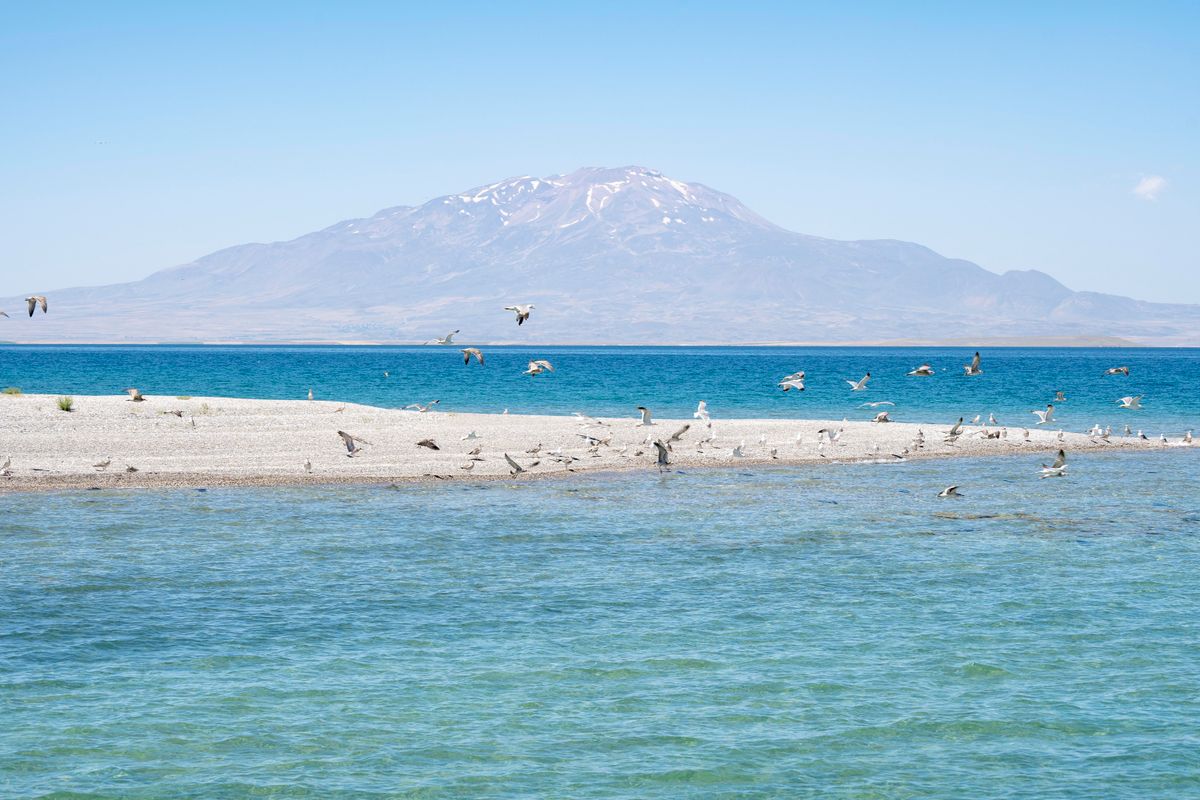
Van is eastern Anatolia’s most dramatic destination — a city of 400,000 on the eastern shore of Lake Van, the world’s largest soda lake (3,755 km², 1,646m altitude), ringed by snow-capped volcanoes and carrying 3,000 years of continuous human history. The lake itself — alkaline, mineral-rich, shifting from turquoise to blue-silver depending on weather and season — is the defining sight. The 10th-century Armenian Cathedral on Akdamar Island, the medieval Van Castle, and the Van Museum’s Urartian collections complete a destination unlike anywhere else in Turkey.
Browse Van and Lake Van tours on GetYourGuide to book Akdamar Island trips, guided castle visits, and regional day tours.
Lake Van
Lake Van is one of the largest terminal lakes in the world — with no outflow, the water is alkaline (pH 9.8) and mineral-rich from millennia of volcanic input. It is not a swimming lake in the conventional sense (the high alkalinity and salinity make prolonged immersion unpleasant), but the visual experience is extraordinary.
The colour: The lake changes colour with light, season, and angle — deep turquoise in morning light, a flat silver-grey under cloud, intensely blue under direct afternoon sun. The colour comes from the mineral content and the lake’s depth (maximum 451m). At dawn, the lake surface and the volcanic peaks behind it create one of the most photogenic landscapes in Turkey.
The shore: The western shore (lakeside hotels, 5km from Van city centre) has the best direct views. The southern shore near Gevaş and Akdamar Island has calmer water and the most visited spots. The northern shore road toward Erciş passes through relatively undeveloped agricultural land with fewer tourists.
Boat trips: Seasonal boat services operate on the lake from the Van ferry terminal (Van Gölü İskelesi), including the historic cross-lake ferry to Tatvan (on the western shore, 4 hours) — an unusual journey across the open lake.
Akdamar Island — Cathedral of the Holy Cross
The Church of the Holy Cross (Kutsal Haç Kilisesi) on Akdamar Island was built between 915 and 921 CE by the Armenian King Gagik I Artsruni as the palace church of the Artsrunid dynasty. It is one of the most significant surviving examples of medieval Armenian religious architecture and one of the few in Turkey.
The exterior reliefs: The Cathedral’s exterior walls are covered with carved stone reliefs — biblical scenes, animal hunts, figures from Armenian royal iconography, and decorative interlace. The programme is extensive and remarkably well-preserved given 1,100 years of weathering. Key panels include David and Goliath, Jonah and the Whale, Adam and Eve, and the Sacrifice of Abraham.
Interior: The interior frescoes have been partially restored following decades of damage; the apse programme and upper drum paintings remain in fragmentary but legible condition. The scale of the church is modest — a single domed nave — but the architectural proportion and the exterior carving make it one of the most rewarding buildings in eastern Turkey.
The island: Akdamar Island itself is small (5 hectares) with walking paths around the perimeter. The view back to the mainland from the island — Van in the distance, the mountains behind — shows the setting that the Artsrunid kings chose for their dynastic chapel.
Annual service: An Armenian liturgy is held at the Cathedral annually in September, drawing Armenian Christians from Turkey, Armenia, and the diaspora. This is the most emotionally charged time to visit.
Practical: 45km southwest of Van. Taxi from Van to Gevaş pier: approximately ₺200–300. Boat: 10 minutes, seasonal operation (April–October approximately). Entry approximately ₺50–100. Tours from Van hotels typically include transport. Allow 2–3 hours total for the excursion.
Van Castle (Van Kalesi)
The citadel above Old Van (Eski Van), on a volcanic rock outcrop above the lake’s eastern shore, has been fortified continuously from the Urartian period (9th century BCE) through Median, Achaemenid Persian, Hellenistic, Roman, Armenian, Arab, Seljuk, and Ottoman occupation. The visible remains are primarily Urartian and Ottoman.
Urartian remains: The Urartian fortress walls, storage chambers, and cuneiform inscriptions carved into the rock face are the oldest structures at the site — dating from the reign of Sarduri I (840s–830s BCE) and his successors. Van (ancient Tushpa) was the Urartian capital; the rock inscriptions are substantial and relatively accessible.
The Toprakkale fortress: The 9th-century BCE Urartian citadel on the hill north of Van Castle — the most complete Urartian fortress site in Turkey, though less visited than Van Castle itself. The site has yielded extraordinary bronze objects now in the Van Museum and the British Museum.
Old Van below the castle: The abandoned site of the old Ottoman city, destroyed during the World War I period, still has the ruins of mosques, a hammam, and domestic architecture. The ghostly urban landscape — stone foundations and minarets against the lake backdrop — is one of the more haunting sights in Turkey.
Entry: The castle and Old Van site is freely accessible. The walk from the road to the upper citadel takes 20–30 minutes; the views over Lake Van from the summit are the reward.
Van Museum (Van Müzesi)
The Van Museum is one of Turkey’s most important regional archaeology museums — the collection documents the Urartian civilisation (9th–7th century BCE) that made Van its capital, with bronze objects, cuneiform tablets, architectural fragments, and jewellery from the excavations at Van Castle, Toprakkale, and Ayanis.
Urartian collection: The museum holds one of the world’s largest collections of Urartian artefacts — the bronze lion-headed cauldrons, ornate belts, helmets with cuneiform inscriptions, and ceramic forms that define Urartian material culture. The Urartians were rivals and contemporaries of the Assyrian Empire; their metalwork reached a technical standard that influenced Greek and Near Eastern production.
Entry: Approximately ₺100 (verify current pricing). Allow 1.5–2 hours.
Van kahvaltısı — the breakfast
The Van breakfast (Van kahvaltısı) is considered one of Turkey’s great regional breakfast traditions. Unlike the standard Turkish kahvaltı with 5–8 dishes, the Van version expands to 20–30 items — a spread that constitutes a morning meal lasting 1–2 hours.
What it includes: Multiple white cheeses (including the local Van otlu peyniri — a herb cheese made with wild mountain herbs specific to the region), honeys (including the local comb honey from Van’s high-altitude flowers), various egg preparations, olives, tomatoes, herbs, beyaz peynir, kaymak (thick cream), and local preserves.
Where to eat it: The Van city centre has multiple kahvaltı specialists — many clustered near the Ipekyolu district and the lake-facing restaurants. Expect to pay ₺150–300/person for a full Van breakfast at a dedicated restaurant. The experience of sitting with this spread, looking out at Lake Van on a clear morning, is one of the better travel moments eastern Turkey offers.
Van otlu peyniri: The herb cheese specific to Van — made with wild herbs gathered from the mountain slopes in spring, pressed and cured over summer, and available from autumn. Strong, aromatic, and unlike any other Turkish cheese. Available at the Van market and specialist cheese sellers; vacuum-packed for travel.
Van cats (Van kedisi): The white cats with different-coloured eyes (typically one blue, one amber) are Van’s most photographed residents. The Van Cat Research Centre (Van Kedi Evi) at Yüzüncü Yıl University keeps and breeds authenticated Van cats; free to visit. The cats are genuinely distinct — long-coated, large-bodied, reportedly fond of water.
Practical information
Getting around: Van city centre is walkable for the museum and market area. Lake Van (lakeside hotels, 5km west), Akdamar Island (45km southwest, via Gevaş), and Van Castle (5km west, near Old Van) require taxis. Taxi: city centre to castle approximately ₺80–120; to lakeside hotels approximately ₺60–90.
Van Airport (VAN): 6km east of the city centre. Turkish Airlines and Pegasus fly from Istanbul (1 hour 50 minutes) and other Turkish cities. Taxi to centre approximately ₺80–120.
Best season: May–June and September–October. Summer (July–August) is hot (30–35°C) but dry; the lake is beautiful in summer light. Winter (December–March) is very cold (regularly below -10°C at night) with heavy snow; some roads around the lake may be difficult. Spring brings wildflowers on the mountain slopes — the source of the wild herbs for Van cheese.
Currency: Cash is more important in Van than in western Turkish cities. ATMs are available in the city centre. Many restaurants and local businesses do not accept card.
Where to stay
The city centre is the most practical base for restaurant access, museum visits, and transport connections. Lakeside hotels (5km west) offer lake views but require taxis for city access.
Where to stay in Van — hotel picks for every budget
Budget: 2–3 star central hotels from approximately ₺450–800/night. Mid-range: 4-star hotels from approximately ₺900–2,500/night. Upscale: 5-star lake-view hotels from approximately ₺2,500–4,500+/night.
For eastern Turkey context, see where to stay in Diyarbakır and where to stay in Şanlıurfa for the broader southeastern circuit.
Book an experience
Top experiences in Van
Explore the best tours and activities in Van, with instant confirmation and free cancellation on most bookings.